Why Emily Carr Kept a Can of Gasoline Beside Her Easel

Beginning around 1932, Carr largely abandoned traditional watercolour for her field studies. Instead, she began using oil paint (and sometimes house paint) thinned with gasoline on manilla paper, creating a medium that combined the fluidity of watercolour with the rich colour and permanence of oil. This technique became central to many of her finest forest paintings of the 1930s.
Why gasoline?
Carr had several practical reasons for adopting gasoline:
- Rapid drying. Gasoline evaporates much faster than turpentine, allowing her to build layers quickly while working outdoors.
- Fluid brushwork. The thin paint flowed freely across the paper, enabling the sweeping, calligraphic brushstrokes that characterize her mature forest paintings.
- Portability. Working in her caravan, the “Elephant,” she needed a lightweight, inexpensive medium she could easily carry into the woods.
- Economy. During the Depression she could not always afford canvas. Paper mounted later on plywood or board was much less expensive.
A new expressive style
The gasoline-thinned oils produced effects that would have been difficult with conventional oil painting:
- transparent washes beside thick passages of paint
- soft, feathered edges where the paint soaked into the paper
- energetic, gestural brushwork
- luminous colour with little visible buildup of paint
This freedom suited Carr’s growing desire to express the living energy of the forest rather than simply describe its appearance. Paintings such as Sunshine and Tumult, B.C. Forest, and many of her late forest studies exemplify this technique.
From sketches to finished works
Initially, Carr regarded these oil-on-paper works as studies for larger canvases. By about 1936 she increasingly considered them finished paintings in their own right. Today many art historians regard these spontaneous oil-on-paper works as among the strongest achievements of her career.
Conservation challenges
Ironically, the very technique that gave Carr such expressive freedom has created major preservation problems.
Gasoline is an extremely aggressive solvent. Because Carr painted directly onto relatively inexpensive paper without a protective ground, the gasoline penetrated the paper fibres. Many of these works were later mounted on plywood, whose natural acids also migrated into the paper over time. As a result:
- the paper has become brittle;
- discoloration and browning have occurred;
- some sheets have weakened structurally;
- conservators must carefully control light, humidity, and handling.
A Canadian Conservation Institute publication noted that gasoline attacked the paper support, while acids from the plywood further accelerated deterioration.
An important turning point
Carr’s adoption of gasoline-thinned oils marked a decisive shift in her artistic development. Around the same time she began spending extended periods living in her caravan she called the Elephant in the forests around Victoria. The new medium allowed her to work directly in nature with unprecedented speed and spontaneity, helping her create the dynamic, spiritual forest images that define her late career. As the Art Canada Institute notes, from 1932 onward this technique enabled Carr to achieve the powerful expressionism she had been seeking.
Although Emily Carr adopted gasoline-thinned oil paint beginning in 1932, it is important to distinguish between her oil-on-paper field studies and the larger oil-on-canvas paintings that were often developed from them. The gasoline was used primarily to thin oil paint applied to paper, giving it the fluidity of watercolour while retaining the richness of oil.
Paintings associated with this technique are:
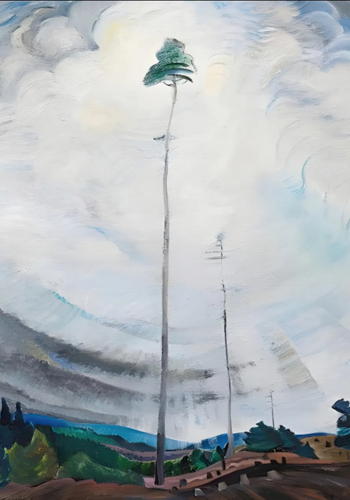
Scorned as Timber, Beloved of the Sky
(c. 1935, study)
Oil on paper mounted on board
This is the oil-on-paper study for the famous canvas of the same title. Like most of Carr’s oil-on-paper works from the 1930s, it was painted using oil thinned with gasoline. This was Carr’s preparatory field study. It remained in private collections for many years and was sold at a Heffel auction in May 2024 for $871,250 CAD. The oil on canvas version has been part of the Emily Carr Trust collection at the Vancouver Art Gallery and has been since 1940s.
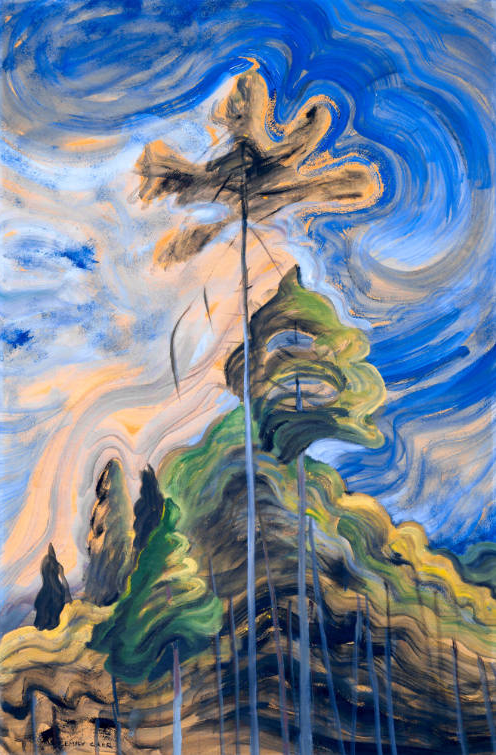
Sunshine and Tumult
(1938–39)
Oil on paper
One of the best documented examples of Carr’s gasoline-thinned oil technique. The Art Canada Institute specifically cites this painting when discussing her adoption of gasoline-thinned oils after 1932. Collection: Art Gallery of Hamilton.
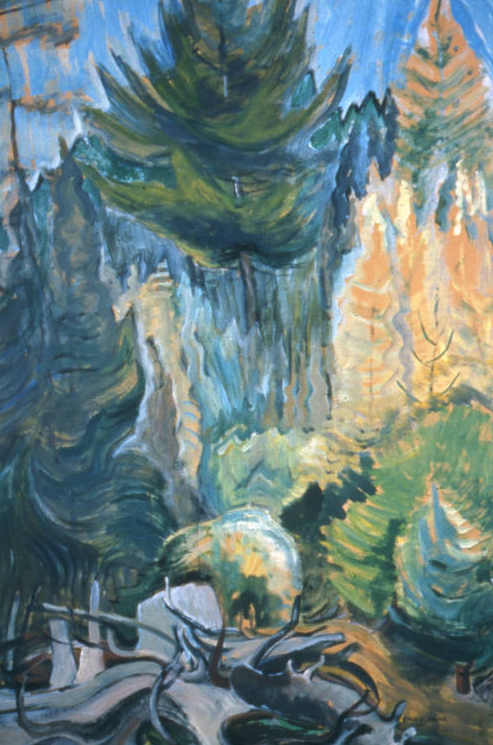
Forest Clearing
(c. 1934–35)
Oil on paper
Carr painted this work outdoors on manila paper using oil paint diluted with gasoline “to the consistency of watercolour.”
Auction records note that this technique enabled her to complete the painting in a single sitting and achieve the spontaneity that characterizes her finest forest studies.
Not every painting created after 1932 was painted with gasoline-thinned oils. Major exhibition paintings such as Big Raven (1931), Red Cedar (1931), Scorned as Timber, Beloved of the Sky (canvas, 1935), and Above the Gravel Pit (1937) are oil on canvas. The gasoline was generally used for Carr’s oil-on-paper sketches and finished paper works, many of which later served as the basis for larger canvases. By about 1936, however, Carr increasingly regarded these oil-on-paper works as finished paintings in their own right.