Max Stern and Emily Carr: The Art Dealer Who Believed in Her
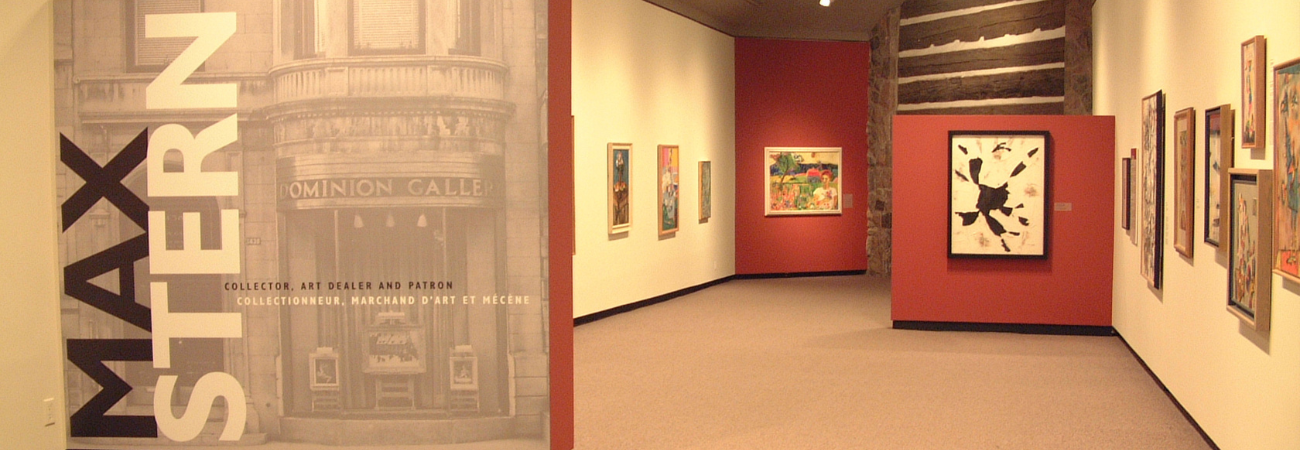
Max Stern (1904–1987) was one of the most influential art dealers in Canadian history, but his path to Montreal and his relationship with Emily Carr were shaped by forces far beyond the Canadian art world. A German-born art historian, refugee from Nazism, collector, dealer and champion of modern art, Stern arrived in Canada after nearly two years of internment during the Second World War. Within a few years, he had transformed Montreal’s Dominion Gallery into one of Canada’s leading commercial galleries for contemporary artists.
Among the artists whose careers he championed, Emily Carr held a special place. Stern met Carr in Victoria in 1944, when she was 72 years old and already in declining health. He persuaded her to allow him to exhibit her work at Dominion Gallery in Montreal. The resulting exhibition was the only commercial exhibition of Carr’s work that achieved significant success during her lifetime. After her death less than a year later, Stern organized a memorial exhibition and continued to represent her work. His collecting, promotion and donations helped ensure that Carr’s paintings entered important Canadian museum collections and that her reputation continued to grow long after her death.
From a German art-dealing family
Max Stern was born on April 18, 1904, in Mönchengladbach, Germany, the youngest child of Julius Stern and Selma Heilbron. His father was a prosperous clothing manufacturer in the textile-producing city, but Julius also had a passion for art. By the early twentieth century, he had established himself as an art dealer and collector.
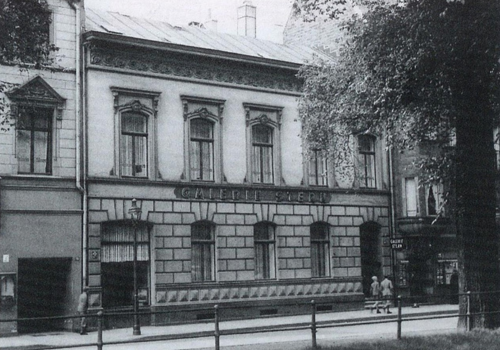
In 1913, Julius opened the Galerie Julius Stern in Düsseldorf. The gallery initially specialized in academic German painting and Old Masters. Because of Julius Stern’s contacts with museum directors, scholars and art historians, Max grew up in an unusually rich intellectual environment.
Art history became the young Stern’s own profession. Between 1923 and 1928, he studied at universities in Berlin, Cologne, Bonn and Vienna. In 1928, he received a doctorate in art history from the University of Bonn, where his dissertation examined the eighteenth- and nineteenth-century German academic painter Johann Peter von Langer.
After completing his studies, Stern joined his father at the Düsseldorf gallery. When Julius died in 1934, Max became its proprietor.His future seemed secure. But the rise of Adolf Hitler and the Nazi regime transformed his circumstances completely.
Forced out of Germany
As a Jewish art dealer, Stern was increasingly prevented from conducting business. The Nazi campaign against Jewish-owned businesses and Jewish professionals made it impossible for him to continue operating the family gallery.
In 1937, he closed the Düsseldorf gallery and arranged for 228 paintings to be sold at auction in Cologne. Other works belonging to his family were left in Germany and subsequently confiscated. Some of the paintings from the Stern family collections disappeared into Nazi-controlled channels.
Stern left Germany on December 23, 1937. He eventually reached London, where his sister Hedi had established West’s Galleries. He continued to work with art, but the outbreak of the Second World War brought another devastating interruption.
As a German national living in Britain, Stern was interned as an enemy alien. In 1940, he was transferred to Canada and interned first near Fredericton, New Brunswick, and subsequently at Farnham, Quebec.It was a remarkable turn of events. The refugee who had been forced out of Germany would ultimately make Canada his home and become one of the country’s most important promoters of modern art.
The Dominion Gallery
In 1941, after almost two years of internment, Stern decided to settle in Montreal. The Montreal art market was relatively conservative. Commercial galleries tended to emphasize picturesque landscapes and established artists rather than the experimental work of living Canadian painters. Stern saw an opportunity.
In December 1941, Rose Millman founded the Dominion Gallery of Fine Art on Sainte-Catherine Street West. In October 1942, impressed by Stern’s knowledge and experience, she appointed him the gallery’s director. Stern soon began changing the character of the gallery.
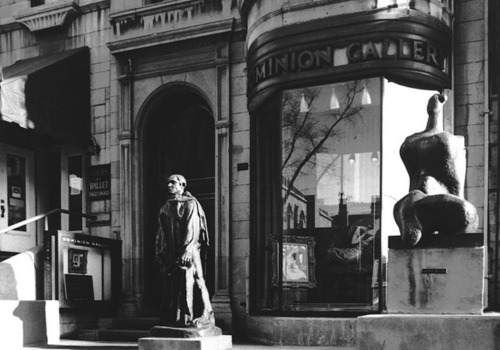
He developed relationships with Canadian artists and introduced exclusive contracts that provided artists with a more dependable source of income. His first major exhibition was devoted to Goodridge Roberts in 1943. He subsequently presented artists such as John Lyman, Stanley Cosgrove and Jean Dallaire, as well as members of the Group of Seven and younger modernists.
Stern also supported artists whose work was considerably more experimental. The gallery presented the first commercial-gallery exhibition of Paul-Émile Borduas and exhibitions associated with the Contemporary Arts Society.
This was the environment in which Emily Carr came to Stern’s attention.
Stern discovers Emily Carr
By the time Stern encountered Carr, she was hardly an unknown artist. Her work had already attracted considerable critical attention, particularly following the recognition she received from members of the Group of Seven and the National Gallery of Canada.
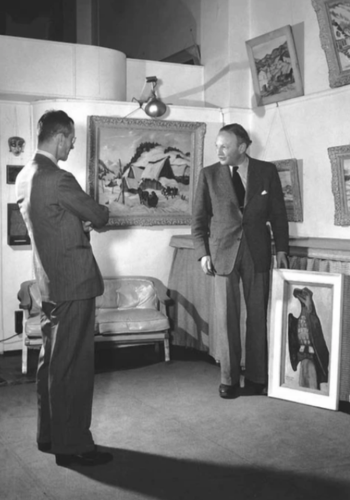
By the time Stern encountered Carr, she was hardly an unknown artist. Her work had already attracted considerable critical attention, particularly following the recognition she received from members of the Group of Seven and the National Gallery of Canada.
Yet Carr’s critical reputation had not translated into sustained commercial success.
She had spent much of her life working in relative isolation in Victoria. Her paintings of forests, Indigenous villages and monumental trees were unlike the picturesque landscapes favoured by many galleries. Her later work had become increasingly personal and expressive, and she had never enjoyed the financial rewards that her artistic reputation might have suggested.
The initial introduction to Carr’s work in Montreal came through A.Y. Jackson, who had helped bring her paintings to the attention of Rose Millman. Stern subsequently became interested enough to travel west.
In 1944, during a trip to British Columbia, he went to Victoria and met Emily Carr. The meeting proved decisive. Carr was 72. She was increasingly frail and had suffered serious health problems. Yet she continued to paint and had accumulated a large body of work.
According to accounts of the meeting, Carr showed Stern a substantial number of her paintings over his three day visit. Stern was impressed by what he saw and proposed an exhibition at the Dominion Gallery.
Carr was reportedly skeptical. After years of struggling to sell her paintings, she had little reason to believe that a Montreal exhibition would suddenly make a difference.
Stern, however, believed that her work could find an audience.
He did not see Carr simply as a regional painter from British Columbia. His experience as an art historian and European dealer enabled him to recognize the modern qualities in her work—the expressive handling of paint, the simplification of forms and the increasingly spiritual relationship between landscape and image.
He selected works that represented different stages of her career rather than presenting only her paintings of Indigenous subjects. That decision was significant.
The 1944 Dominion Gallery exhibition
In October 1944, Dominion Gallery presented Emily Carr: Paintings and Watercolours.
Approximately sixty works were included, providing Montreal audiences with an overview of Carr’s artistic development.
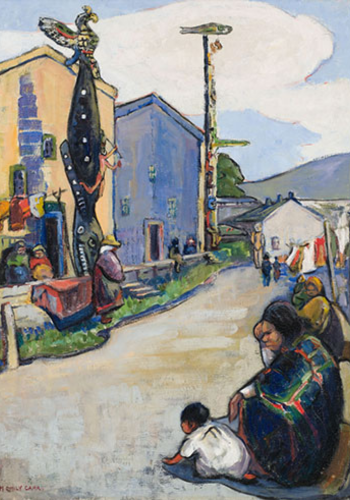
Street, Alert Bay (1912)
The painting had initially been consigned by Carr to Dominion Gallery in August, under the title Alert Bay, Mother in Foreground. It was exhibited in the 1944 show as catalogue no. 2, Street, Alert Bay.
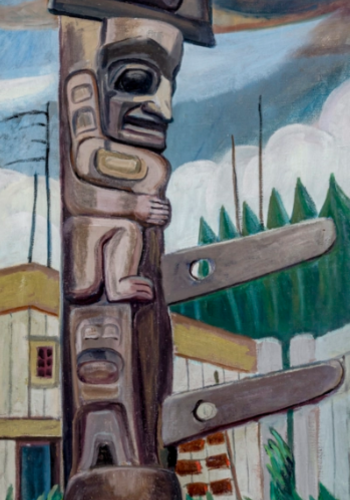
Haida Totem (1928)
This provenance is particularly significant because it establishes that Dominion Gallery was actually purchasing Carr’s paintings from her, rather than merely exhibiting works she had consigned.
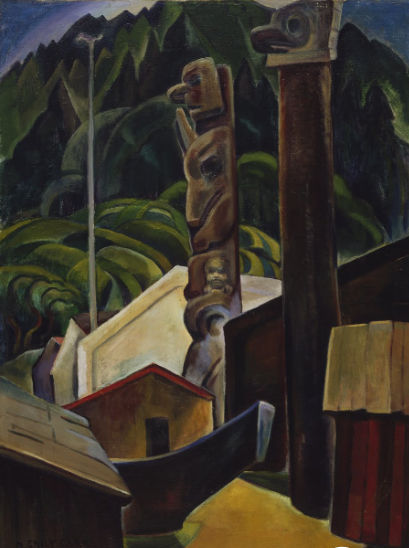
Haida Village (1929)
This painting is exactly the kind of Carr painting Stern appears to have valued: a modern interpretation of a First Nations village rather than a straightforward documentary representation. Stern gifted i\\the painting to the Michael Canadian Art Collection.
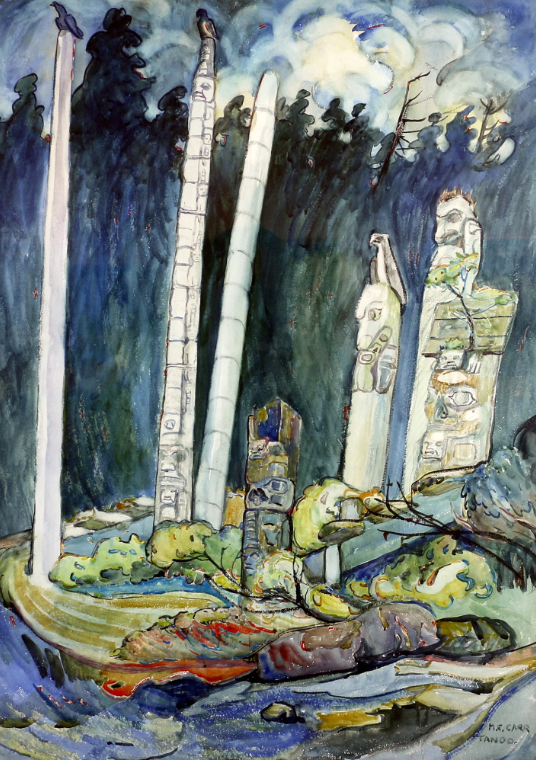
Totems, Tanoo (1930)
Carr gave Stern this painting as a gift in 1944 soon after their first meeting, It remained in his private collection unseen publicly for decades.
Corner, Kitwankool Village (1930)
The painting was exhibited in the 1944 Dominion Gallery exhibition and remained in Max Stern’s personal collection until he donated it to the McMichael in 1977 after 33-year period of personal ownership. This suggests that Stern wasn’t simply buying Carr paintings to resell them. He was selecting works he personally believed were important.
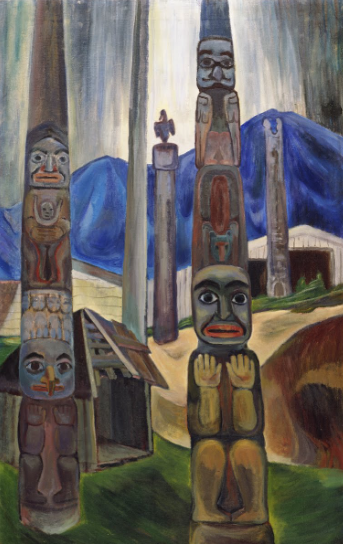
The exhibition was a remarkable success and would turn out to be the most important in her career.
It was the only commercial exhibition of Carr’s work that achieved substantial commercial success during her lifetime. For Carr, who had spent decades struggling to find a market, the success was enormously important. It provided financial recognition at a point in her life when she could hardly have expected her circumstances to change so dramatically.
For Stern, the exhibition confirmed his belief that Carr belonged in the broader Canadian and international story of modern art. After consulting with her twooexecutors, Lawren Harris and Ira Dilworth, she shipped 87 paintings (oils, sketches and watercolours) to Stern in mid-August. From these, he choose 59 paintings for the exhibition which opened on October 9, 1944 and ran for two weeks.
The works spanned Carr’s entire career beginning with her attendance at art schools in France in 1910 to her forest and sky studies at the end arranged chronologically in four different rooms. Forty six of the paintings sold, bring Carr a total of $1,260.78. At an average of $27 per painting, the volume exceeded anything Carr had experienced before.
The relationship between artist and dealer therefore began very late in Carr’s life—but it was intensely important. Stern became her principal dealer.
Carr and Stern after the exhibition
The 1944 exhibition did more than sell paintings. It established a relationship that continued until Carr’s death. Stern acquired some of Carr’s work himself, and he and his wife, Iris, would eventually become important collectors of her paintings.
Among the works associated with the Stern collection were paintings representing different aspects of Carr’s career, including works depicting Indigenous communities and landscapes.
His collecting was important because Stern was not merely purchasing paintings for resale. He was building a personal collection that reflected his conviction about the quality and importance of Canadian artists. Carr’s relationship with Stern was therefore fundamentally different from the many disappointing encounters she had experienced with dealers during her career.
He believed in her work. And, crucially, he believed that other people would believe in it too.
Emily Carr’s death
The triumph of the Montreal exhibition came very late.
Carr’s health deteriorated during the following months. She died in Victoria on March 2, 1945, less than five months after the Dominion Gallery exhibition. She was 73.
Rather than allowing the successful Montreal exhibition to become simply a footnote in Carr’s career, he organized a commemorative exhibition of her work at Dominion Gallery.
This was an important act of advocacy.
Carr could no longer promote herself, answer critics or establish relationships with collectors. Stern assumed the role of continuing to present her work to the public.
In that sense, his relationship with Carr entered a second phase after her death. During her lifetime, Stern had been her dealer. After her death, he became one of the principal custodians and promoters of her artistic reputation.
Stern and Carr’s legacy
The importance of Stern’s relationship with Carr becomes even clearer when we look at what happened over the following decades.
After Carr’s death, Stern continued to handle and promote her work. He purchased paintings, placed them with collectors and retained works in his own collection. His collection eventually became an important source of Carr paintings for Canadian museums.
Among the works associated with Max and Iris Stern are several now held by the Montreal Museum of Fine Arts Other Carr works from the Stern collection—including Sawmills, Strait of Juan de Fuca and Corner of Kitwancool Village—eventually entered the McMichael Canadian Art Collection.
These gifts mattered enormously.
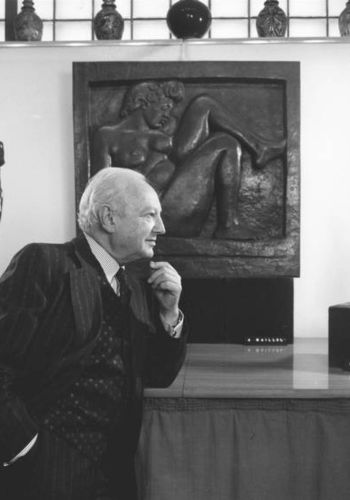
Museum collections determine, to a considerable degree, which artists subsequent generations are able to study, exhibit and interpret. Stern’s collecting and philanthropy helped ensure that Carr’s work would not disappear into private collections where it might remain inaccessible to scholars and the public.
His support also helped establish Carr as an artist whose work belonged in major Canadian institutions.
For many years, Max Stern was reportedly the only art gallery director in Canada to hold a PhD in art history. In addition to tirelessly promoting Canadian art and artists, he also helped to further popularize the sculptures of Henry Moore and Auguste Rodin. At one point, Stern held the largest collection of Rodin’s work outside the Musée Rodin in Paris. Since he had no children, he left much of his collection to Canadian institutions.
Honours and Legacy
Stern was made a Member of the Order of Canada in 1984. In 1985, he received an honorary degree from Concordia University.
Max Stern Art Restitution Project
Stern had the executors of his estate keep the Dominion Gallery open after his death in 1987 before beginning the process of liquidating its assets. During this time, it became widely known that Nazi Germany had stolen massive quantities of goods and material culture from Jews throughout Europe. Much of the fine art that had been stolen had since been sold and resold several times over. Holocaust survivors were seeking the artworks that had been stolen from them and their families five or six decades earlier.
Since 2002, the Max Stern Art Restitution Project has attempted to locate the artworks previously held by the Galerie Stern in Düsseldorf, which Max Stern was forced to auction by the Nazis. The project is supported by Concordia University, McGill University and the Hebrew University of Jerusalem. Stern had attempted to recover these works after the Second World War with only limited success. The restitution project seeks to use the proceeds of its venture to reinvest in the restitution of more artworks. So far, more than 200 paintings have been identified as missing from the collection, and over 30 have been recovered.
In 2024, Canadian filmmaker Jamie Kastner released The Spoils, a documentary about the continuing international effort to recover artworks dispersed after the Nazis forced him to liquidate his Düsseldorf gallery in 1937. Kastner served as the film’s director, writer and one of its two producers, alongside co-producer Laura Baron Kastner.
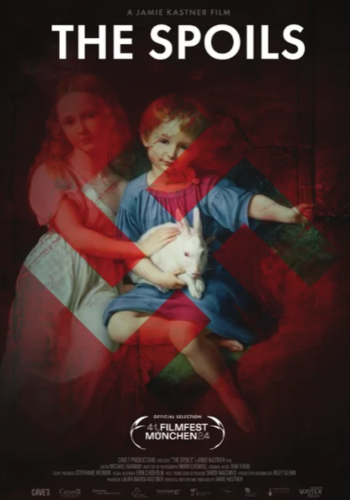
Concordia co-presented the film’s Canadian première in October 2024 with the Montreal Museum of Fine Arts and the Musée d’art contemporain de Montréal. The Spoils played at TIFF Lightbox and Hot Docs Cinema. It is now streamed on CBC Gem.
By tracing one man’s pursuit of justice, The Spoils sheds light on the moral and legal complexities of art restitution — and on the enduring cultural impact of Stern’s story.