From Victoria to Ottawa: Emily Carr’s Journey to the National Gallery
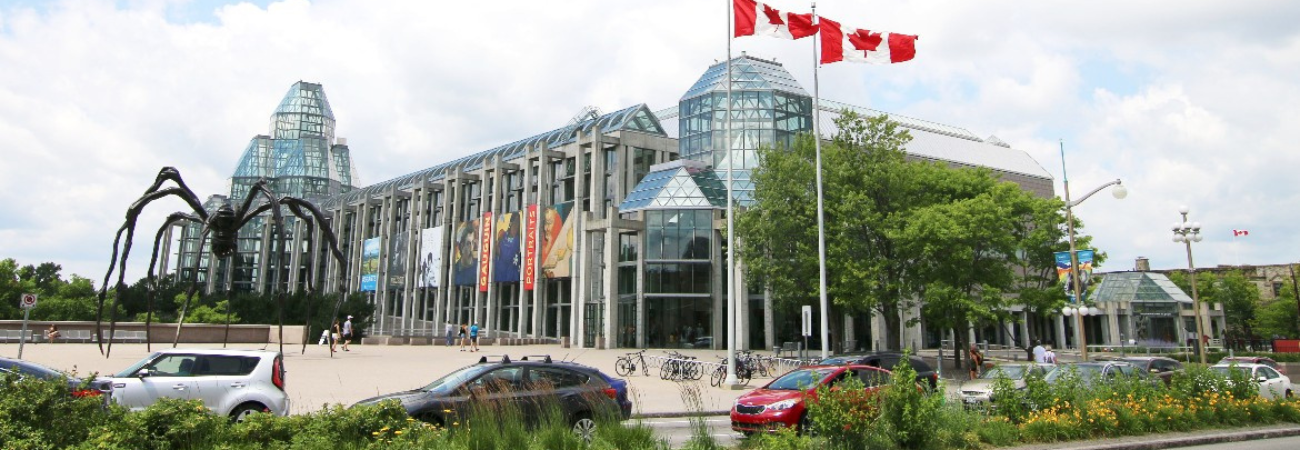
The story of the National Gallery of Canada (NGC) up to its initial purchase of three Emily Carr watercolours in 1928 is especially interesting because Carr’s acquisition came at a moment when the Gallery was changing from a relatively small, government-administered collection into an institution with a national vision—and when Canadian artists were beginning to be taken seriously as part of Canada’s cultural identity.
The founding of the National Gallery, 1880
The National Gallery of Canada was founded in 1880, making it one of Canada’s oldest national cultural institutions. Its creation was closely connected with the Royal Canadian Academy of Arts (RCA) and with Canada’s Governor General, the Marquess of Lorne.
On March 6, 1880, Lorne opened the first exhibition of the newly established Royal Canadian Academy in Ottawa and simultaneously announced the creation of a national gallery. The Academy’s members—known as Academicians—were required to donate a work of art, called a “diploma work,” to the new national collection. These donated works formed the nucleus of what became the National Gallery’s collection.
When Emily Carr first became connected with the National Gallery in the 1927, there was no grand National Gallery building in Ottawa. The institution was operating from borrowed or shared museum space. The Gallery did not begin with a large government collection or a purpose-built museum. It essentially began with works donated by Canadian artists.
1907: A more formal approach to collecting
A significant change came in 1907, when the government appointed an Advisory Arts Council. The council advised the Minister of Public Works on the acquisition of works of art and on government expenditures related to art. This was an important step toward creating a more systematic national collection rather than relying primarily upon Academy donations. The Gallery was still, however, essentially part of the federal government’s administrative structure.
Eric Brown (1877-1945)
Born in England, Eric Brown immigrated to Canada in 1909 after working in the British art world. He joined the Art Gallery of Toronto before becoming the National Gallery of Canada’s first director in 1910. A champion of Canadian modernism, he supported the Group of Seven and, in 1927, recognized Emily Carr’s significance.
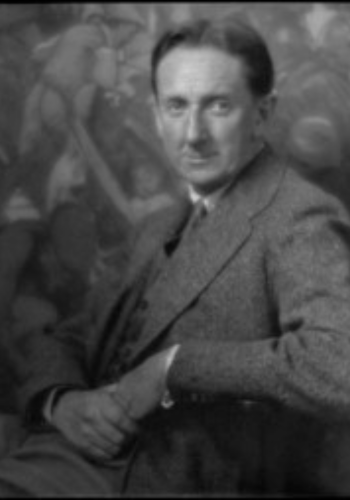
English-born Eric Brown arrives
The next major turning point came with the arrival of Eric Brown art critic and museum professional and his appointed the first curator of the National Gallery in 1910. In 1913, Parliament passed the National Gallery of Canada Act, incorporating the Gallery and establishing a Board of Trustees. Brown became the institution’s first Director. This matters enormously to the Emily Carr story.
Brown was not simply an administrator. He became an important advocate for modern Canadian art and gradually broadened the Gallery’s conception of what constituted Canadian art worthy of national recognition. As he wrote in 1913:
a national spirit is being slowly born.… There are painters who are finding expression of their thought in the vast prairies of the far West, in the silent spaces of the North, by the side of torrent and tarn, and in the mighty solitudes of the winter woods.”
He also understood that the Gallery had a responsibility to represent the country beyond central Canada. That would eventually bring him into contact with Emily Carr.
The Gallery begins looking beyond Eastern Canada
During the early twentieth century, Canadian art institutions were heavily concentrated in Ontario and Quebec. Artists working in British Columbia were geographically and culturally distant from Ottawa. The National Gallery began developing a more national outlook. A particularly important development came in 1924, when the Gallery was placed in charge of the Canadian Fine Arts section of the British Empire Exhibition in London at the Wembley stadium. This was a major opportunity to present Canadian art internationally for the first time.
The National Gallery’s first major international venture was the Canadian Section of Fine Arts at the British Empire Exhibition at Wembley, London, held in 1924 and continued in 1925. The Gallery was responsible for organizing the Canadian art section. Its director, Eric Brown, played a central role in selecting and presenting the works. The exhibition was an important opportunity to present Canadian painting as a distinctive national art within the British Empire.
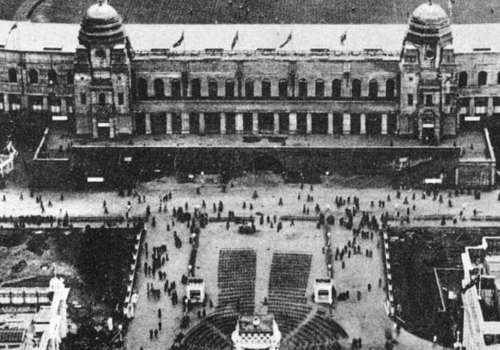
The exhibition travelled to around England including the Whitechapel Art Gallery in London, York, Bury, Blackpool, Rochdale, Oldham, Bradford, Manchester, Sheffield and Plymouth, extending into early 1927.
The Wembley exhibition was followed by a tour of selected Canadian works through England. The exhibition travelled to places including the Whitechapel Art Gallery in London, York, Bury, Blackpool, Rochdale, Oldham, Bradford, Manchester, Sheffield and Plymouth, extending into early 1927.
Paris: Musée du Jeu de Paume, 1927
Another significant 1927 event in which they participated was Exposition d’art canadien, held at the Musée du Jeu de Paume in Paris from April 10 to May 10, 1927.
The Jeu de Paume was situated beside the Louvre, giving the exhibition a prestigious location at the heart of the French art world.
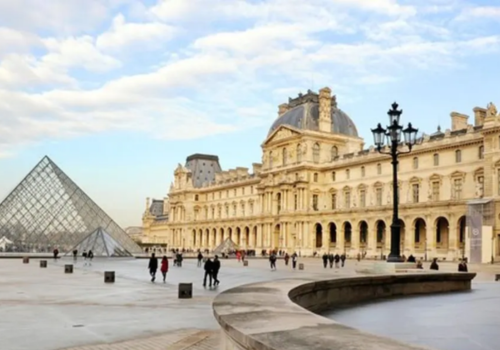
This was described subsequently by the Massey Commission as the first continental exhibition of Canadian art.
Eric Brown was the sole curator of the Paris exhibition. Compared with Wembley, he placed even greater emphasis on the emerging image of Canadian modernism, particularly the Group of Seven and Tom Thomson. The exhibition also included a retrospective of Thomson’s work. The exhibition was substantial and presented Canadian art not simply as colonial British art, but as something with a distinctive Canadian identity. Landscape was particularly important.
An interesting connection to Emily Carr
Emily Carr was not included in any of these international exhibitions. The exhibition’s conception of Canadian modernism was still heavily centred on the Group of Seven and the northern landscape. Carr was only beginning to receive the recognition that would eventually bring her into the national story.
It is also worth noting that the National Gallery’s own 1927 publication, Exhibition of Canadian West Coast Art, to which Carr was invited, demonstrates that the Gallery was simultaneously developing another conception of Canada’s art—one that placed First Nations art of the West Coast alongside modern Canadian painting. The catalogue was published in Ottawa in December 1927 and was prepared in cooperation with the National Museum, Royal Ontario Museum, McGill University and the Art Association of Montreal.
First Gallery international exhibitions:
| Year | Location | Significance |
|---|---|---|
| 1924–25 | Wembley, London | First major international exhibition organized by the National Gallery; Canadian Section of Fine Arts at British Empire Exhibition |
| 1925–27 | Various English cities | Selected works from Wembley circulated in England |
| 1927 | Paris, Musée du Jeu de Paume | First continental European exhibition of Canadian art |
| 1927 | Ottawa | Exhibition of Canadian West Coast Art, bringing Indigenous and modern Canadian art together |
Eric Brown discovers Emily Carr
Emily Carr had been painting in Victoria and Vancouver for decades, but she remained largely unknown to the Canadian art establishment. The connection that finally brought her to the attention of Eric Brown began with Sophie Pemberton, who introduced her work to Mortimer Lamb, who in turn brought it to the attention of Marius Barbeau, the prominent ethnologist at the National Museum of Canada. Barbeau then recommended Carr to Brown, who visited her Victoria studio in September 1927. Impressed by what he saw, Brown invited Carr to submit paintings to the National Gallery’s ambitious upcoming exhibition.
Exhibition of Canadian West Coast Art: Native and Modern 1927 Ottawa
This was a remarkable exhibition because it deliberately placed Indigenous art and contemporary Canadian art from the West Coast within the same larger cultural conversation. Carr’s work was therefore not being presented simply as the work of an obscure Victoria artist. She was being introduced to the national art establishment as an important West Coast artist.
The exhibition included 26 of Carr’s oil paintings, along with her pottery and hooked rugs.
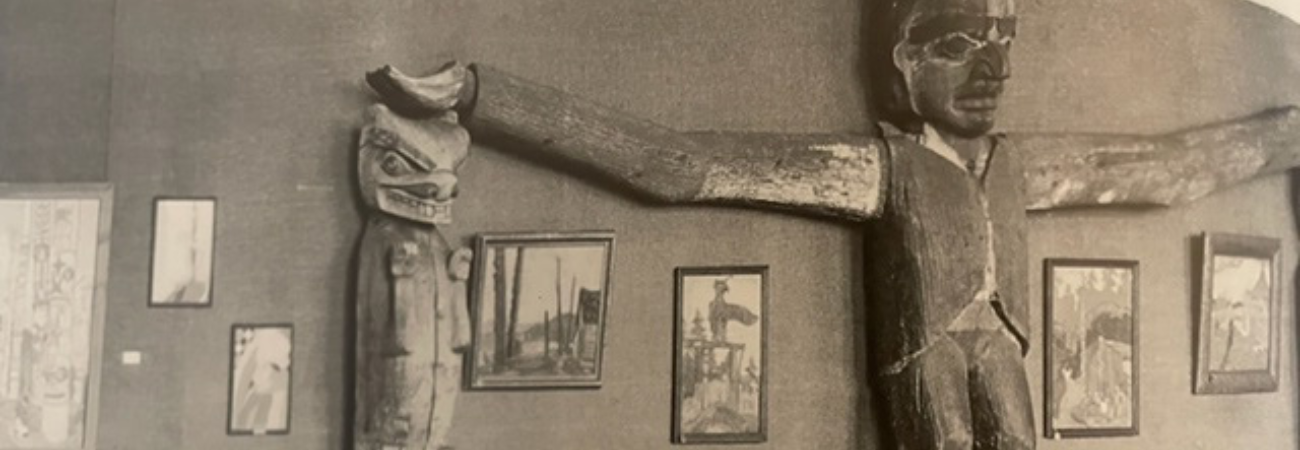
Carr travelled east for the opening of the exhibition in 1927. The trip changed her life. In Ottawa and Toronto she met the members of the Group of Seven artists who were far more advanced in their understanding of modern Canadian painting than the artistic styles of artists in Victoria. Lawren Harris became an important confident and stalwart champion for the rest of her life and thereafter as the executor of her artwork.
The National Gallery exhibition therefore had two important consequences for Carr:
- It gave her national recognition.
- It connected her personally with the Canadian modernist movement.
Art Canada Institute describes the 1927 exhibition [LINK] as the moment when Carr’s national recognition finally began, when she was already in her fifties.
1928: The Gallery buys Emily Carr
The relationship between Carr and the National Gallery quickly moved beyond exhibition to acquisition.
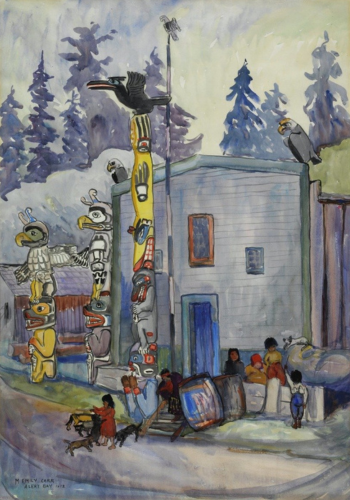
The three watercolours by Emily Carr that the National Gallery of Canada purchased in 1928, under director Eric Brown, were all from her 1912 period:
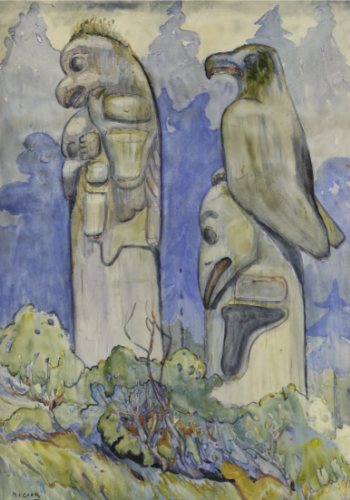
Tanoo (1912)
watercolour on paper
National Gallery of Canad
accession no. 3542
Albert Bay (1912)
watercolour and graphite on paper
National Gallery of Canada,
accession no. 3544
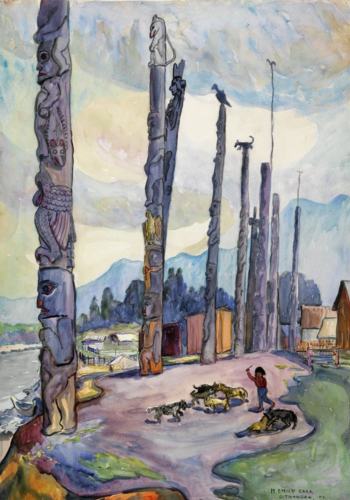
Gitwangak (1912)
watercolour and graphite on paper
National Gallery of Canada,
accession no. 3544
The purchase price was $75 each—$225 in total.
The $225 total was a modest amount, but the purchase was enormously important for Carr. It represented her first significant institutional acquisition by Canada’s national art gallery and gave her work a permanent place in the national collection. The Gallery’s interest had begun with Eric Brown’s involvement in the 1927 Exhibition of Canadian West Coast Art: Native and Modern, which helped launch the remarkable final phase of Carr’s career.
Why the 1928 purchase was so important
The significance of the $225 purchase goes far beyond its monetary value considering Carr’s circumstances at the time. Between 1913 and 1927, she had largely stopped painting. Her self-presented 1913 exhibition at the Dominion Hall in Vancouver been poorly received. She had returned to Victoria to design, build and operated a boarding house, now called the House of All Sorts, on the family property she had inherited, as well as raising dogs, making pottery, hooking rugs and other income generating activities and was often too exhausted to paint as she explains in her book The House of All Sorts (1944) about the experience.
Then, in the space of only about two years:
1927
→ Eric Brown discovers her work
→ National Gallery exhibition
→ Carr travels to Ottawa
→ Meets the Group of Seven
→ Meets Lawren Harris
→ Begins to rethink her art
1928
→ National Gallery purchases three of her earlier watercolours
→ Carr returns to the northern British Columbia villages
→ Begins producing the work that will lead toward her mature style
The National Gallery was therefore not simply one of the institutions that eventually collected Emily Carr. It was one of the institutions that helped change the trajectory of her career.
Curiously, the National Gallery’s initial purchase in 1928 consisted of watercolours that Carr painted in 1912, when almost nobody in the Canadian art establishment, east coast or west, was paying any attention to her. Her more modern painting style was not at all popular in Victoria. Those old watercolours suddenly became important because the Gallery recognized their significance in 1928 after her debut in 1927.
After Brown’s death in 1939, Carr in a letter to his widow Maud she paised his inspirational abilities:
saved me from being a quitter…I owe him so much for I was overwhelmed by despair about my work when he came west and pulled me out and made me start again.
Some curiosities about the Gallery’s Emily Carr acquisition strategy: they did not purchase another Carr painting until 1936 and did not purchase the watercolour Cumshewa (1912) until 1953 when they could have purchased it along with the other three 1928 for $$25. This painting is often promoted as one of the most popular paintings at the Gallery.
A current structured listing of the NGC collection identifies 30 paintings by Carr. It is based on the Gallery’s own collection records and was last updated in June 2026.
Emily Carr paintings at the National Gallery
| Date | Painting | NGC inventory no. |
|---|---|---|
| 1911 | Autumn in France | 4882 |
| 1911 | Four Children in a Breton Cottage | 28422 |
| 1911 | House in Brittany | 28120 |
| 1912 | Memalilaqua, Knight Inlet | 5043 |
| 1912 | Totem Pole at Hazelton | 16731 |
| 1912 | Potlatch Figure (Mimquimlees) | 35994 |
| 1912 | Graveyard Entrance, Campbell River | 42280 |
| 1913 | The Welcome Man | 40448 |
| 1922 | Arbutus Tree | 35081 |
| 1928 | Heina | 4284 |
| c. 1930 | Blunden Harbour | 4285 |
| c. 1930 | Totems | 5807 |
| c. 1930 | Indian Hut, Queen Charlotte Islands | 15470 |
| c. 1930 | Grizzly Bear Totem, Angidah, Nass River | 15728 |
| 1932 | Forest Landscape | 41339 |
| 1932 | Portrait of Woo | 30754 |
| 1934 | British Columbia Landscape | 16555 |
| 1935 | Landscape | 15847 |
| 1935 | Seascape | 4832 |
| 1935 | Inside a Forest | 4876 |
| 1935 | Forest Landscape No. 2 | 5042 |
| 1930s | Sky | 4286 |
| 1930s | Fir Tree and Sky | 28992 |
| 1936 | Strait of Juan de Fuca | 40471 |
| 1930s | Forest (Tree Trunks) | 36120 |
| 1939 | Self-portrait | 30755 |
| 1939 | Forest Landscape No. 1 | 5041 |
| 1940 | Logged-over Hillside | 4861 |
| 1940 | Landscape | 4862 |
| 1942 | Clearing | 6354 |
Note: I am still compiling and fact checking this list drawn from several sources. When it is complete, this note will not appear.
The three most recent acquisitions were all gifted to the Gallery
| Acquisition | Painting | Accession no. | Acquisition | Donor / Gifter |
|---|---|---|---|---|
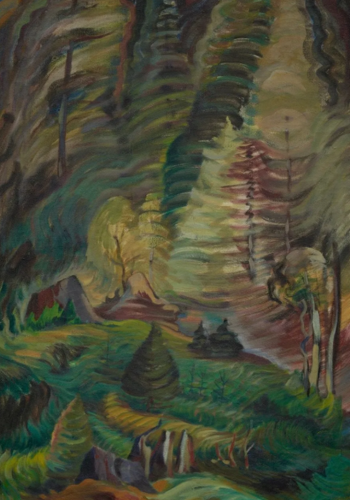
| 2019 | Something Unnamed, 1937 | 49108 | Gift | Murray and Marvelle Koffler, Toronto |
| 2019 | Forest Interior in Shafts of Light, c. 1935–37 | 49109 | Gift | Murray and Marvelle Koffler, Toronto |
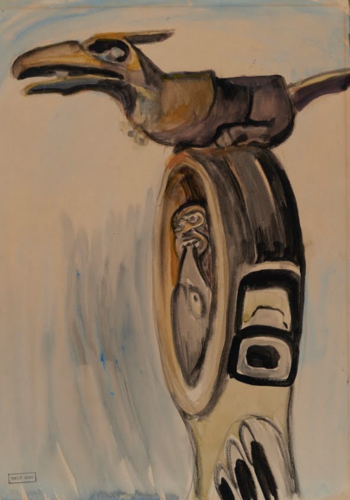
| 2017–18 | Bird Totem, c. 1930 | 47687 | Gift | Diana E. Ainslie, Ottawa |
Bird Totem
(1930)
gift from Diana E. Ainslie, Ottawa in 2017
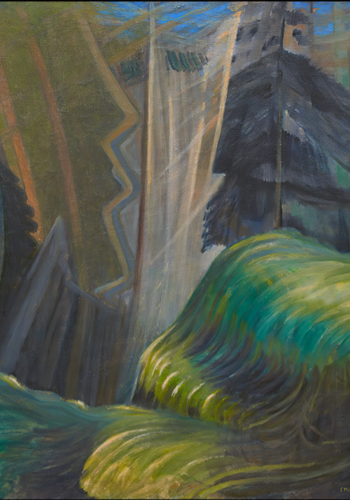
Forest Interior with Shafts of Light
(1935)
gift from Murray and Marvelle Kofler, Toronto in 2019
Something Unnamed
(1937)
gift from Murray and Marvelle Kofler, Toronto in 2019
The story of Emily Carr and the National Gallery of Canada is ultimately one of delayed recognition—and of one person willing to look beyond the established Canadian art world. By the time Eric Brown visited Carr’s Victoria studio in 1927, she had been painting for decades, largely outside the networks that shaped the country’s official art history. Brown’s enthusiasm changed all that. His decision to include her work in the National Gallery’s exhibition in 1927 and his purchase of three of her watercolours in 1928 brought Carr into the national collection and onto a larger stage. Yet recognition was gradual. Her eventual place in the National Gallery’s history reflects both Carr’s persistence and Brown’s willingness to see the significance of her work.