From Student to Exhibitor: Emily Carr’s Return to London at the Tate Gallery
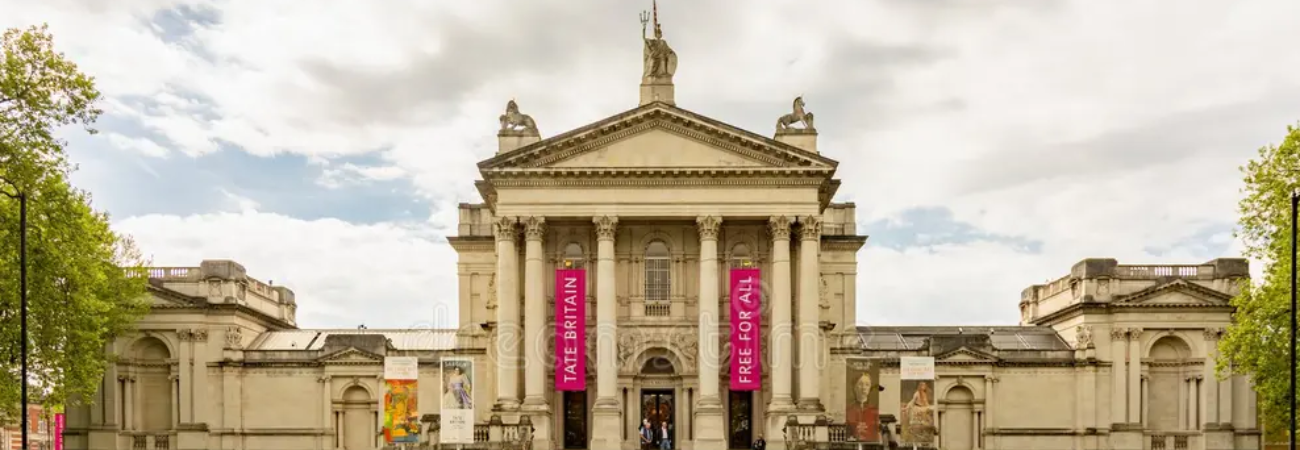
Tate Gallery’s A Century of Canadian Art was one of the most important international exhibitions in the history of Canadian art. Organized by Canada’s National Gallery and opening at London in October 1938, it was the first comprehensive historical survey of Canadian art ever shown overseas. It introduced British audiences to the breadth of Canadian artistic achievement, from early colonial portraiture and religious carving to modern landscape painting by the Group of Seven and Emily Carr. The exhibition featured 263 works spanning roughly one hundred years of Canadian art.
The exhibition was largely the vision of Vincent Massey, Canada’s High Commissioner to Britain. Massey believed that art could strengthen cultural ties between Canada and Britain at a time when Europe stood on the brink of war. Drawing heavily on the collections of the National Gallery of Canada and his own personal collection, he worked with National Gallery director H.O. McCurry and Tate officials to organize an exhibition that presented Canada as a mature nation with a distinctive artistic identity.
Emily Carr’s role
Although Emily Carr was already highly respected among Canada’s modern artists, her reputation remained largely national. Her inclusion in the Tate exhibition marked her first major international recognition and confirmed her position as one of Canada’s leading modern painters. Later biographies consistently identify the Tate exhibition, together with the 1939 New York World’s Fair exhibition, as the moment when Carr entered the international stage.
Carr represented something unique within the exhibition. While the Group of Seven portrayed the forests and lakes of central Canada, Carr’s paintings of the forests and Indigenous villages of British Columbia demonstrated that Canada’s artistic identity extended from coast to coast. Andrew Horrall argues that the exhibition presented Canadian art as the product of European traditions transformed through Canada’s landscape and its encounters with First Nations cultures, with the work of the Group of Seven and Emily Carr serving as the clearest expression of that national aesthetic.
The paintings
Carr was represented at the exhibition by these four paintings:
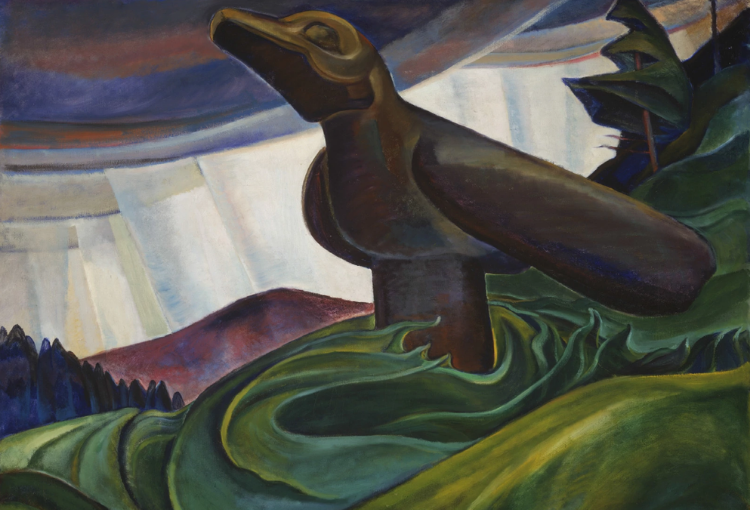
Big Raven (1931)
Big Raven depicts a solitary Haida raven totem at the abandoned village of Cumshewa on Haida Gwaii. Surrounded by swirling forest and luminous sky, the weathered pole symbolizes the resilience of Indigenous culture, the passage of time, and nature’s reclaiming of once-thriving communities.
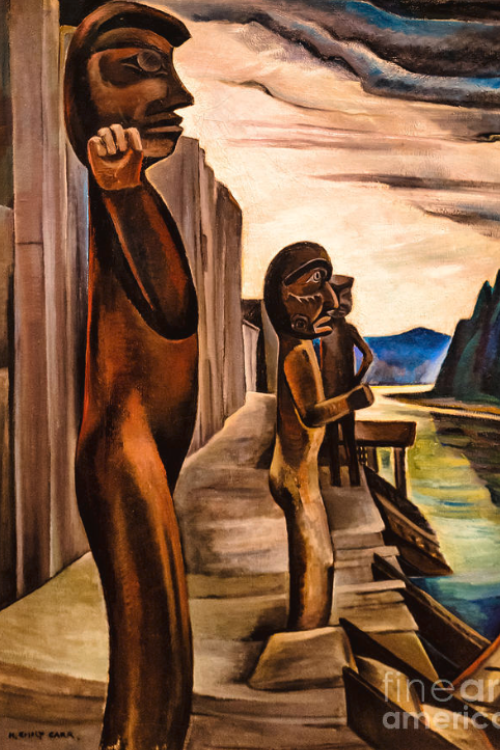
Blunden Harbour (1930)
Blunden Harbour captures Emily Carr at the height of her mature style, transforming a remote Kwakwaka’wakw village on the central coast of British Columbia into a powerful vision of towering totem poles and enveloping forest. Sweeping forms, rhythmic movement, and luminous colour convey both the spiritual presence of the site and Carr’s deep reverence for the West Coast landscape. Carr painted this masterpiece from a photograph lent to her by Willie Newcombe, the son of Charles Newcombe a Victoria based physician, botanist, and ethnographic researchers and collector. Many of his artifacts are held at the Royal BC Museum.
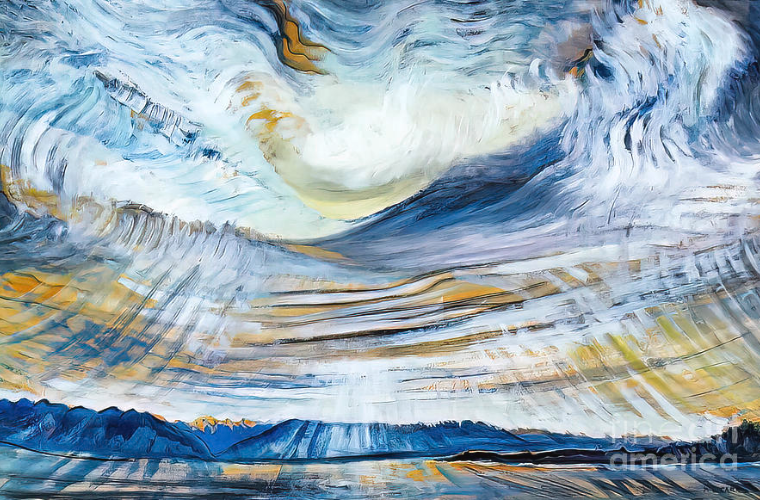
Sky (1936)
Sky is among Emily Carr’s most abstract and expressive late works. Dispensing with detailed landscape, she focused on the restless movement of clouds and light, using sweeping brushstrokes and luminous blues, whites, and greys to evoke the vast spiritual energy of the natural world and the infinite space above.
Church at Yuquot Village – formerly Indian Church (1929)
The artwork titled “Indian Church” by Emily Carr was created in the year 1929. This landscape genre oil on canvas measures 108.6 by 68.9 cm and currently resides in the Art Gallery of Ontario. While the artwork has been erroneously associated with the Cubism movement in the provided details, it is essential to clarify that Emily Carr’s style is more accurately aligned with Post-Impressionism and the Canadian Group of Seven, rather than Cubism.
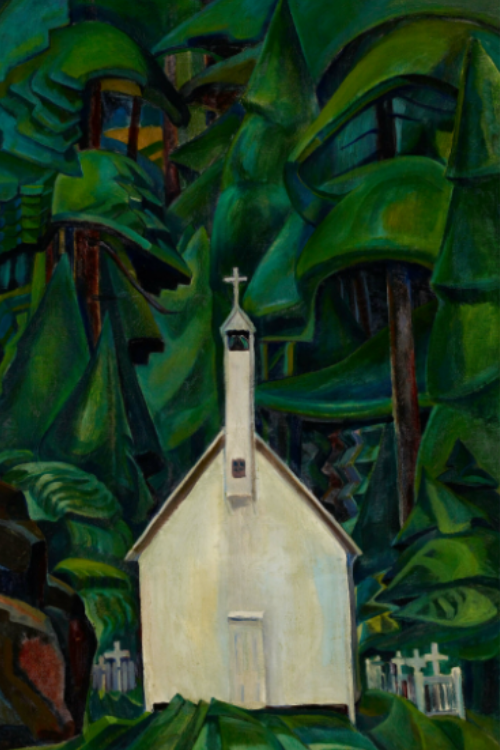
These works had already become among her best-known paintings and demonstrated the mature style she developed after reconnecting with modern Canadian painters following the 1927 Exhibition of Canadian West Coast Art. Together they showcased the monumental forests, Indigenous architecture, and spiritual atmosphere that had become the hallmarks of her work.
Critical reception
British critics generally responded favourably to the exhibition. While many expected to see art closely imitating British traditions, they instead encountered a confident modern school of landscape painting. The Group of Seven attracted considerable attention, but Emily Carr’s paintings stood out because they depicted a landscape and Indigenous cultural heritage unfamiliar to British audiences. Her work was frequently noted for its originality, expressive power, and distinctly western Canadian character.
Eric Newton, arts reporter for the Manchester Guardian writes in the Canadian Forum:
She is at her best when she is working on a big scale. And her best is magnificent. If the word ‘genius’ can be applied to any Canadian artist it can be applied to her. She belongs to no school. Her inspiration is derived from within herself….Where the Eastern Canadians have been content to stylize the outward pageantry of the landscape, she has symbolized its inner meaning, and in doing so has, as it were, humanized it. Her trees are more than trees: they are green giants , and slightly malevolent giants at that. The totem poles she often paints are haunted by the deities they represent.
Significance for Emily Carr
The Tate exhibition came at an important moment in Carr’s career. Earlier in 1938, the Vancouver Art Gallery had mounted her first major retrospective. The London exhibition followed shortly afterward, extending her reputation beyond Canada. Although poor health prevented her from travelling to England, the international exposure reinforced the growing recognition she was receiving during the final years of her life. Within a year, her work would also be shown at the New York World’s Fair, further establishing her international reputation.
Why the exhibition matters today
For Canadian art history, A Century of Canadian Art represents a turning point. It was the first time Canada presented its artistic heritage to an international audience as a coherent national tradition. Emily Carr’s inclusion alongside the Group of Seven signalled that British Columbia—and the Pacific Northwest more broadly—was essential to that story. Today, the exhibition is widely regarded as the moment when Emily Carr became recognized not simply as an important regional artist, but as one of Canada’s foremost modern painters.