Emily Carr, Max Stern and E. J. Hughes: The Making of a West Coast Art Legacy
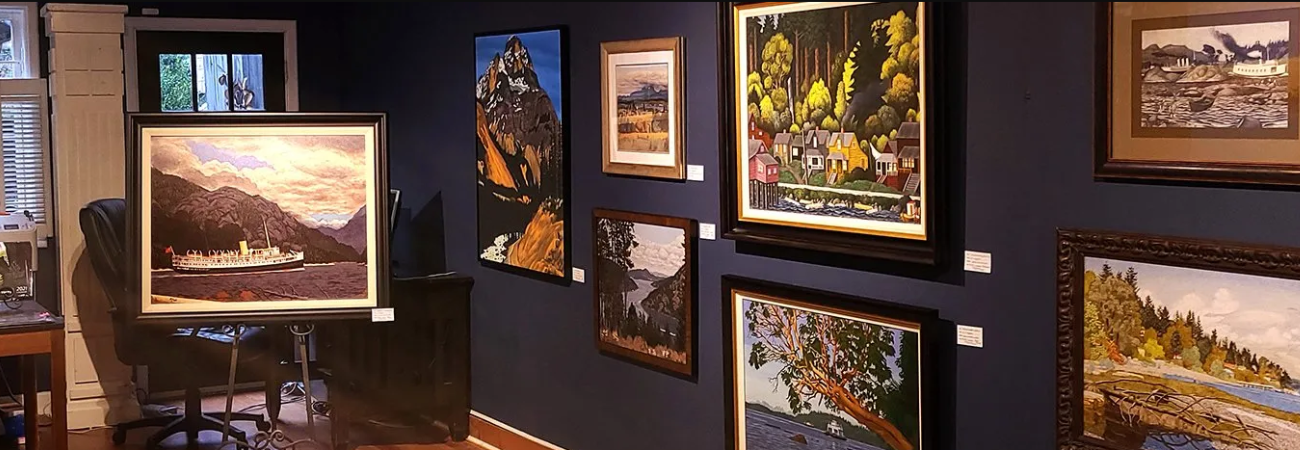
The relationship between Max Stern and E. J. Hughes was one of the most consequential dealer–artist partnerships in Canadian art. Stern did much more than sell Hughes’s paintings like he did for Emily Carr. Instead he provided Hughes with the unusual security that allowed him to remain a private, almost reclusive artist on Vancouver Island while Stern built his reputation nationally.
Their relationship began in 1951
The story begins with Lawren Harris, who had already recognized Hughes’s talent. Harris recommended that Montreal dealer Dr. Max Stern, owner of the Dominion Gallery, seek Hughes out.
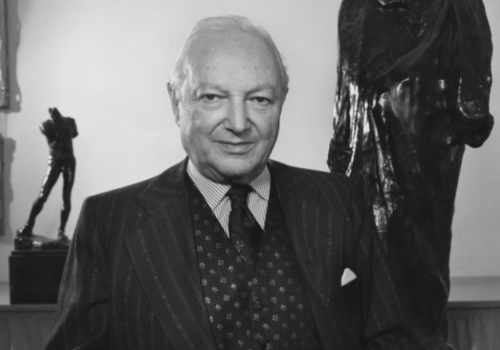
Max Stern (1904–1987), owner of Montreal’s Dominion Gallery, was a pivotal supporter of Canadian art. He championed Emily Carr, helping establish her reputation beyond British Columbia, and represented E. J. Hughes, promoting his distinctive paintings of the West Coast. Stern’s discerning eye and advocacy connected both artists with collectors across Canada.
E. J. Hughes (1913–2007) was a leading British Columbia painter known for his precise, luminous landscapes and coastal scenes. His career intersected with Lawren Harris, whose encouragement helped shape his early development, and Max Stern, owner of Montreal’s Dominion Gallery, who represented Hughes and brought his work to a wider Canadian audience.
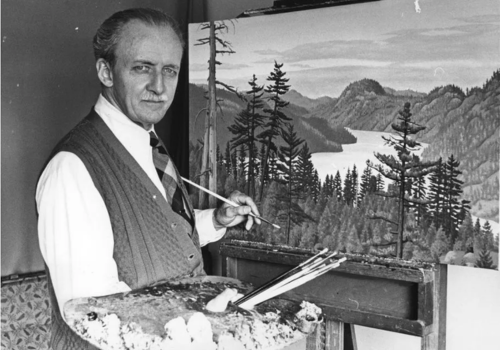
In 1951 Stern travelled to Vancouver Island and found Hughes at his home and studio at Shawnigan Lake. Stern later recalled being struck by the fact that Hughes was a shy, relatively unknown painter who did not fully appreciate the quality of his own work. Stern decided immediately to represent him.
Stern bought everything Hughes had in his studio. He purchased every artwork Hughes had, 14 oil paintings, four oil sketches and 32 “lovely broad pencil sketches.” The price was $500. But it wasn’t a one-off deal. Stern agreed to buy every painting Hughes produced in the future, providing the artist with some much-needed financial security. The relationship continued for more than 35 years, until the Dominion Gallery eventually closed in 2000.
Stern gave Hughes something unusual for an artist: freedom
Hughes did not want the conventional life of a successful artist. Like Carr, he disliked publicity, openings and self-promotion. He wanted to live quietly on Vancouver Island and paint the landscape around him.
Stern’s arrangement made that possible.
Because Hughes knew that Stern would take his paintings, he did not have to spend his time cultivating collectors, finding exhibitions or promoting himself. Instead, he could concentrate almost entirely on drawing, sketching and painting British Columbia.
The University of Toronto’s review of Ian Thom’s major study of Hughes makes this point explicitly: the long relationship with Dominion Gallery gave Hughes the freedom to live in relatively isolated places on Vancouver Island, close to his preferred subject matter.
A recent review of Robert Amos’s work on Hughes describes the relationship even more strongly, calling Stern a “near perfect outlet” for Hughes’s ambitions because Stern agreed to buy every piece Hughes produced.
Stern became Hughes’s principal—and perhaps most important—correspondent
Their relationship was not simply commercial.
Hughes and Stern maintained an extensive correspondence about paintings, subjects, compositions and the artist’s work. According to Vancouver artist and writer Robert Amos, Stern was Hughes’s only regular correspondent with whom he discussed art. When Dominion Gallery closed, the gallery’s Hughes correspondence was donated to the University of Victoria Library. Hughes had also retained his side of the correspondence, meaning that researchers can potentially see both sides of this remarkable artist–dealer relationship.
Stern helped turn Hughes into a national artist
he Dominion Gallery gave Hughes something that was difficult for a West Coast artist to achieve in the 1950s: a national market and a national reputation.
Hughes’s paintings were being shown and sold in Montreal while he remained on Vancouver Island. By the early 1950s his work was already entering important public collections in Ottawa, Toronto and Vancouver. The E.J. Hughes Gallery notes that his career during this period was exceptional among his contemporaries.
Stern also organized exhibitions of Hughes’s work. One surviving example is the 1982 Dominion Gallery exhibition E.J. Hughes, R.C.A., and the gallery published E.J. Hughes: 40 Years with Dominion Gallery in 1991.
That 1991 publication is particularly significant because it documents the extraordinary longevity of their partnership.
Their correspondence shows how personally Stern was involved
One wonderful example comes from 1975, after the death of Hughes’s wife, Fern. After her death in December of 1974, devastated, Hughes found himself unable to work for some three months. He relocated from their home in Cobble Hill to the town of Duncan, British Columbia, perhaps in search of a fresh start. By February 1975, he was able to again find solace in his work, and painted Goldstream, the first canvas completed after Fern’s her death death
Goldstream (1975)
In a letter dated 20 February 1975, sent to Stern, Hughes wrote: “Although time has not yet eased the grief, I am starting to paint again, and hope to have a canvas ready to send to you on Mon. Feb. 24. It is called “Goldstream”.
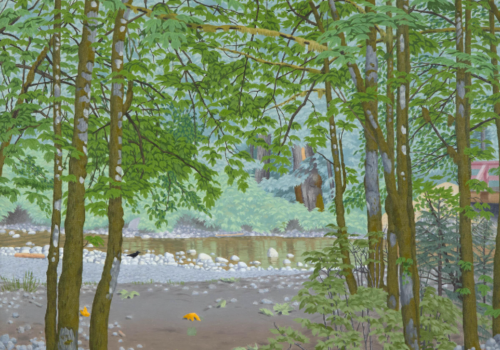
The two wrote at length about the painting, with Hughes explaining the composition and where it was painted from – the parking lot at Goldstream Park. In his letter, he reiterated his goal:
to make all of my paintings clear and realistic, even more understandable than a photograph.
That letter is revealing because Stern was not simply the person who purchased the finished painting. He was the person Hughes turned to when he began painting again after one of the most difficult periods of his life.
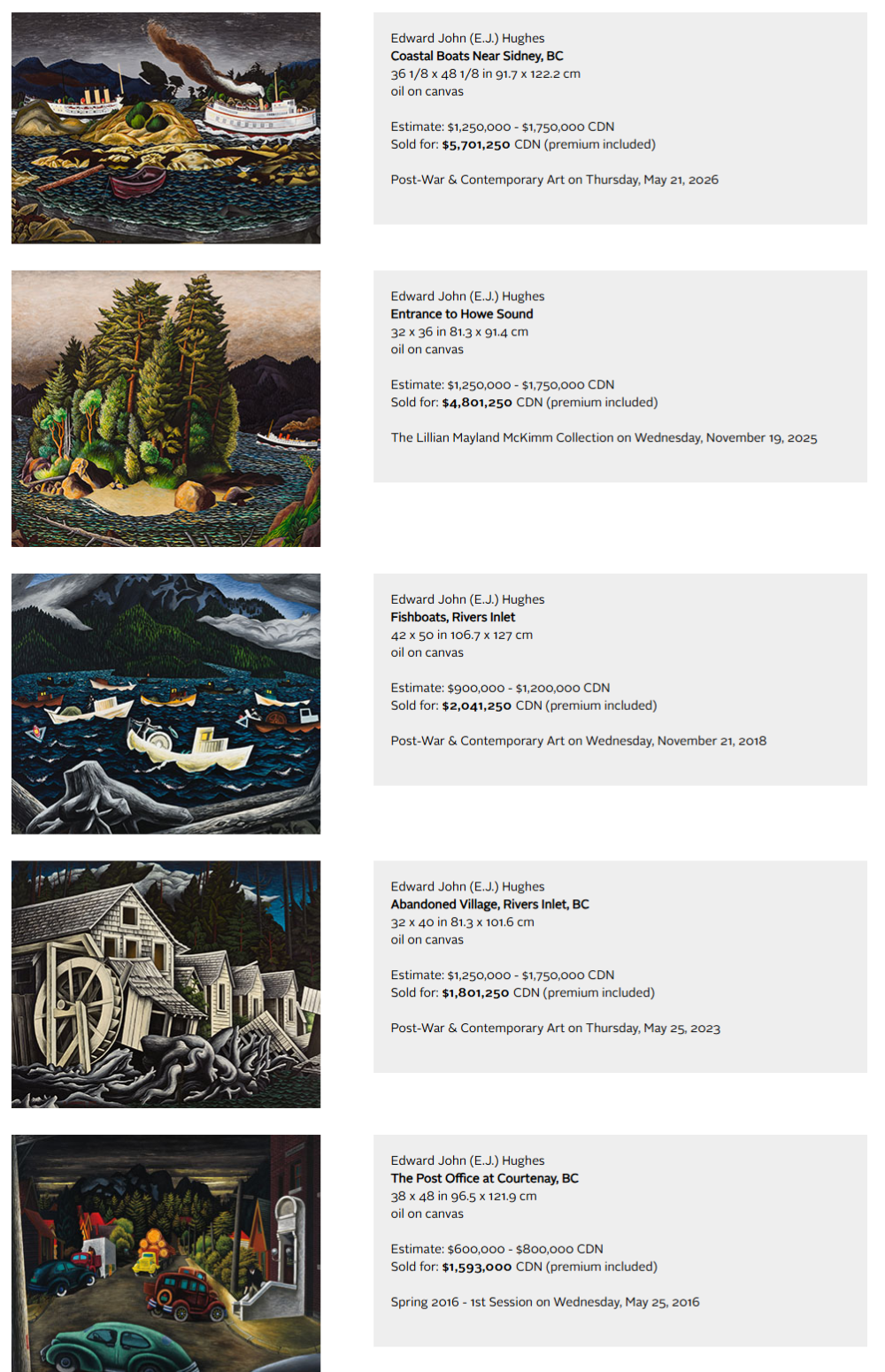
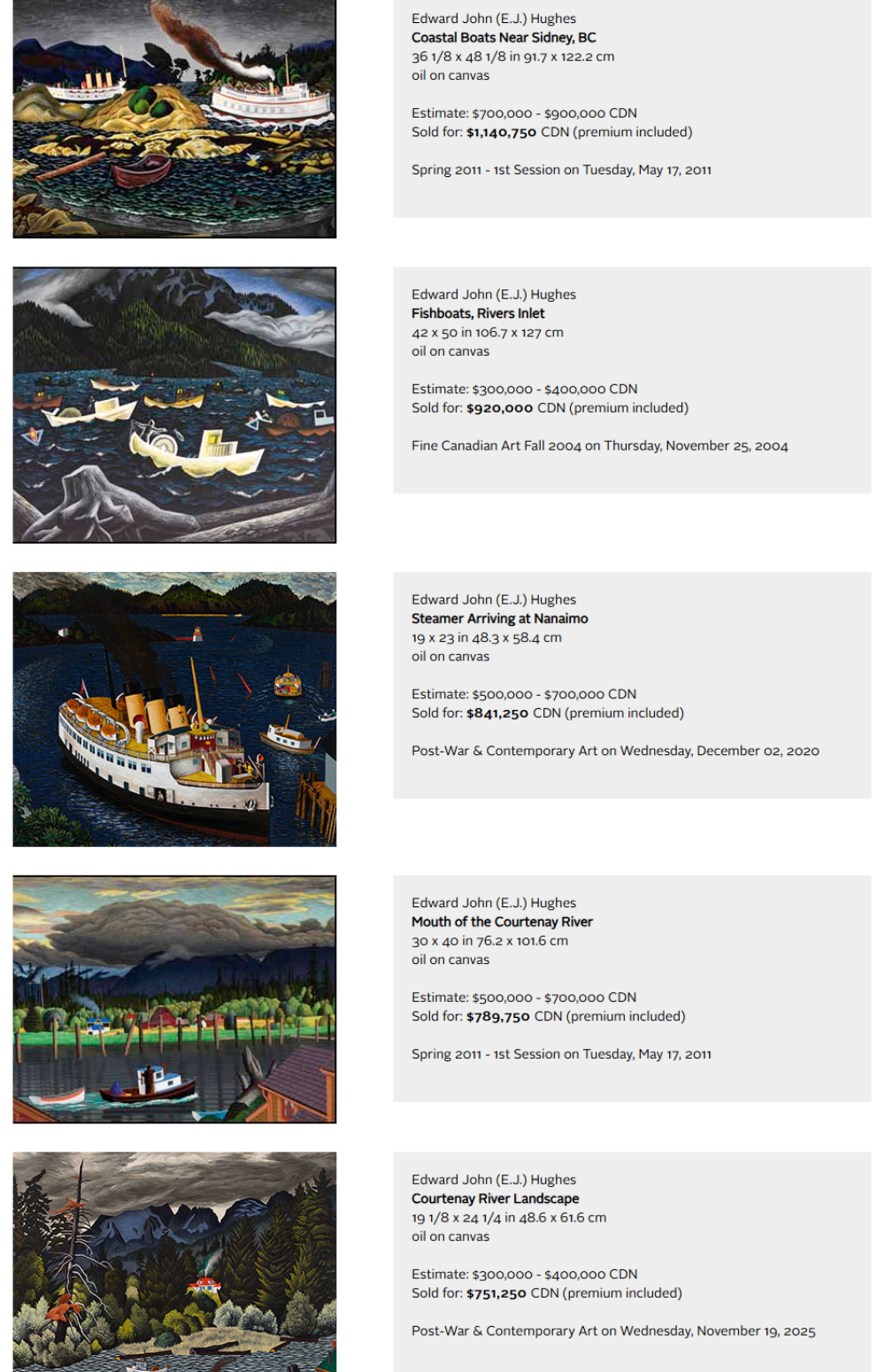
Hughes’ paintings have dramatically increased in price
And there is a fascinating Emily Carr connection
This is where the story becomes even more interesting.
Stern had first become involved with Emily Carr in 1943. Seven years later, in 1951, he encountered Hughes also through Lawren Harris’s recommendation.
Stern himself explicitly connected the two experiences. In recalling his first meeting with Hughes, he said that, just as he had done with Carr seven years earlier—when he became her representative and agent—he decided to take Hughes “under my wings.”
So there is a remarkable chain:
Emily Carr → Max Stern → E. J. Hughes
And Lawren Harris is another crucial link:
Lawren Harris → Emily Carr → Max Stern → E. J. Hughes
More precisely, Harris helped establish Carr’s importance within the Canadian modernist network, Stern became Carr’s dealer and representative, and then Harris recommended Hughes to Stern. Stern subsequently became the dominant dealer in Hughes’s career.
The importance of Stern’s relationship with Hughes can still be seen in the provenance of Hughes paintings today.
For example, Beside the Public Wharf, Crofton, BC (1981) was sold through Dominion Gallery and later belonged to the Estate of Max Stern. Its provenance also records its inclusion in the 1982 Dominion Gallery Hughes exhibition.
Similarly, South of Chilliwack (1973) passed from Dominion Gallery to Stern’s estate and was included in the 1991 E.J. Hughes: 40 Years with Dominion Gallery publication.
So Stern wasn’t merely the dealer who helped Hughes become famous. He became the custodian of a substantial body of Hughes’s work and documentation.
Hughes graduated from the Vancouver School of Decorative and Applied Arts in 1933 and was awarded the first Emily Carr scholarship in 1947 by Lawren Harris. One year later was elected member of the Canadian Group of Painters. His reputation grew in the 1950s, especially after being represented by Max Stern, He was commissioned by the Standard Oil Company to travel on a tanker to paint a series on the British Columbia coast. He also traveled and sketched on the coast and the interior of B.C. on Canada Council grants (Kaslo on Kootenay Lake, 1969). Hughes was elected to the Royal Canadian Academy in 1968 and received the Canada Council Award one year later. In 2001 he received the Order of Canada and was awarded the Order of British Columbia in 2005.
Max Stern as a bridge to next generation of BC Artists
Stern recognized Carr when the Canadian art establishment was still uncertain about her significance. Then, only eight years after Carr’s death, he followed Lawren Harris’s recommendation to Shawnigan Lake and recognized something equally distinctive in E. J. Hughes.
Carr’s connection with Stern helped establish the dealer’s role in promoting BC art; Stern’s subsequent relationship with Hughes helped carry that legacy into the postwar generation.