Emily Carr, Her Influences, and Her Paintings of Environmental Loss
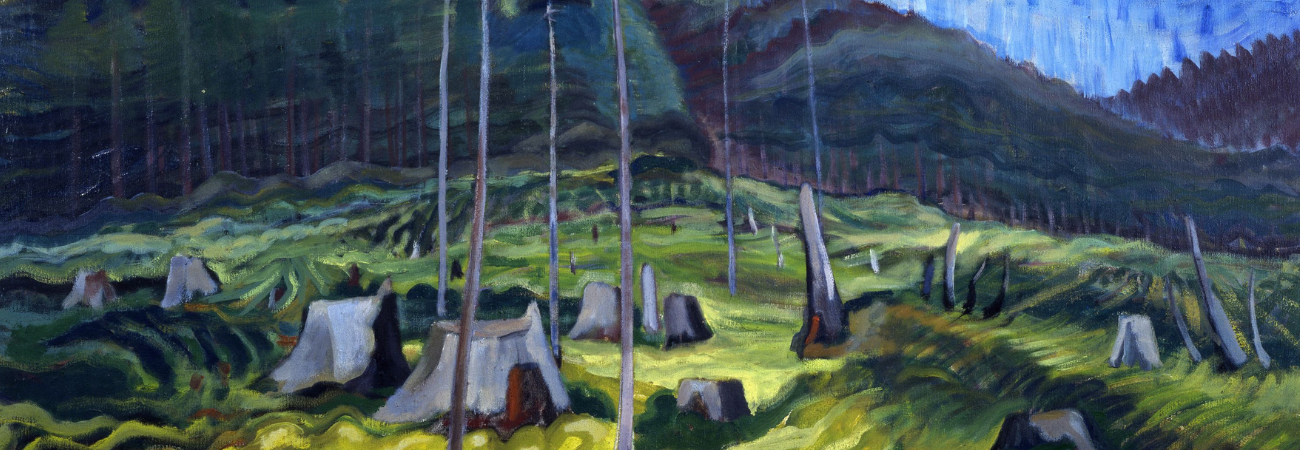
Emily Carr is often described as an early environmentalist. She did not campaign for conservation in the modern political sense, nor was she involved in environmental organizations. Through her writings, paintings, and personal observations, she expressed a deep concern about humanity’s impact on forests, Indigenous villages, and the natural world. Her work anticipated many ideas that later became central to the environmental movement.
A profound reverence for forests
During the 1920s and 1930s, Carr increasingly turned away from painting Indigenous villages and focused on British Columbia’s forests. She saw the forest as a living, spiritual presence rather than simply a collection of trees.
She wrote about the immense vitality of cedar, fir, and spruce forests, often describing them as possessing their own life force. Her paintings such as Scorned as Timber, Beloved of the Sky (1935), Loggers Culls (1935) Above the Gravel Pit (1937) and Odds & Ends (1939) portray nature as dynamic, powerful, and deserving of respect.
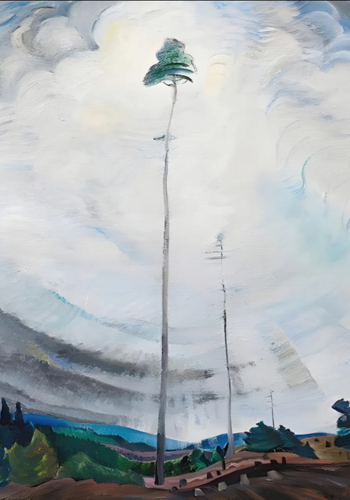
Scorned as Timber, Beloved of the Sky (1935)
This painting is often interpreted as a response to industrial logging. A towering tree rises above a landscape of stumps, celebrating the dignity of a tree beyond its commercial value.
Rather than depicting landscapes as scenic views, Carr portrayed forests as active participants in the life of the earth.
Although written about painting, this passage reflects her philosophy toward nature.
“The thing is to be able to apprehend things, to know what we are trying to get at, to know what we see. So many of us open our flesh eyes but shut the eyes of the soul.”
For Carr, truly seeing nature required spiritual perception, not simply observation.
Alarm over industrial logging
Carr witnessed dramatic changes in British Columbia’s forests during her lifetime. The rapid expansion of commercial logging disturbed her deeply.
She lamented the destruction of ancient forests, particularly the cutting of giant Douglas firs and western red cedars. In her journals she reflected on seeing majestic trees felled simply for commercial purposes.
The title itself suggests a contrast between two ways of seeing:
- Timber — an economic resource.
- Beloved of the Sky — a living being worthy of reverence.
add text here
Respect for Indigenous relationships with nature
Carr admired many aspects of Indigenous cultures, although her understanding reflected the attitudes and limitations of her era. She believed Indigenous peoples possessed a closer relationship with forests, animals, and the land than most non-Indigenous settlers. She often contrasted this with what she saw as the materialism of industrial society.
Today scholars recognize that Carr’s views were sincere but sometimes romanticized Indigenous cultures. Nevertheless, her admiration for Indigenous respect toward nature shaped both her writing and her painting throughout her career.
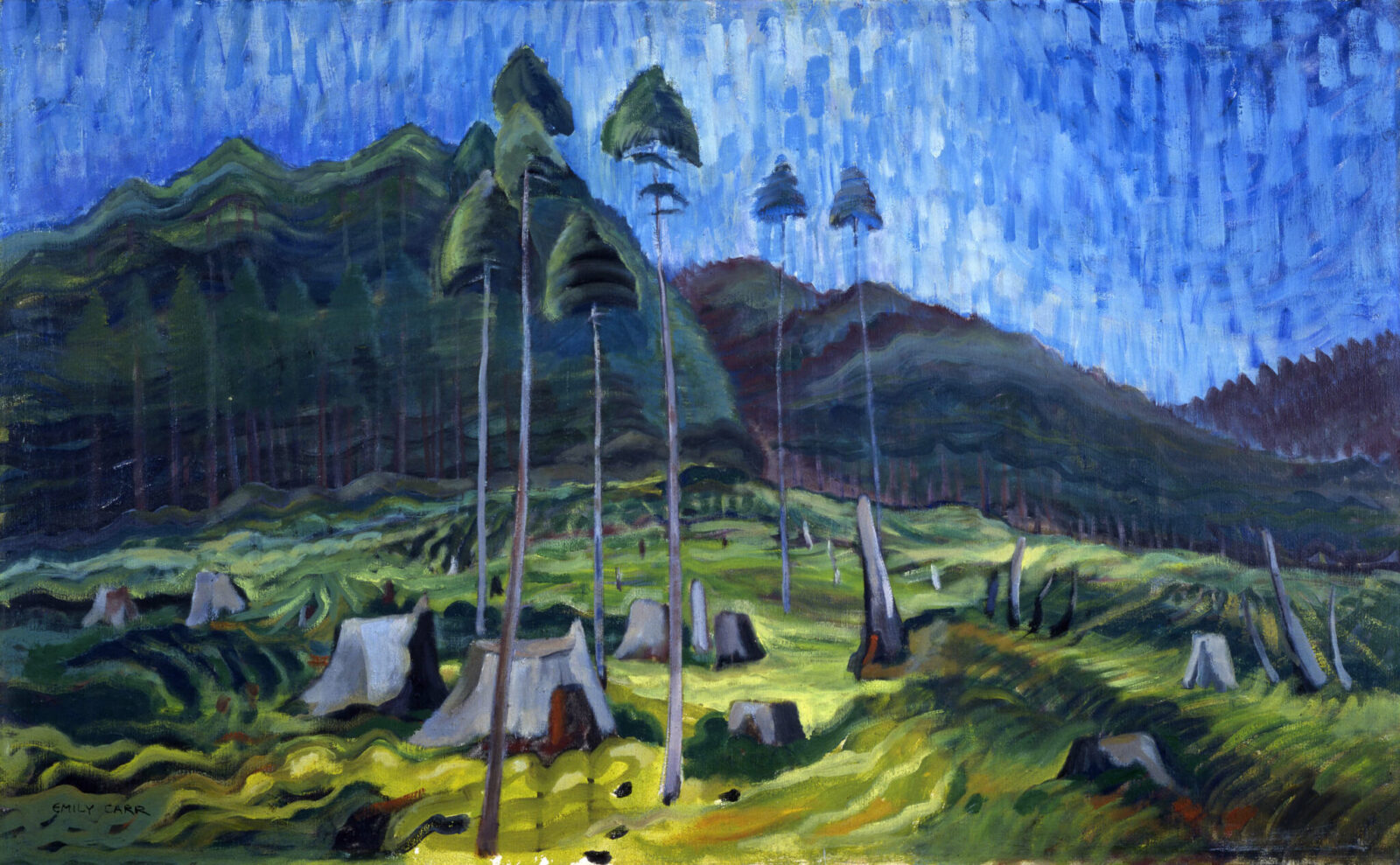
Odds and Ends (1939)
Lorem ipsum dolor sit amet, consectetur adipiscing elit. Quisque sagittis laoreet mollis. Sed hendrerit justo ac nibh tincidunt, tristique blandit est bibendum. Sed sodales lacus tincidunt ante lobortis fringilla. Integer feugiat lectus et finibus pulvinar.
Carr realized that the Indigenous villages she visited beginning in 1907 were changing rapidly as a result of colonization, disease, government policies, and the removal of cultural objects. She understood she was documenting places undergoing irreversible change. Although her primary concern was cultural preservation rather than environmental conservation, the two were closely connected in her mind because villages, forests, poles, and landscapes formed an inseparable whole.
Nature as a spiritual teacher
Carr often wrote that she learned more from the woods than from art schools.
In Hundreds and Thousands, she recorded solitary walks in the forest where she felt humbled by nature’s rhythms. She rejected the idea that humans stood above nature, instead believing people were only one part of a much larger living world.
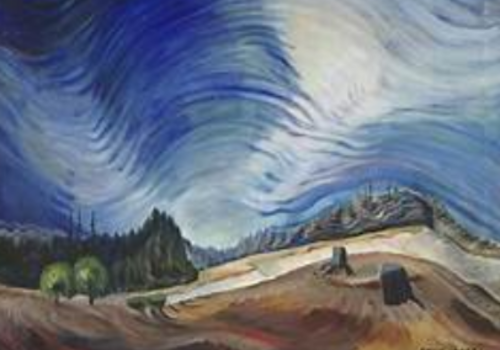
Above the Gravel Pit (1937)
Lorem ipsum dolor sit amet, consectetur adipiscing elit. Quisque sagittis laoreet mollis. Sed hendrerit justo ac nibh tincidunt, tristique blandit est bibendum. Sed sodales lacus tincidunt ante lobortis fringilla. Integer feugiat lectus et finibus pulvinar. Orci varius natoque penatibus et magnis dis parturient montes, nascetur ridiculus mus. Ut vel turpis.
Carr believed forests possessed a spiritual life beyond human understanding.
“There is a cold, mysterious wonder amid the trees… what God-filled spaces totally untrod, what voices in an unknown tongue.”
Rather than viewing forests as scenery, she experienced them as sacred places filled with mystery and awe.This spiritual outlook became central to her mature paintings, where swirling skies, bending trees, and sweeping forms suggest that the natural world possesses its own energy and presence.
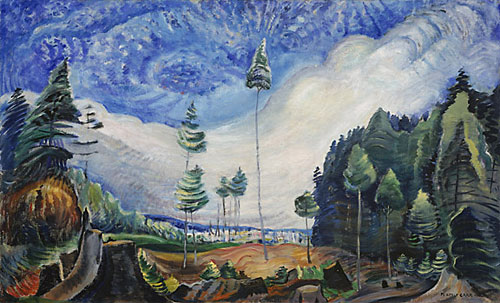
Loggers’ Culls (1935)
Carr viewed these desolate, rotting stumps as acting as both their own tombstones and mourners within the ravaged landscape.
The Influences That Shaped Emily Carr’s Artistic and Spiritual Vision
Carr’s belief that nature possessed an inner spirit did not emerge in isolation. It was shaped and reinforced by a circle of artists, writers, and thinkers who shared the conviction that the natural world was animated by a deeper, universal life force.
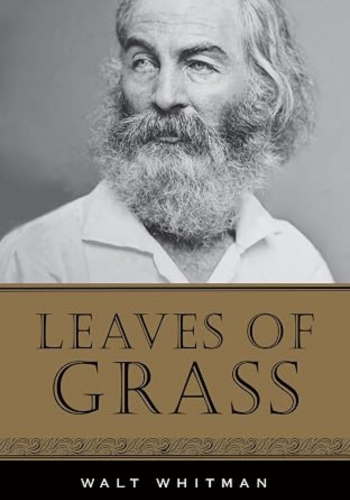
Walt Whitman (1819 – 1892)
Few books influenced Emily Carr more deeply than Walt Whitman’s Leaves of Grass, which she returned to throughout her life for inspiration and comfort. Whitman’s poetry celebrates the unity of all living things, portraying people, animals, plants, and the landscape as expressions of a single universal life force. This vision resonated profoundly with Carr’s own spiritual understanding of the natural world.
Mark Tobey (1890 – 1976)
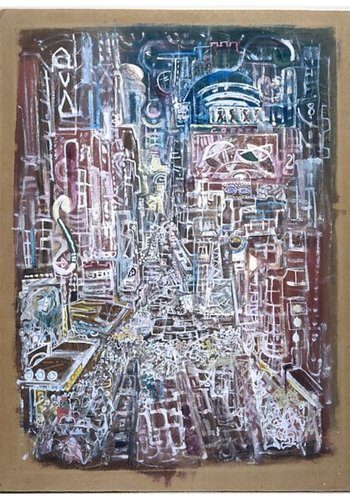
When Seattle artist Mark Tobey spent three weeks teaching at Emily Carr’s House of All Sorts in 1928, he introduced her to new ways of expressing nature’s spiritual dimension. Influenced by the Baháʼí Faith, Tobey believed all creation was interconnected through a universal divine presence. His painting Broadway, completed a decade later, illustrates the interconnected energy of a busy New York street. His emphasis on simplifying natural forms and revealing their inner energy encouraged Carr to move beyond realistic representation toward a more expressive style that captured the living spirit of forests, trees, and sky.
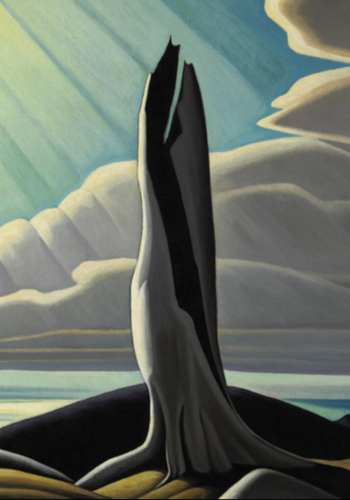
Lawren Harris (1885 – 1970)
Her close friend Lawren Harris, influenced by Theosophy, encouraged Carr to look beyond the visible landscape and paint its spiritual essence rather than its outward appearance. He introduced Carr to ideas associated with Theosophy, which held that nature revealed a universal spiritual reality. Encouraged by Harris, Carr moved beyond depicting the outward appearance of forests to expressing their inner life, believing trees, mountains, and sky were manifestations of a divine presence permeating the natural world.
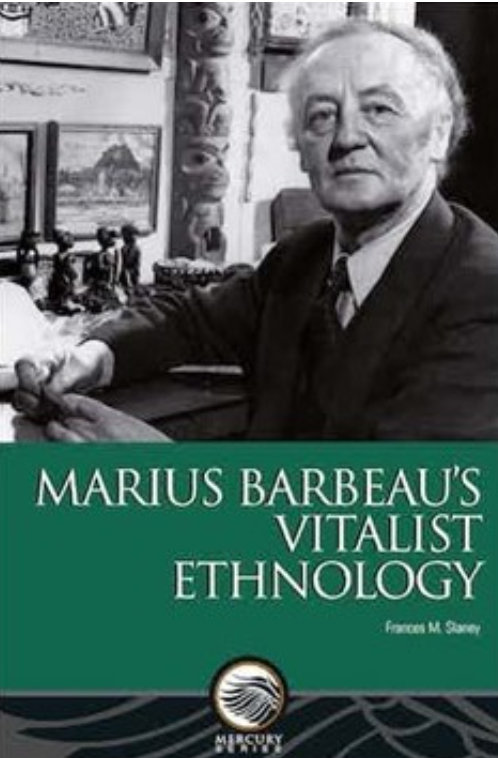
Marius Barbeau (1883 – 1969)
Anthropologist Marius Barbeau, influenced by vitalist ideas and his appreciation for Indigenous cultures, further affirmed Carr’s belief that forests, mountains, and Indigenous art embodied living spiritual energy. Some scholars have described Barbeau as being influenced by vitalist ideas circulating in the early twentieth century—the belief that living organisms possess qualities that cannot be fully explained by physical or mechanical processes alone. While he did not explicitly advocate vitalism as a formal philosophy, his respect for Indigenous worldviews and his appreciation of the living relationship between culture and landscape resonated with Carr’s own belief that forests were animated by an inner spirit.
Together, these influences strengthened Carr’s conviction that forests were far more than timber and landscapes more than scenery—they were living expressions of a universal spirit that deserved reverence and respect.
Carr’s Environment Legacy
Today many historians and environmental writers see Emily Carr as a cultural precursor to the modern environmental movement. Her legacy lies less in activism than in changing how people see British Columbia’s forests. Her paintings encourage viewers to regard old-growth forests not merely as natural resources but as places of beauty, mystery, history, and spiritual significance.
As environmental concerns have grown over the past half-century, Carr’s work has gained renewed relevance. Her paintings continue to inspire conversations about old-growth forest conservation, biodiversity, Indigenous stewardship, and humanity’s relationship with nature.
Emily Carr was not an environmental activist in the contemporary sense. Rather, she was an artist and writer who developed a profound ecological sensibility. Through her paintings and journals, she urged people to look beyond the economic value of forests and recognize the intrinsic worth of the natural world—a message that remains remarkably relevant today as raging wildfires engulf Canada’s boreal forests.