Emily Carr, Group of Seven, & the Search for a Canadian Art Identity
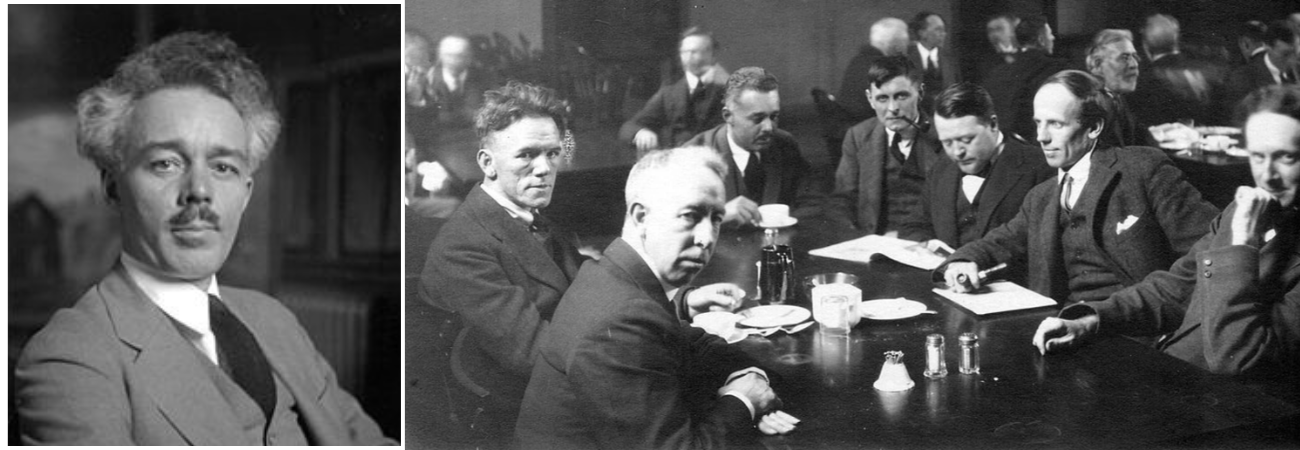
Emily Carr’s relationship with Lawren Harris and the Group of Seven is one of the most compelling artistic connections in Canadian cultural history—marked by admiration, encouragement, distance, and ultimately, a shared vision of a distinctly Canadian art. When Emily Carr returned to painting after meeting the Group of Seven in 1927 after years of financial struggle and creative uncertainty, she could not have anticipated the profound impact that a group of Toronto-based painters would have on her work.
Nor could she have predicted that her own bold, spiritually charged interpretations of the West Coast landscape would come to be seen as a vital counterpart to their vision. At the center of this connection was Lawren Harris, a founding member of the Group of Seven, whose belief in Carr’s talent helped reignite her artistic career.
A Late but Transformative Introduction
By the time Carr met the Group of Seven in 1927, she was already in her mid-50s and had spent decades pursuing her own path in relative isolation on the West Coast. Her earlier training in England and France had exposed her to modernist ideas, yet her subject matter—Indigenous villages, totem poles, and the dense forests of British Columbia—remained outside the central Canadian art narrative.
Everything changed when Carr was invited to exhibit her work in the landmark 1927 exhibition at the National Gallery of Canada. This exhibition, titled Exhibition of Canadian West Coast Art: Native and Modern, brought her paintings into dialogue with both Indigenous art and the emerging national landscape movement led by the Group of Seven.
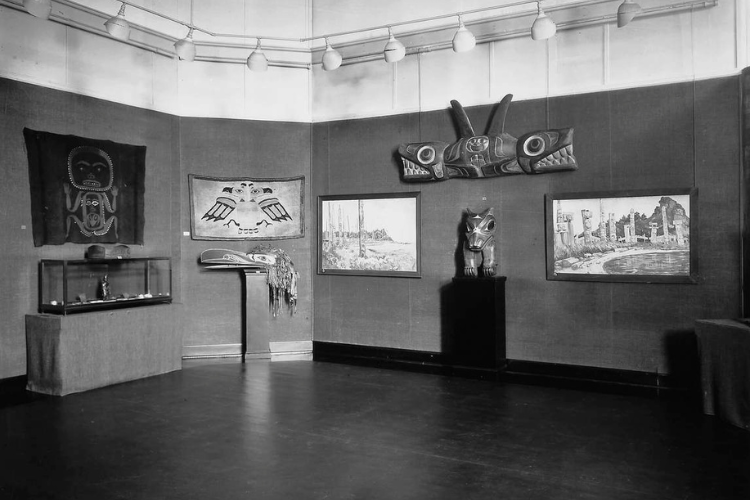
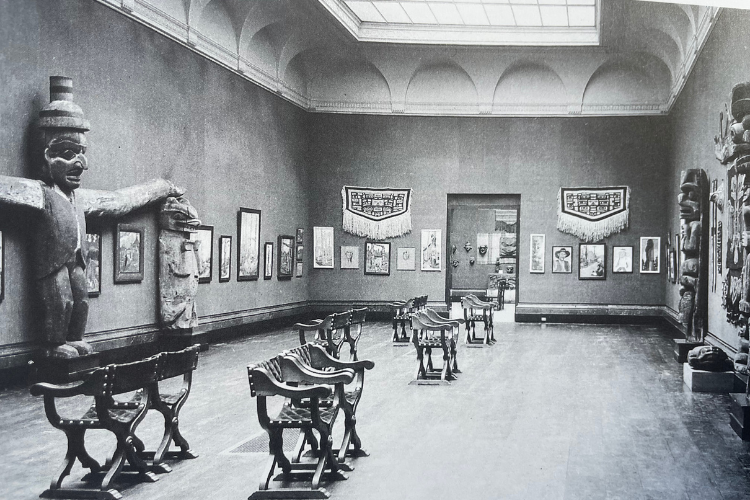
It was here that Carr met members of the Group, including Harris, and discovered that she was not alone in her quest to express the spirit of the Canadian landscape. The encounter was electrifying. Carr later wrote of the experience as a moment of artistic validation—she had found, at last, a community of like-minded painters.
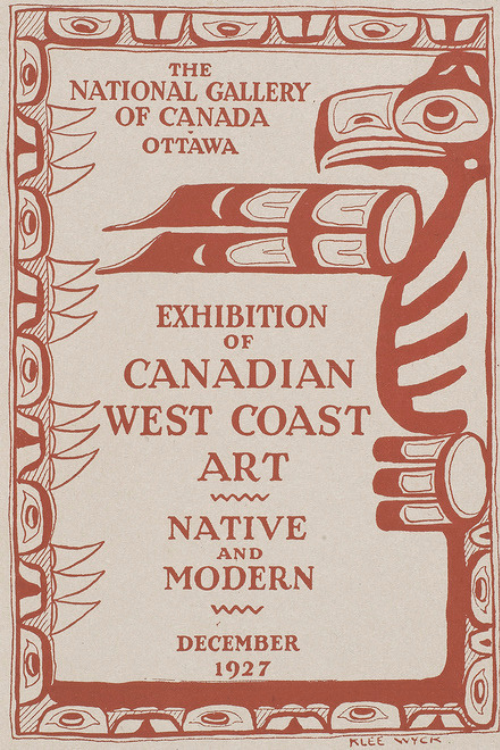
Despite that many members of the Group of Seven were professional graphic designers, they invited Carr to design the exhibition catalogue cover.
She also began documenting her experience in what would then become Hundreds and Thousands: The Journals of an Artist (1966). In the first entry, dated Thursday, November 10, 1927, she describes her departure for the trip west to meet the Group of Seven on November 8, and in following entries from then until her return home to Victoria on December 21. She meets with each of the members of the Group of Seven and recalls the impact Harris’s paintings had on her in her last entry for the year. December 25, 1927.
The memory of Harris’s paintings is never-failing joy. They are the biggest , the strongest parts of my whole trip East. It is as if a door had opened, a door into unknown tranquil paces.
Lawren Harris: Champion and Spiritual Ally
Among the Group, Lawren Harris stood out as Carr’s most important advocate. Harris was deeply committed to the idea that art could express spiritual truths through the landscape, a belief that resonated strongly with Carr’s own sensibilities.
Harris recognized something exceptional in Carr’s work. Unlike many artists of her time, Carr approached the forests and Indigenous cultural sites of British Columbia not merely as subjects to be recorded, but as living presences imbued with energy and meaning. Harris encouraged her to continue along this path, urging her to simplify forms, heighten emotional intensity, and trust her instincts.
Their correspondence over the years reveals a relationship grounded in mutual respect and philosophical alignment. Harris’s letters often emphasized clarity, structure, and spiritual purpose, while Carr’s responses conveyed both gratitude and a fierce independence. She valued his guidance but resisted becoming a follower. Her voice, even when influenced, remained distinctly her own.
Shared Vision, Different Landscapes
At first glance, Carr and the Group of Seven appear united by a common goal: to create a uniquely Canadian art rooted in the land. Yet their approaches diverged in important ways.
The Group of Seven, including artists like A. Y. Jackson and J. E. H. MacDonald, focused largely on the rugged wilderness of Ontario and the North—rocky outcrops, windswept pines, and vast, unpopulated expanses. Their work often emphasized structure, rhythm, and design, presenting the landscape as both powerful and orderly.
Carr, by contrast, immersed herself in the dense, humid forests of the Pacific Northwest. Her paintings pulse with movement: trees twist and sway, skies churn, and the earth itself seems alive. Where the Group often depicted landscapes devoid of human presence, Carr’s work frequently engaged with the cultural imprint of Indigenous peoples, particularly through her depictions of totem poles and village sites.
This difference in subject matter was not merely geographic—it reflected a broader divergence in perspective. Carr’s work is deeply personal and often spiritual in a more mystical, intuitive sense, while the Group’s work, especially Harris’s later paintings, tends toward abstraction and formal clarity.
Yet Carr was never formally a member of the Group of Seven, nor did she seek to be. Geographic distance played a role, as did her independent temperament. She worked largely alone, traveling into remote areas of Haida Gwaii, Vancouver Island and the mainland coast, sketching and painting directly from nature.
Encouragement and Independence
The encouragement Carr received from Harris and the Group of Seven was crucial in rekindling her artistic confidence. After years of running a boarding house in Victoria to make ends meet, Carr had nearly abandoned painting altogether. The recognition she received in 1927—and the subsequent support from Harris—gave her renewed purpose.
Her journals reveal a complex relationship with influence. While she admired Harris and valued his advice, she was wary of losing her individuality. “I do not want to be swallowed up,” she wrote, expressing a determination to remain true to her own vision.
A Dialogue Through Letters and Paintings
This exchange helped shape some of Carr’s most powerful works from the 1930s, including her forest paintings, where form and emotion merge in sweeping, almost abstract compositions. Paintings such as Big Raven, Forest, British Columbia and Blunden Harbour demonstrate a heightened sense of rhythm and unity that reflects Harris’s influence, yet they remain unmistakably Carr’s.
Importantly, Carr’s engagement with Indigenous subject matter also evolved during this period. While her earlier works focused on documenting specific sites, her later paintings move toward a more symbolic and interpretive approach, emphasizing the spiritual presence of the land itself.
Recognition and Legacy
By the 1930s, Carr was increasingly recognized as a major figure in Canadian art. The support of Harris and the Group of Seven played a significant role in this shift, helping to bring her work to a broader audience.
However, Carr’s legacy is not simply an extension of the Group’s achievements. Rather, it stands alongside them as a parallel and equally vital contribution to the development of Canadian modernism.
In many ways, Carr expanded the vision of what Canadian art could be. She brought the West Coast into the national narrative, foregrounded the cultural significance of Indigenous sites (albeit through a colonial lens that is critically examined today), and infused her work with a deeply personal spirituality.
Beyond the Group of Seven
It is also worth noting that the Group of Seven itself evolved over time. By the early 1930s, the original group began to dissolve, eventually forming the broader Canadian Group of Painters in 1933. Carr was invited to join this new collective, further cementing her place within the national art community.
Yet even within this expanded framework, Carr remained something of an outsider—in the best sense of the word. Her work resisted easy categorization, blending elements of Post-Impressionism, Expressionism, and her own intuitive approach into a style that was entirely unique.
A Relationship That Shaped Canadian Art
Harris helped Carr see the broader significance of her work, encouraging her to embrace its spiritual dimensions and to pursue a more unified, expressive style. Carr, in turn, demonstrated that the Canadian landscape was far more diverse and complex than the Group of Seven had initially imagined.
Together, though never formally united as a group, they contributed to a richer, more inclusive vision of Canadian art—one that continues to resonate today.
In the end, Carr was not defined by her association with the Group of Seven, but rather strengthened by it. Her work stands as a testament to the power of artistic connection—how the exchange of ideas, even across great distances, can inspire new directions and lasting achievements.
In her short story from Growing Pains: An Autobiography (1946) simply called “Lawren Harris”, she writes “His work and example did more to influence my outlook upon Art than any school or any master.”
Today, Carr is recognized not simply as a contemporary of the Group of Seven, but as one of Canada’s most original and enduring artists. Her forests still move, her skies still swirl, and her vision, shaped in part by her close relationship with Lawren Harris continues to invite us into a deeper understanding of the land and its spirit.