Chronology of Emily Carr (1871–1945)
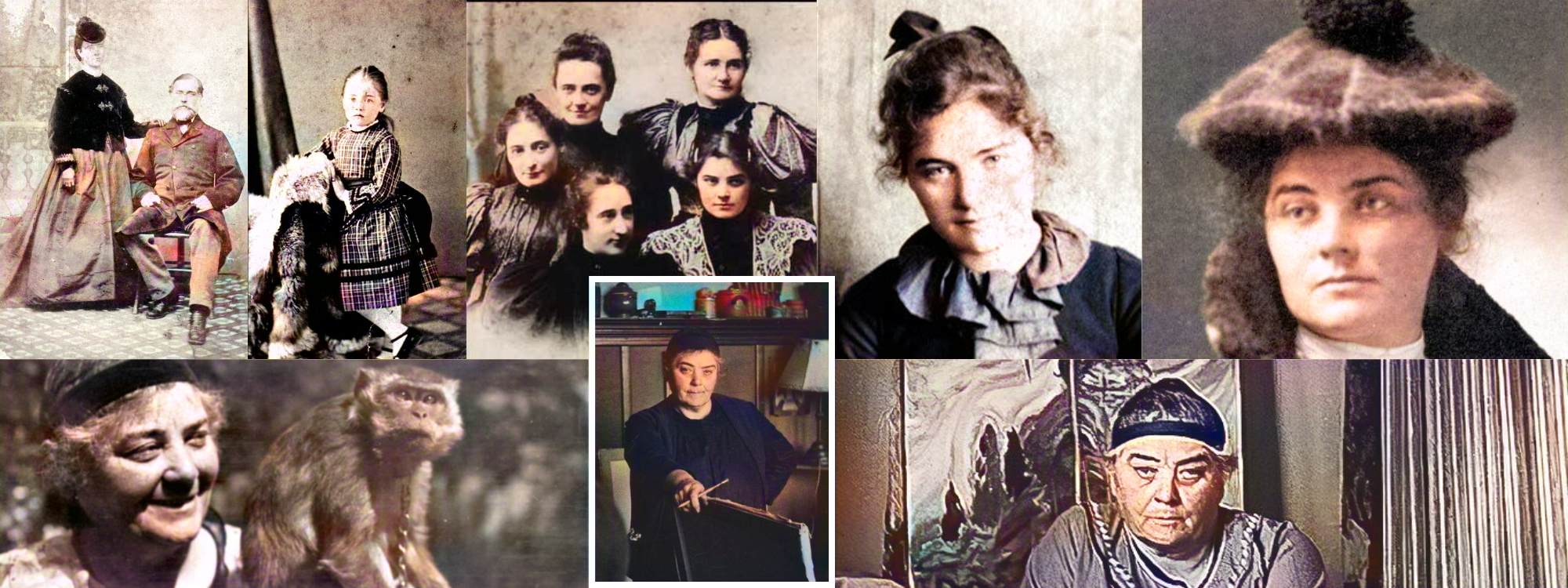
Emily Carr’s life was a remarkable journey from a privileged Victorian childhood in Victoria to becoming one of Canada’s most distinctive painters and writers. Born in 1871, she studied art in San Francisco, London and Paris before travelling throughout British Columbia, where the forests, landscapes and Indigenous communities profoundly influenced her work. Recognition came slowly. After her ambitious 1913 Vancouver exhibition, Carr withdrew from the art world for more than a decade, supporting herself by running a boarding house.
Her fortunes changed in 1927 when the National Gallery of Canada invited her to its landmark West Coast exhibition, introducing her to Lawren Harris and other modern Canadian artists. During her final years, Carr produced some of her most powerful paintings and discovered a remarkable literary voice. She died in Victoria in 1945, leaving a legacy that continues to shape our understanding of Canadian art, literature and the West Coast.
Childhood and adolescence
- December 13, 1871 — Emily Carr is born at 207 Government Street, Victoria, the fifth daughter of Richard and Emily Carr.
- About 1879–1880 — Emily attends school in Victoria and begins taking drawing lessons. One of her early teachers is Emily Woods, who becomes an important early influence on her artistic development.
- 1883 — Emily’s increasingly independent personality begins to clash with the strict expectations of her Victorian family and society. Her later autobiographical writing would portray these years as formative in her determination to become an artist.
- 1886 — Emily’s mother, Emily Saunders Carr, dies after years of illness with tuberculosis. Her older sister Edith assumes much of the responsibility for the younger children.
San Francisco and the beginning of her professional career
- 1890 — At age 18, Emily leaves Victoria for San Francisco, travelling aboard the Walla Walla, to study at the California School of Design. She studies drawing, portraiture, still life and landscape.
- 1890–1893 — Emily studies in San Francisco, receiving her first substantial professional art training.
- 1893 — Financial circumstances force Emily to return to Victoria. She begins teaching art to children and converts the family barn into a studio.
- 1894–1899 — Emily teaches art privately in Victoria, exhibits drawings locally and continues developing her skills. She is increasingly determined to make art her life’s work.
England and the first major European training
- 1899 — Emily leaves Victoria for England, where she studies at the Westminster School of Art in London.
- 1901 — While studying in England, Carr spends time at St. Ives, Cornwall, where she encounters the work and teaching of artists including Julius Olsson and Algernon Talmage.
- 1902–1903 — Carr’s health deteriorates. She spends a period in a sanatorium in England, an experience that interrupts her artistic studies.
- 1904 — Emily returns to Victoria. She makes another trip to Ucluelet, where her interest in Indigenous villages and Northwest Coast art deepens.
Vancouver, teaching and the Northwest Coast
- 1905 — Carr works as a cartoonist and illustrator for The Week and teaches art in Victoria.
- 1907 — Emily moves to Vancouver, where she teaches more than 70 pupils. She also travels to Alaska, stopping at Alert Bay on the return journey. Her experiences on the coast increasingly influence her artistic direction.
- 1909 — Carr continues teaching and painting in Vancouver. She produces Studio Billie’s Calendar, a series of drawings and writings featuring her dog Billie.
Paris and the transformation of her painting
- 1910 — Emily returns to Europe to study in France, enrolling at the Académie Colarossi in Paris. She encounters the revolutionary new approaches of the Fauves and other European modernists.
- 1910–1911 — Carr travels and studies in France and Brittany, absorbing the influence of modern European painting.
- 1911 — Emily returns to British Columbia. The experience of European modernism changes the way she sees and paints the Northwest Coast.
- 1911 — Carr’s work is exhibited in Paris, including at the Salon d’Automne.
The great 1912 coastal journey
- 1912 — Carr undertakes one of the most important journeys of her artistic career, travelling to Indigenous communities along the British Columbia coast and into Haida Gwaii. She visits Kwakwaka’wakw, Gitxsan and Haida communities and makes hundreds of sketches and paintings.
- 1912 — Works such as Cumshewa emerge from this journey. Carr increasingly makes the totem pole, village and surrounding landscape central subjects of her paintings.
- 1912 — Carr tries unsuccessfully to persuade the provincial government to purchase her collection of paintings and sketches as a record of Indigenous art and communities.
Dominion Hall and the House of All Sorts
- April 1913 — Carr presents lectures on Indigenous art and exhibits approximately 200 paintings and drawings in Vancouver. The exhibition is held at Drummond Hall/Dominion Hall.
Although the response is encouraging, sales and press attention fall short of her expectations. - 1913 — Disappointed by the reception of her work and needing a dependable income, Carr returns to Victoria.
- 1913 — Emily begins operating the building that would become known as the House of All Sorts, a boarding house at 646 Simcoe Street. She spends much of the next two decades earning her living from the property rather than from painting.
- 1914–1918 — Carr’s artistic career enters a difficult period. She paints when she can but spends considerable time managing her boarding house, raising dogs, making pottery and producing handicrafts to supplement her income.
- 1918 — Carr works as a cartoonist for the Western Women’s Weekly.
- 1919 — Carr’s sisters Clara and Edith die, leaving the family increasingly diminished.
- 1920s — Carr resumes regular summer sketching trips whenever circumstances permit. Her painting gradually moves away from her earlier documentary approach toward a more personal and modern interpretation of forest and landscape.
The turning point: 1927
- 1926–1927 — Carr takes a correspondence course in short-story writing. Writing will eventually become as important to her legacy as painting.
- 1927 — The National Gallery of Canada organizes the landmark Exhibition of Canadian West Coast Art: Native and Modern. Carr is invited to participate.
- 1927 — Carr travels east to Ottawa and meets artists associated with the Group of Seven, including Lawren Harris, Arthur Lismer and A.Y. Jackson. The encounter is a major turning point in her artistic life.
- 1927 — Lawren Harris becomes an important artistic supporter and friend. Carr begins to understand that her work has a place within the developing story of Canadian modernism.
Recognition and the mature painter
- 1928 — The National Gallery purchases three of Carr’s earlier watercolours, providing important institutional recognition.
- 1928 — Carr returns to the northern coast and begins another major period of painting. Her work increasingly concentrates on the forest itself, rather than solely on Indigenous villages and cultural objects.
- 1929 — Carr continues painting and travelling in British Columbia, developing the powerful forest paintings that would become central to her mature reputation.
- 1930 — Carr exhibits with the Group of Seven and has solo exhibitions in Ottawa, Victoria and Seattle. She travels east again and meets other major artists, including Georgia O’Keeffe.
- 1931–1934 — Carr makes numerous sketching trips around British Columbia. Her paintings become increasingly expressive, rhythmic and modern.
- 1933 — Carr purchases the small caravan she names “The Elephant.” It allows her to travel and camp while sketching and painting in the British Columbia landscape.
- 1934 — Carr takes another summer course in short-story writing, continuing the literary work that will become increasingly important during the final decade of her life.
The end of the House of All Sorts and beginning of the writer
- 1936 — Carr sells the House of All Sorts and moves to 316 Beckley Street in Victoria. Her sister Lizzie dies.
- 1937 — Carr suffers her first major heart attack. During her recovery, she begins writing stories based on her experiences travelling among Indigenous communities.
- 1937–1938 — Carr has important solo exhibitions in Toronto and Vancouver. Her reputation as a major Canadian painter grows rapidly.
- 1938 — Carr’s work is included in A Century of Canadian Art at London’s Tate Gallery, bringing international recognition.
Illness, writing and national recognition
- 1939 — Carr suffers another heart attack. Her ability to travel and paint outdoors becomes increasingly limited.
- 1940 — Carr moves in with her sister Alice. She s
uffers a serious stroke, leaving her largely housebound. During this period she turns increasingly to writing. - 1940 — Carr’s stories are broadcast on CBC Radio, bringing her writing to a wider audience.
- 1941 — Klee Wyck is published. The collection of stories about Carr’s experiences on the British Columbia coast receives the Governor General’s Award for non-fiction.
- 1942 — The Book of Small is published, drawing heavily on Carr’s childhood and family life in Victoria.
- 1942 — Carr makes her final sketching trip, spending time near Mount Douglas Park. She produces works including Cedar.
- 1942 — Carr establishes the Emily Carr Trust and makes arrangements concerning her paintings and their future. Her desire to support other artists becomes part of her legacy.
- 1943 — Carr’s work is shown in major solo exhibitions in Montreal, Toronto, Vancouver and Seattle.
The final year
- 1944 — The House of All Sorts is published, recounting Carr’s years operating her Victoria boarding house.
- 1944 — Despite declining health and another stroke, Carr continues to paint and write, often from bed or a wheelchair.
- 1944 — Art dealer Max Stern organizes a major commercial exhibition of Carr’s work at the Dominion Gallery in Montreal. It is an important commercial success for an artist who had struggled financially for much of her career.
- Early 1945 — Carr learns that the University of British Columbia intends to award her an honorary Doctor of Letters. She will not live long enough to receive the degree.
- March 1945 — Carr is preparing for a forthcoming Vancouver exhibition and is working on oil-paper sketches. She enters St. Mary’s Priory, a residence that occupied the building now known as the James Bay Inn, for a period of rest.
- March 2, 1945 — Emily Carr dies in Victoria at the age of 73, following a hear
t attack. She dies only a short distance from the Government Street house where she was born. - March 1945 — Carr is buried in Ross Bay Cemetery, Victoria.
An important postscript
- 1946 — Growing Pains: The Autobiography of Emily Carr is published posthumously.
- 1953 — The Heart of a Peacock and Pause are published posthumously.
- 1966 — Hundreds and Thousands: The Journals of an Artist is published, providing an extensive record of Carr’s thoughts about art, nature, spirituality and her own creative development.
In broad terms, Carr’s life can be divided into five remarkable periods:
- Victoria childhood and education (1871–1890);
- professional art training and travel (1890–1911);
- the coastal and Indigenous-art period (1911–1913);
- the long struggle for recognition and financial independence (1913–1927);
- the extraordinary period of artistic and literary achievement that began with the National Gallery exhibition in 1927 and continued until her death in 1945.