
The Book of Small: The Stories That Made Emily Carr Famous
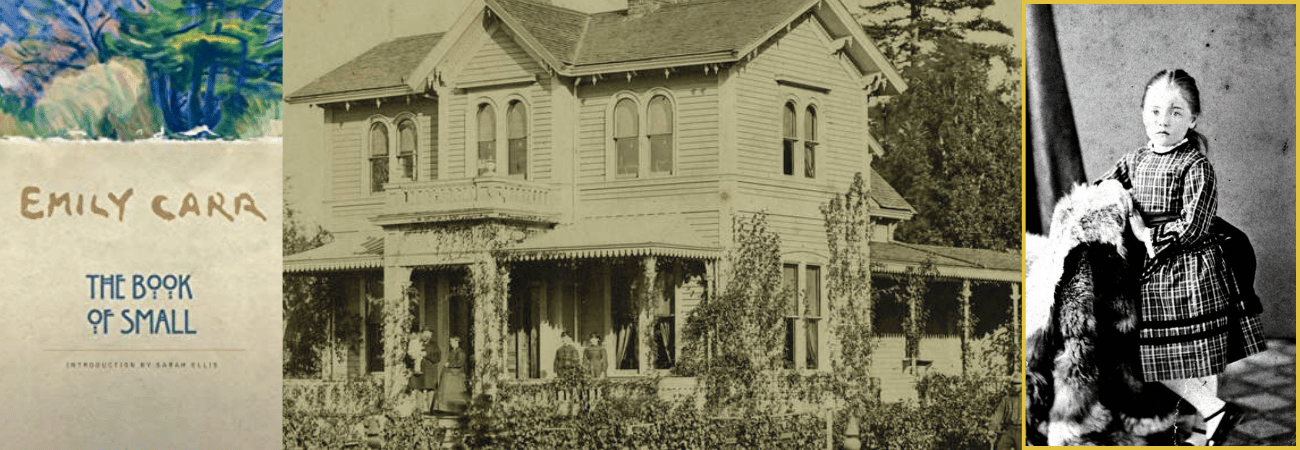
The Book of Small is a collection of thirty-six word sketches in which Emily Carr–four decades later–relates anecdotes about her life as a young girl in the frontier town of Victoria. She notes: “There were a great many things that I only half understood, such as saloons and the Royal Family and the Chain Gang.” The young Emily, who gave herself the nickname “Small,” was an intense, observant and sensitive yet rebellious child, who often got into scrapes because of her frankness or innocence.
When Emily Carr was born, the city of Victoria was “only twenty-eight years away from its origins as a Hudson’s Bay Company fur trading post built in 1843.” In the book, “young Victoria” is a frontier town viewed in retrospective voice, since Emily was in her 50s by the time she began writing. Here is an iconic artist and writer engaging in a reconstruction of her own wild, young self.
The vividly told stories reveal an awareness of the comedy — and pathos — of people and situations. The also offer an intimate look into childhood in a pioneer society in Victorian Times.
Emily Starts To Write Her Recollections
The events leading up to the writing and publication of The Book of Small reflects a period of profound transformation in Emily’s life, as she shifted from visual art to literary expression. After suffering a series of heart attacks in the late 1930s, Carr could no longer paint with the same intensity. Yet her creative spirit endured, finding new life in writing.
In 1941, her first collection of short stories, Klee Wyck, was published to critical acclaim and went on to win the Governor General’s Award for literature. The collection of short stories established Emily as not just a painter of Canada’s West Coast but also as a powerful storyteller, giving voice to her deep connection with Indigenous people, landscapes, and memory.
Her stories began to reach a wider audience through radio, with CBC broadcasts expanding her literary presence across the country. This period also saw renewed recognition of her visual art: the Vancouver Art Gallery, under director Donald Buchanan, mounted exhibitions of her work and acquired several major pieces for its collection, reinforcing Emily’s status as a significant cultural figure.
Emily Publishes Her Second Collection of Short Stories
Encouraged by this momentum and the editorial support of Ira Dilworth, who recognized her literary gifts, Carr began shaping autobiographical material into a new manuscript focused on her childhood in Victoria. These reflective, whimsical tales—told through the eyes of “Small”—became The Book of Small, published by William Clarke in 1942. The book cemented Emily’s second career as a writer and deepened the public’s understanding of her rich inner world.
Encouraged by friends and literary acquaintances, most notably broadcaster and editor Ira Dilworth, she began to shape her childhood memories into vivid, reflective stories. Dilworth, a trusted confidant and advocate for Carr’s work, played a crucial editorial role, helping her organize and refine the manuscript for publication.
The stories that became The Book of Small, her second collection of short stories, had their roots in Emily’s lifelong habit of journaling and sketching word-pictures of the people and landscapes of British Columbia. The manuscript focused on her early life in Victoria in the late 19th century—a world viewed through the eyes of “Small,” her childlike alter ego. These recollections mingled factual autobiography with imaginative storytelling, resulting in a deeply personal and lyrical portrait of the colonial West Coast.
Small Tells Her Story
Dilworth submitted the manuscript to Oxford University Press in London, who declined to publish it. It was ultimately accepted by William Clarke, a Toronto based publisher and released in 1942 to widespread acclaim. The book resonated with readers across Canada, not only for its charm and nostalgia but also for its literary merit and distinct west coast voice. With Dilworth’s guidance and Emily’s natural storytelling ability, The Book of Small launched her successful second career as a writer.Smml
Each sketch reads like a distilled memory—some light and humorous, others shadowed by loss, confusion, or spiritual longing. From neighborhood characters and strict Sunday rituals to early brushes with death and Carr’s awakening sense of artistic and spiritual independence, the book captures the early forces that shaped her identity as one of Canada’s most celebrated painters and writers.
The first edition featured woodcut illustrations by Carr herself and was well-received by critics and readers alike. It marked a significant milestone in Carr’s literary career, as she was gaining national recognition not only as a painter but also as a writer. The stories, based on Emily’s childhood in colonial Victoria, were noted for their vivid detail, humor, and lyrical voice.
Following Carr’s death in 1945, The Book of Small remained in print and continued to find new audiences. It was reissued several times by Clarke Irwin, who took over rights to her work in later years. The stories were included in later compilations, such as The Heart of a Peacock (1953) and The Complete Writings of Emily Carr (published posthumously in 1996 by Douglas & McIntyre).
Today, The Book of Small is widely available in both print and digital editions, often published by Douglas & McIntyre. It remains a key work in Canadian literature, studied and enjoyed for its distinctive voice and rich historical context.
What makes The Book of Small particularly compelling is Carr’s distinctive prose style—rich in rhythm, image, and feeling—and her unfiltered ability to connect childhood impressions with adult insight. It’s a rare book that evokes both the innocence of youth and the complexity of growing up female, curious, and creative in a tightly bound world. Through it all, Carr’s love for the land and her longing for freedom pulse beneath the surface, marking the early emergence of a voice and vision that would come to define West Coast Canadian art and literature,
In Her Own Words:
from Growing Pains: An Autobiography (1966)
One year after the publication of Klee Wyck, The Book of Small appeared. I had wintered in a Nursing Home. Domestic help and fuel problems were difficult owing to war. I was quite eligible for a Nursing Home because I was really ill.
There I lay waiting and waiting for Small to come from the publisher. The publishing houses were under a heavy war strain—men, presses, material; but at last the book came in a smart green jacket with a medallion of the little old Small in the centre.
The Book of Small was entirely different from Klee Wyck. She was bigger. Some people liked her more, some less. The first half of Small was a collection of childhood (our childhood) stories, the life we lived in the far West where Father and Mother pioneered and raised their large family.
The other half of Small was called A Little Town and a Little Girl. It told of little old Victoria before she was even a town. Nearly all the people who lived there were English and they had a good many difficulties to cope with. They had only small Chinaboys as helps, no plumbing, only pumps and wells, no electric light and no telephone. Indians went round the streets selling their beautiful cedar-bark baskets or trading them for old clothes, or peddling clams or pitch wood tied in bundles for the lighting of fires. The Book of Small told of the slow, conservative development of Canada’s most Western city.
My Editor was up north on a business trip. He had waited impatiently for the appearance of Small. She came the day he left. He wrote me, “I suppose you are being swamped with fan mail.”
No, Small lay shut in a drawer. I could not bear to look at her. She lay there for three or more weeks. No reviews, no letters came about The Book of Small. They had followed the appearance of Klee Wyck immediately or within a few days. In bitterness and disappointment I turned to the wall. My Editor came back from the North and, coming to Victoria, dashed into my room.
“The reviews? The letters?”
“There aren’t any. Oh, Ira, she’s flopped, Small has flopped dead, I’m so shamed!” and I cried till I nearly drowned him. He looked perplexed.
“I can’t understand it. Clarke and I both thought she was the equal, if not better than Klee Wyck. She can’t have flopped!”
I hid my shamed face in the pillow.
“I don’t care so much about Small and me, but I’ve disappointed you and Bill Clarke.”
I howled quarts of tears that had been strangled back for three weeks.
“The Press too, Small will be a dead loss to them. I wrote Bill last night and told him how dreadful I felt.”
“Cheer up, remember it’s war time and everything is higgledy-piggledy. There has been a hold-up somewhere. It’s a marvel to get a book published at all these days! All dates are uncertain. Reviewers can’t review till they have got the stuff, nor the booksellers sell till they have the books.”
He left me cheered, but not convinced. I could only wail, “She’s flopped, she’s flopped! Small’s flopped!”
“Silly!” said my Editor, “you’ll see. Small’s all right. Look at the reception Klee Wyck got; Small will too—give her time.”
Letters came from both Mr. and Mrs. Clarke. Kind letters they were, very upset that I should have thought Small had flopped. There had been delays, just as Eye had said, owing to war conditions. The date of publication had had to be postponed several times, the reviews could not come out till the critics got the books and read them. Shipments of books had been late going to the bookstores and libraries. The reviews were just as good, just as complimentary, as those of Klee Wyck.
Eye wrote from Vancouver, “What did I tell you? All who read Small (and everyone is reading her now) love her. Book stores are sold out of copies!”
Mr. Clarke made his autumn trip to the West—dear Bill and his kind little wife felt so sorry about all the doldrums I had been through because of Small. Bill’s first question was, “Is the next book ready? I plan to publish one each year.” The script was ready, but we were deeper than ever in war. Hitler is a nuisance from every possible angle.
by Emily Carr


0 comments