Rug Hooking in Canada and Emily Carr’s West Coast Vision
From 1916 to 1930 when Emily Carr struggled to make a living from her art, she turned to an unlikely but deeply creative form of work—rug hooking. Living in her boarding house in Victoria, the House of All Sorts, while running a boarding house, Emily designed and produced hooked rugs to support herself through difficult financial years.
What began as “breadwork,” as she called it, became another outlet for her restless imagination. Her rugs transformed wool, old clothing and burlap into vivid west coast scenes—trees, totems, and animals drawn from her own sketches—and connected her to a wider Canadian tradition of women’s handcraft that stretched back generations.
To appreciate Carr’s venture into rug making is to place her within a long and fascinating story: the story of rug hooking in Canada, a craft born of thrift and artistry that grew into a form of visual storytelling across the country.
Roots in Resourcefulness: The Origins of Rug Hooking in Canada
Rug hooking took root in Canada in the early 19th century, arriving with settlers from Britain and New England. In an age before central heating or manufactured carpets, women used what they had at hand—old clothing, yarn ends, and burlap sacks—to create warm and colourful mats for their homes.
In fishing villages and farmhouses across the Maritimes, the sound of a hook pulling through coarse burlap became part of the domestic soundscape. Patterns were often traced from the pages of catalogues or drawn by hand, using whatever dyes were available. Flowers, animals, geometric borders, and ships appeared in early designs, blending personal imagination with the practical need to insulate wooden floors.
By the late 1800s, rug hooking had become particularly associated with Nova Scotia, New Brunswick, and Newfoundland, where communities of women turned necessity into artistry. Cheticamp, in Cape Breton, developed a signature style of fine, detailed work—often created by Acadian women and later commissioned by visiting artists and collectors.
Farther north, the Grenfell Mission in Labrador transformed rug hooking into an organized cottage industry. Women used dyed silk stockings and cotton to create vivid pictorial mats—depicting sled dogs, icebergs, and wildlife—to sell for income. These so-called Grenfell rugs became famous internationally in the mid-20th century for their craftsmanship and storytelling power.
By then, rug hooking was no longer just a domestic chore. It had entered the realm of cultural identity and folk art—representing the perseverance, artistry, and quiet resilience of generations of Canadian women.
The Spread Westward: Rug Hooking Comes to British Columbia
As settlers journeyed westward, they carried their household crafts with them, and rug hooking found new ground in British Columbia. Pioneer women, often from the Maritimes or Ontario, brought their hooks and habits across the prairies and over the mountains to the Pacific coast.
In rough-hewn cabins and clapboard farmhouses, hooked mats brightened the floors and walls of new homes in Victoria, the Cowichan Valley, and the Fraser Canyon. Wool scraps, worn-out socks, and flour sacks once again became the raw materials of comfort. Because imported patterns were hard to come by, women on the coast often drew their own designs—mountain ranges, ferns, cedar boughs, and birds inspired by their new environment.
Before and after the pioneer women brought their craft to BC’s west coast, Indigenous women had traditionally have taken on an active role in the production and sale of woven baskets, mats and other handicrafts to sell to settlers and tourists. Victoria Fall Fairs included Indigenous handicrafts. By 1908, the Fair offered a prize for the “best assortment of serviceable Indian-made baskets” and “the best mats, plain and ornamental.”
Indigenous artists sold their wares on street corners and in consignment shops. Carr met her lifelong friend Sophie Frank, a talented basket weaving artist, when she was selling them door-to-door in Vancouver in 1906.
In 1913, the Vancouver Handicraft Guild noted “the steady increase in the demand for Indian work: the Indians themselves come constantly to the shop to dispose of their products” A Woman’s Place: Art and the Role of Women in the Cultural Formation of BC 1850s – 1920s edited by K. A. Finlay, 2004)
These early B.C. rugs, while less formally documented than those from the Maritimes, show a shift in perspective. The imagery reflected the lushness and mystery of the coastal forest, the play of ocean light, and the wildness of west coast life. Even in modest households, there was room for artistry—each mat a small, practical painting.
Guilds, Gatherings, and the West Coast Revival
By the mid-20th century, rug hooking experienced a revival as part of the broader Arts and Crafts movement. Across British Columbia, women’s institutes, art clubs, and guilds began to celebrate and preserve traditional handwork.
Before and after then, Indigenous women had traditionally taken on an active role in the production and sale of handicrafts to sell to settlers and tourists. Victoria Fall Fairs included Indigenous handicrafts. By 1908, a prize was offered at that year’s Victoria Fall Fairs to the “best assortment of serviceable Indian-made baskets” and “the best mats, plain and ornamental.”
Indigenous women sold their wares on street corners and in consignment shops. Carr met Sophie Frank, her lifelong friend, a talented basket weaving artist, when she was selling them door-to-door in Vancouver in 1906.
In 1913, the Vancouver Handicraft Guild noted “the steady increase in the demand for Indian work: the Indians themselves come constantly to the shop to dispose of their products” A Woman’s Place: Art and the Role of Women in the Cultural Formation of BC 1850s – 1920s edited by K. A. Finlay, 2004)
By the 21st century, rug hooking in B.C. had become both heritage and innovation: an art form bridging past and present, domestic and expressive, tradition and individuality.
Places of Preservation
While B.C. never developed a large commercial rug-hooking industry, many local museums and heritage villages preserve early examples of hooked mats and domestic textiles. The Sidney Museum, BC Forest Discovery Centre, and local historical societies often display rugs as part of pioneer home exhibits.
Further east, the Hooked Rug Museum of North America in Hubbards, Nova Scotia, houses the most extensive collection of hooked rugs on the continent—testament to Canada’s leading role in the evolution of this art.
Emily Carr and the Hooked Rugs of the House of All Sorts (1916–1930)
In 1916, Carr exhibit three hooked rugs with Indigenous themes at the annual Island Arts and Craft’s Society. She developed her designs from Indigenous crests and from drawings from Indigenous artists. Carr claimed to have been inspired by watching Indigenous women weave baskets and mats although speculation is that she might have also seen hooked rugs created by Indigenous artists while in Albert Bay and Fort Rupert.
Financially constrained and feeling isolated from the mainstream art world, between 1913 and 1930, Emily looked for ways to support herself without abandoning her artistic spirit. Among other things such as running a boarding house, breeding and kenneling sheep dogs, keeping a large vegetable garden, selling chickens and eggs, crafting and selling pottery, she began creating hooked rug designs based on her own paintings and sketches, translating the forests, totems, and animals of British Columbia into textile form.


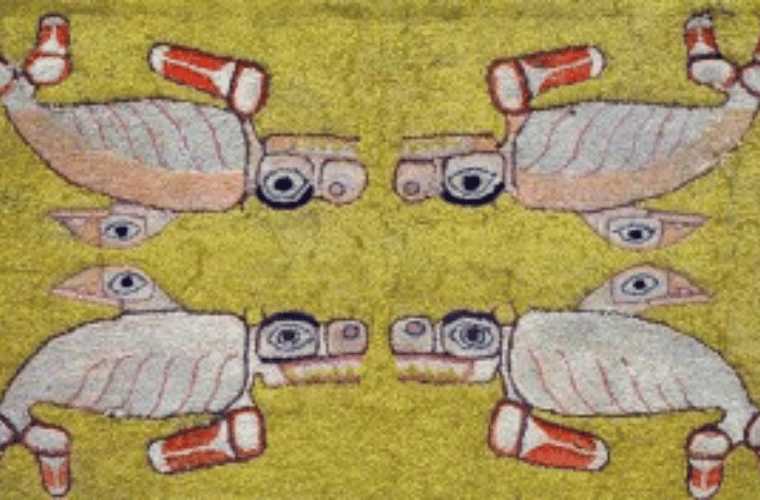
Working with her sister Alice, and others, she drew patterns onto burlap, sold the designs, and sometimes even completed the rugs herself. Some were marketed through Eaton’s Catalogue or local shops under the name Klee Wyck Rugs—a nod to her later nickname, “the Laughing One.”
Her rug designs reflected her painter’s eye: bold, rhythmic compositions drawn from the natural forms of the coast. The undulating lines of trees and sky that define her paintings found new texture in wool and burlap. The work was demanding, but Carr found satisfaction in it, calling it her “breadwork”—both literally and spiritually sustaining during a difficult chapter in her life.
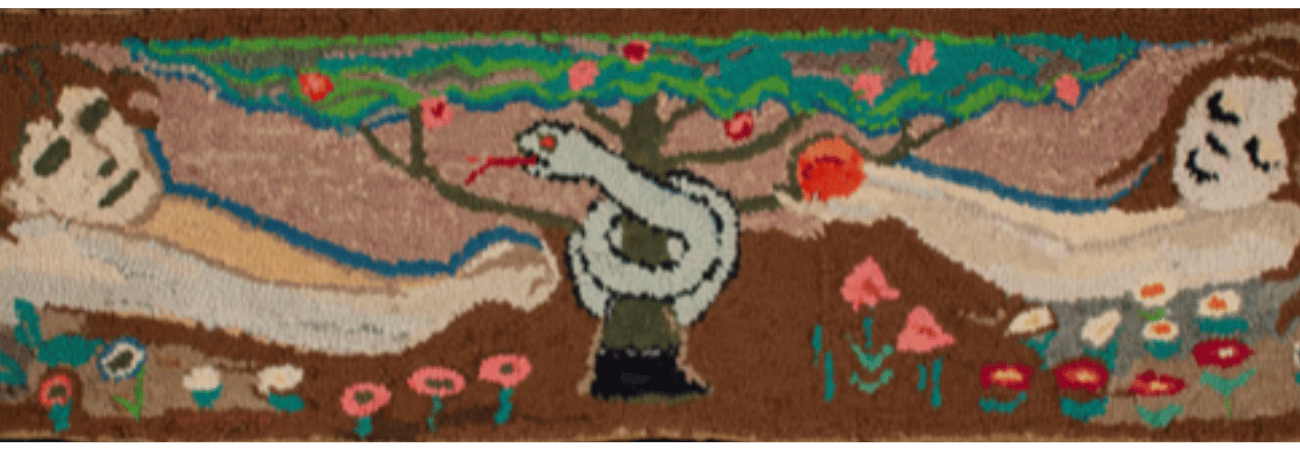
Emily Carr’s Adam and Eve hooked rug, featured above, is one of her most distinctive designs, and unlike many of her other rugs (which feature animals, birds, or abstracted trees), this one depicts the biblical pair in a naïve, folkloric style — a reflection of Carr’s humour and imaginative approach to domestic art.
Though she eventually gave up rug hooking as her painting career revived soon after 1930, the experience left its mark. The repetitive, meditative process, the interplay of colour and form, and the tactile engagement with materials all informed her later artistic approach. The rugs became an extension of her west coast vision—art grounded in place, labour, and love of the handmade.