
My Demon, My Companion: Emily Carr and Her Monkey Woo
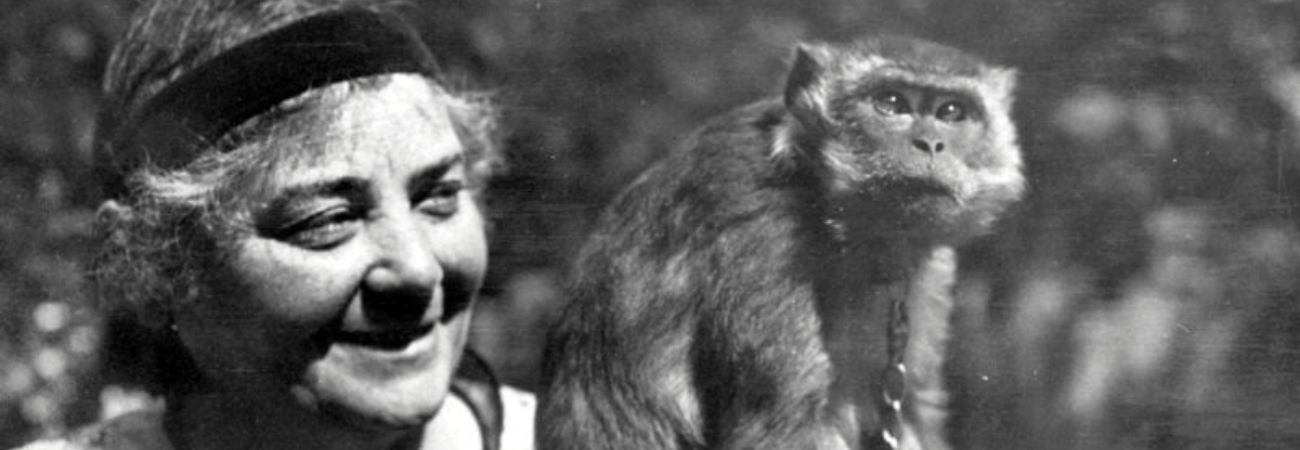
Emily Carr’s pet monkey Woo was one of the most eccentric and beloved companions in her life. Carr was an avid animal lover, and Woo, a small Javanese macaque, became one of the most memorable of her many pets. Woo’s presence added both chaos and joy to Carr’s household, particularly during the years 1913 – 1926 when she was running the boarding house known as the House of All Sorts in Victoria, a residence she would live in with Woo and her many pets until her first heart attack in 1936.
Her stories about her monkey Woo is some of the most vivid, humorous, and emotionally revealing in her published and unpublished works. Woo appears most fully formed in The House of All Sorts (1944) She artfully blends autobiographical truth with literary flair, and Woo emerges not just as a pet but as a full-blown character — chaotic, cunning, willful, and strangely endearing.
Carr acquired Woo around 1923 from a pet shop in Victoria that sold exotic pets. As a port city, exotic pets from afar were not uncommon at the time. Woo was small, clever, temperamental, and highly expressive — a handful in every sense. Emily treated Woo almost like a child, often dressing her in little garments and allowing her to roam freely around the house. Woo’s curious, mischievous personality provided Carr with constant amusement, and sometimes frustration.
Raised in a devoutly religious household, Emily Carr struggled throughout her life to reconcile her untamed, passionate spirit with the rigid expectations of upper-class Victorian society. Finding little comfort in human relationships, she increasingly sought companionship in animals, who offered her the unconditional love and trust she often felt deprived of.
In her 1944 book The House of All Sorts, Carr wrote extensively and affectionately about Woo, who is a recurring character in her stories:
Woo was a Javanese monkey, dressed in a pink flannel petticoat with a lace ruffle. She had a black face, deep-set solemn eyes, and tiny clever fingers. Her soul was full of sin.
Carr’s descriptions of Woo balance affection with comedic exasperation. She paints Woo as both a tormentor and a comfort — someone who cheered her up in times of depression but also wreaked havoc on the household. Carr was often isolated and too busy to paint much during her landlady years and was often too tired to paint. Woo provided a kind of companionship that was emotionally significant.
There are many delightful anecdotes about Woo, such as her dramatic tantrums, her fondness for painting supplies (she reportedly chewed on brushes), and her occasional forays into the guests’ rooms at the boarding house, to Carr’s dismay.
Carr saw Woo not just as a pet but almost as an artistic soul in her own right — chaotic, sensitive, wild. Some biographers and critics have interpreted Woo as a kind of alter ego for Carr: unconventional, outside society’s norms, and hard to tame.
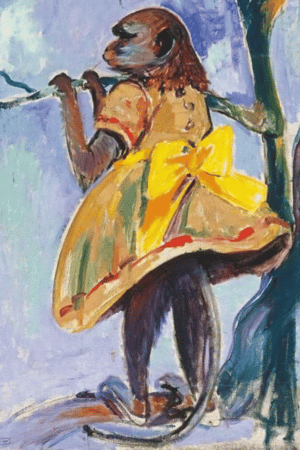
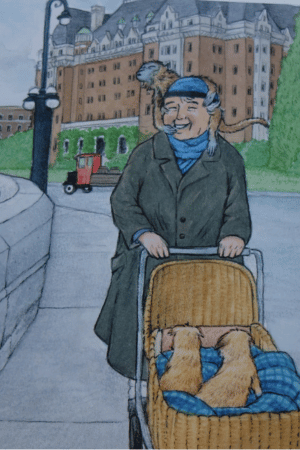
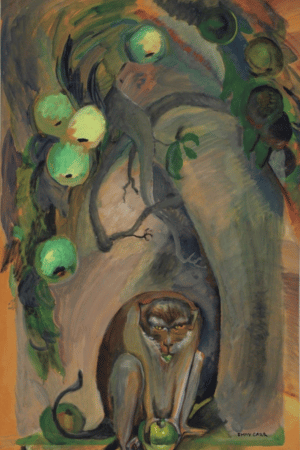
In her later autobiographical writings, Carr often used animals to symbolize emotional states or aspects of human character. Woo, in particular, seems to embody both the frustrations and the strange joys of Carr’s middle years — the tension between domestic entrapment and creative freedom.
Woo chewed up curtains, bit guests, stole food, and created general mayhem, but Carr loved her fiercely. Their relationship was a strange but genuine emotional bond. When Woo was angry, she would sulk or throw tantrums. When she was affectionate, she would cuddle Carr or cry like a baby.
Woo was an odd little beast. Her passions were strong, her hate deep, her love fierce.”
— The House of All Sorts
This quote captures the emotional intensity Carr perceived in Woo — traits she likely recognized in herself. It’s a revealing line about how Carr anthropomorphized the monkey and saw her as a being of deep feeling.
One famous anecdote tells of Woo leaping onto a guest’s shoulder and shrieking wildly — Carr rushed to remove her and made no apologies, simply saying the monkey “didn’t like certain people.”
She was a demon, but she was my demon.
— The House of All Sorts
This simple but powerful sentence shows the conflicted affection Carr had for Woo. Woo was often difficult, chaotic, and destructive, but Carr embraced her anyway — possibly seeing in Woo a reflection of her own unruly spirit.
Woo was jealous. She resented every kindness I showed to any other creature. If I petted the dog, Woo would leap between us, clawing and screaming.”
— The House of All Sorts
Carr writes this with her characteristic wry humor, but it also underscores the intense emotional bond — and exclusivity — in their relationship. Woo was possessive of Carr’s attention, and Carr, despite the mayhem, found this both exasperating and endearing.
When Woo died, the heart of the house broke.
Though Carr loved Woo deeply, her own life was far from stable. After suffering a heart attack in 1936 and being hospitalized, Carr made the difficult decision to send Woo to the Stanley Park Zoo in Vancouver. Friends of Carr often visited Woo there, but the monkey’s spirit diminished in captivity. She died alone in her cage just a year later — a quiet, sorrowful end to a vibrant life once filled with mischief, affection, and the complicated bond she once shared with Carr.


0 comments