From Record-Breaking Sale to Museum Treasure: Emily Carr’s Crazy Stair at the Audain
Heffel Fine Art Auction House celebrated the best in Canadian art with its much anticipated fall auction, held at the Park Hyatt Hotel in Toronto in 2012.. With 137 lots and hundreds of buyers – either present at the hotel, watching live online or bidding by phone – the evening achieved impressive total sales of $13,416,975 million (all prices are in Canadian dollars and include a 17 per cent buyer’s premium). Leading the evening was The Crazy Stair (The Crooked Staircase) by Emily Carr which commanded $3,393,000, setting multiple auction records: the most ever paid at auction for an Emily Carr painting, the most achieved for the work of a Canadian female artist and the fourth most valuable piece ever sold in Canadian art auction history.
This large format painting from Carr’s mature period is indicative of the artist’s lifelong engagement with First Nations culture. Holding special significance, The Crazy Stair was previously the property of the Vancouver Club who purchased it prior to the creation of the Emily Carr Trust, which houses many of Carr’s works. The estimate of $1,200,000 ‐ $1,600,000 was far exceeded after a lively bidding war ending in a record sale to an anonymous buyer. The anonymous buyer turned out to be Michael Audain who would go on to showcase the signature piece for the new art museum in Whistler he was building at that time.
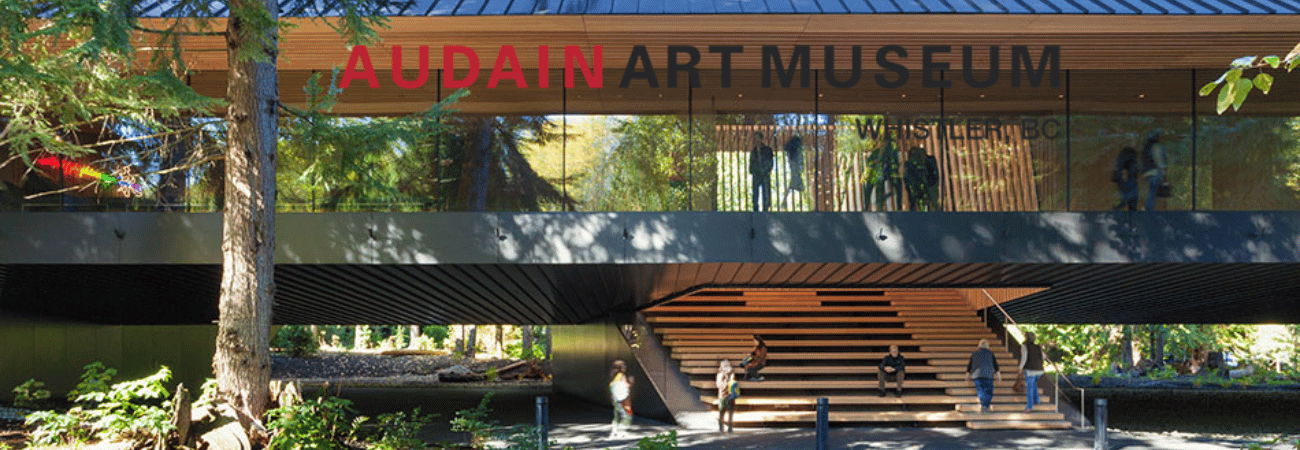
The Audain Art Museum opened to the public in March 2016, grounded in the vision and philanthropy of prominent art collector Michael Audain and his wife Yoshiko Karasawa. The idea for the museum began in 2012 when Audain chose a site in Whistler and entered into an agreement with the Resort Municipality of Whistler to build a dedicated space for his growing collection of British Columbia art. Construction began in 2013 on a 56,000-square-foot building deliberately crafted to blend with the forested alpine setting and accommodate Whistler’s heavy snowfall and floodplain conditions.
The museum was incorporated as a not-for-profit charitable organization in 2012 and achieved registered charity status in 2013, with its mandate to establish and maintain a permanent gallery for the benefit of British Columbia and Canada. Its Permanent Collection focuses on the art of the province from the late 18th century to the present, featuring one of the most comprehensive publicly accessible assemblages of works by Emily Carr, extensive Northwest Coast First Nations masks and carvings, and major pieces by post-war modernists and contemporary artists.
The original estimate for the Crazy Stair was $1.2 to $1.6 million, but during the 2012 auction its price rose dramatically in what was described as a lively bidding war. In total, eight Emily Carr pieces were sold during the Heffel fall auction.
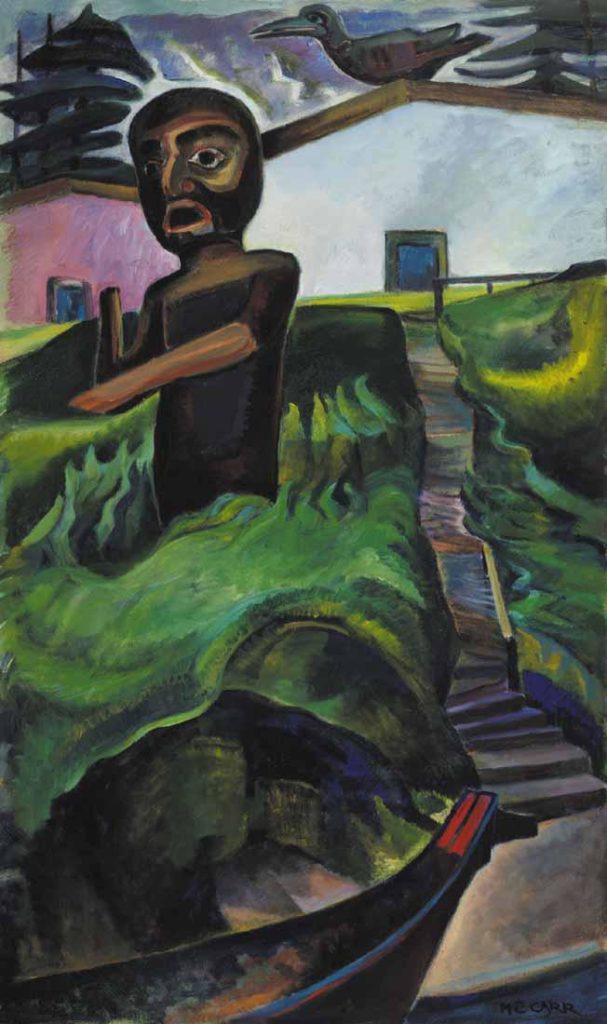
The Crazy Stair (originally known as The Crooked Staircase) is a striking oil on canvas painted in her mature period around 1928–1930, and it encapsulates many of the themes that define her engagement with the landscapes and cultures of British Columbia’s West Coast. The composition features a towering totem pole rising from a forested setting, with a canoe resting on a beach at the foot of a crooked, almost surreal stair‑like form, evoking both the physical presence and the spiritual resonance of Indigenous carvings within the landscape. Its vertical format and evocative imagery reflect Carr’s deep and lifelong engagement with First Nations culture and the powerful natural environment she sought to capture in her art.
Audain recalls first coming across this painting four decades ago at the Vancouver Club.
I did a double take, just to make sure that it was an Emily Carr, because I saw it in a fairly dark staircase,” he recalls. “I think it had a little light over it. I went ‘Oh, wow! Look at that! For forty years I had been admiring the picture where it hung in a dimly lit recess as one descended the staircase in that bastion of privilege known as the Vancouver Club. It had been donated in the 1950s by H.R. MacMillan, chairman of the forest products giant, MacMillan Bloedel Limited. Perhaps it was the power of the welcome figure emerging out of the landscape that intrigued me so, but over the years I could never leave the club without pausing for a minute to pay my respects to the painting. It was far and away the best painting in the club.
The feeling stayed with him. So when it went up for auction in 2013, he decided to try and keep it in British Columbia.
“I didn’t know who was bidding against me, but I knew there was much broader interest in Emily Carr these days,” said Audain. “When a very important painting comes up, who knows where it could end up? But I was particularly interested that it stay in British Columbia.”
The Audain Art Museum in Whistler, British Columbia, is a relatively new but significant cultural institution that opened to the public in March 2016, grounded in the vision and philanthropy of prominent art collector Michael Audain and his wife Yoshiko Karasawa. The idea for the museum began in 2012 when Audain chose a site in Whistler and entered into an agreement with the Resort Municipality of Whistler to build a dedicated space for his growing collection of British Columbia art. Construction began in 2013 on a 56,000-square-foot building deliberately crafted to blend with the forested alpine setting and accommodate Whistler’s heavy snowfall and floodplain conditions.
The museum was incorporated as a not-for-profit charitable organization in 2012 and achieved registered charity status in 2013, with its mandate to establish and maintain a permanent gallery for the benefit of British Columbia and Canada. Its Permanent Collection focuses on the art of the province from the late 18th century to the present, featuring one of the most comprehensive publicly accessible assemblages of works by Emily Carr, extensive Northwest Coast First Nations masks and carvings, and major pieces by post-war modernists and contemporary artists such as Jeff Wall, Gordon Smith, and Stan Douglas. Beyond its permanent holdings, the Audain Art Museum hosts dynamic temporary exhibitions that draw on national and international art. The institution is supported by the Audain Art Museum Foundation, which raises endowment funds to sustain its programming and operations.
The Crazy Stair now anchors the rotation of 15 – 20 Emily Carr paintings from their permanent collection on display at any one time.
In addition to his impressive Carr collection, Audain also collects First Nations art including masks over the years, as well as contemporary west coast art. Beyond its permanent holdings, the Audain Art Museum hosts dynamic temporary exhibitions that draw on national and international art. The institution is supported by the Audain Art Museum Foundation, which raises endowment funds to sustain its programming and operations.