Ethnology, Empire, and Emily Carr: The Story of Charles and William Newcombe

In the British Columbia Archives at Victoria are one hundred and twenty-three pictures by Emily Carr, in pen, pencil, charcoal, watercolour and oils. These formed part of the valuable collection of Indian art and natural history which belonged to the late William Arnold Newcombe, biologist, anthropologist and ethnologist of Victoria, who died suddenly in November 1960. His collection also embraced that of his father, Dr C. F. Newcombe, a noted expert on natural history and Indian art, who had been one of Emily Carr’s first patrons.
William Newcombe was unmarried and the Government of British Columbia purchased the Newcombe Collection from his Estate. In 1889 Dr Charles Frederick Newcombe, a distinguished English surgeon, psychiatrist, and scientist, settled in James’s Bay, Victoria’s oldest residential suburb. He was a man of high professional attainments and wide interests in the arts. He carried out important medical work for the British Columbia Government and was closely associated with John Fannin, the first curator of the Provincial Museum.
Dr Newcombe was also one of the founders of the Natural History Society of Victoria. In addition he developed a passionate interest in the art and culture of the aboriginal inhabitants of the British Columbia coast. During the next thirty-five years Dr Newcombe made countless journeys in his own open sailboat, launch, and even by canoe, to remote and almost unknown villages of the far north, in a ceaseless endeavour to save from destruction some of the great totem poles and other vanishing memorials of the Indians’ past.
He amassed an outstanding collection of the art forms of the Coast Indians for the provincial government, and some of the most impressive exhibits in leading anthropological collections on this continent and in Europe are the results of his labours. In James’s Bay, overlooking Beacon Hill Park, lived the family of Richard Carr. In the year that Dr Newcombe settled in Victoria Emily Carr, aged barely eighteen, overcame the family opposition and left Victoria to study at the San Francisco School of Art (now the University of California School of Fine Arts) where she remained for about five years.
Upon her return home she taught art for several years. In 1898 Emily visited friends at the Indian Mission at Ucluelet on the West Coast of Vancouver Island. She was deeply stirred by the Indians. Upon her first appearance among them she was accepted by the patriarch of the village who said she was fearless, “not stuck up,” and knew how to laugh. She visited them in their houses, and they named her Klee Wyck—Laughing One because her sense of fun bridged the language gap.
She brought home drawings and watercolour sketches of the Indians and their surroundings, Emily subsequently spent more than seven years at celebrated art schools in Europe, but her love and understanding of the Indians remained an abiding factor in her life, and in the development of her art.
Shortly after Emily’s return from five years of study in England, Arnold Watson of the Victoria newspaper The Week visited her studio. He was impressed by her work, but considered her Ucluelet sketches outstanding. The Week engaged her as their cartoonist, and her witty and original cartoons appeared regularly until she moved to Vancouver to teach in 1905.
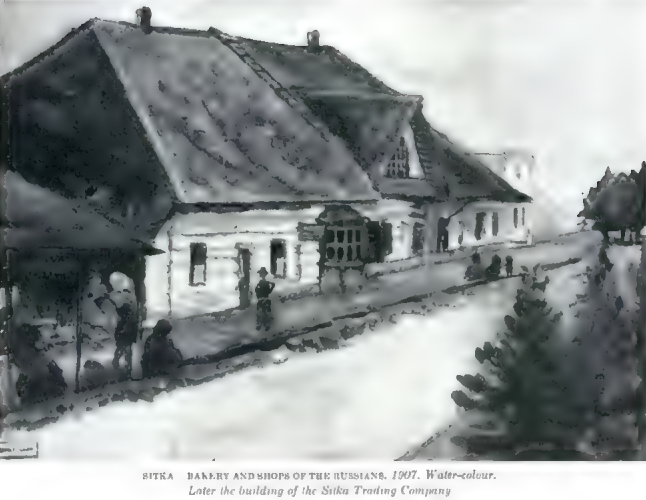
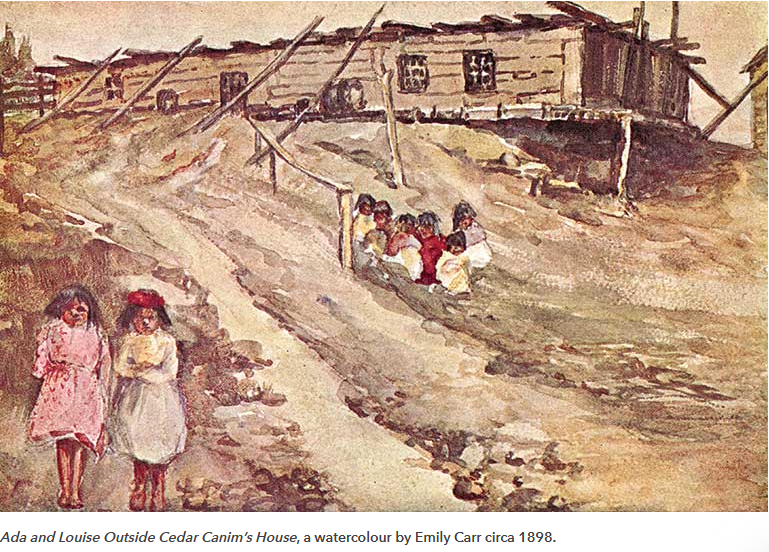
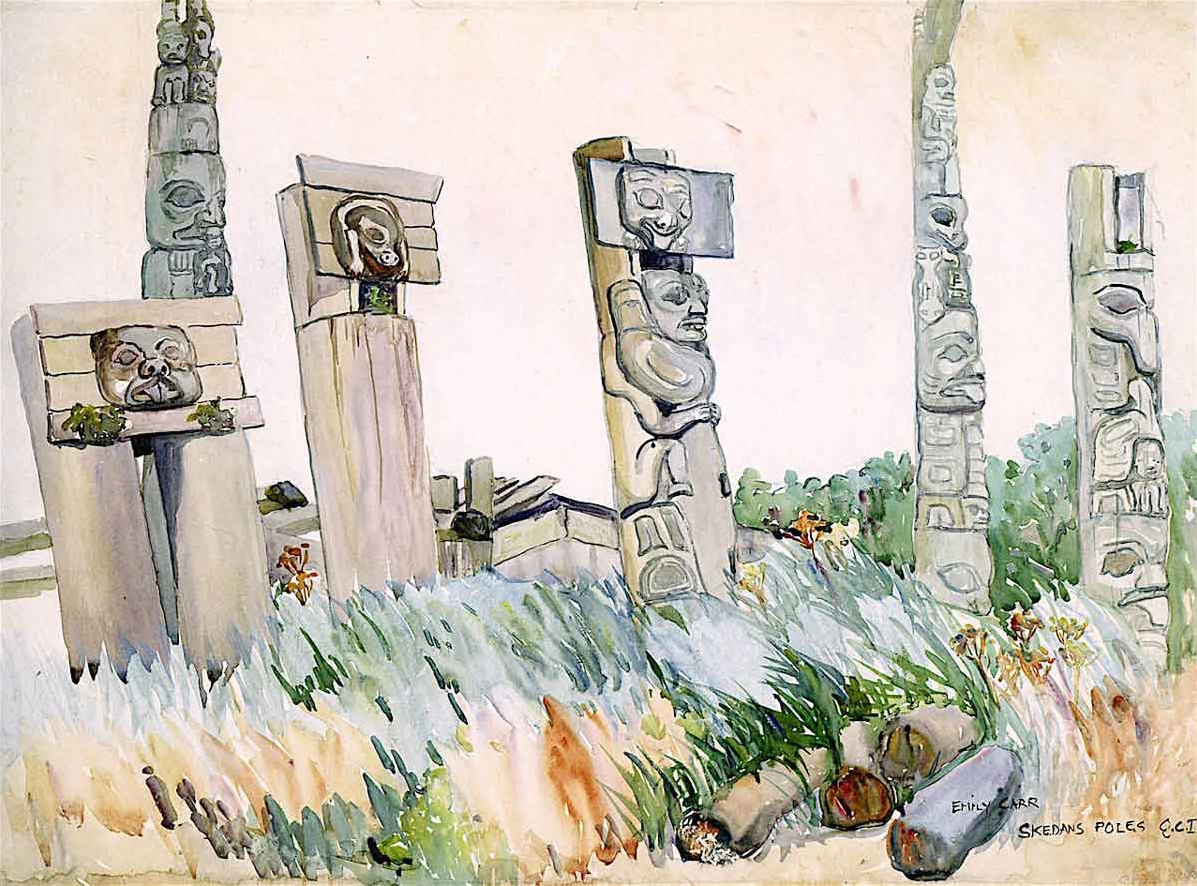
The following year she visited Sitka and the Yukon. On this journey Emily saw many Indian villages with their grand totem poles, their house posts and their unique painted house fronts. She realized that this art was doomed to disappear, and made up her mind to paint the poles in their own settings. She determined to make as complete a collection of them as possible, and every summer during the next four years she went north, going far off the beaten track of hotels and easy travel to reach unspoilt villages.
Through the advice of Dr Newcombe and a few other friends, and by her own indomitable determination, Emily travelled to the most remote areas, by gasboat or canoe, stage or wagon; she slept in mission houses, schoolhouses, lighthouses, Indian houses, or a tent, carrying her own food and bedding with her.
The sheer power and command of materials of the Indian art, combined with its deep underlying relationship to its surroundings, and its creators’ constant search “beneath the surface for the hidden thing which is felt rather than seen, the ‘reality’ which in fact underlies everything,” as Emily expressed it, inspired and liberated her creative energy. but she felt the need for broader technique and stronger handling.
In 1910 Emily went to France for eighteen months. The pure, brilliant colours of the Impressionists, and their new manner of painting in oils made a lasting impression upon her, and she approached her own paint- ing with fresh vision and power. Many of her finest historic canvases date from 1911 and 1912.
In 1913 she built her apartment house and studio in Victoria, and held an exhibition of her latest paintings which she called “the new way of seeing.” With very few exceptions Victorians were shocked and mystified by the powerful canvases. with their strong. vibrating colours and bold contours, but Dr Newcombe, an acknowledged authority on Indian art, bought eight or more of her pictures.
The First World War precipitated a financial collapse in Victoria, and the next hfteen years were a desert of struggle and frustration for Emily. She could not sell her pictures and was forced to earn a precarious living by running a combined apartment and boarding-house. breeding dogs, and making pottery and hooked rugs for sale. Except for occasional relaxation, she did not paint. My personal friendship with Emily began in 1925, after the death of my mother who was a close friend of Emily, and a great admirer of her work.
Art circles elsewhere knew nothing of Emily Carr, but Marius Barbeau, Director of the National Museum at Ottawa, heard of her paintings from his Tsimshian interpreter, He sought her out and in 1927 the Canadian National Gallery invited her to show sixty of her paintings at the Exhibition of Northwest Coast Art in Ottawa.
Emily went East for the show and met many of Canada’s foremost artists. They were enthusiastic about her work and she returned to Victoria inspired and reinvigorated by their encouragement. Emily wished to resume her northern painting trips but great changes had taken place in the intervening years.
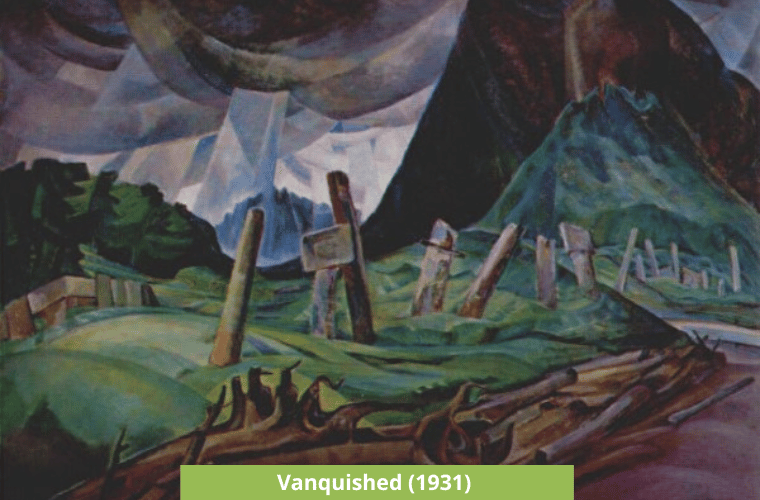
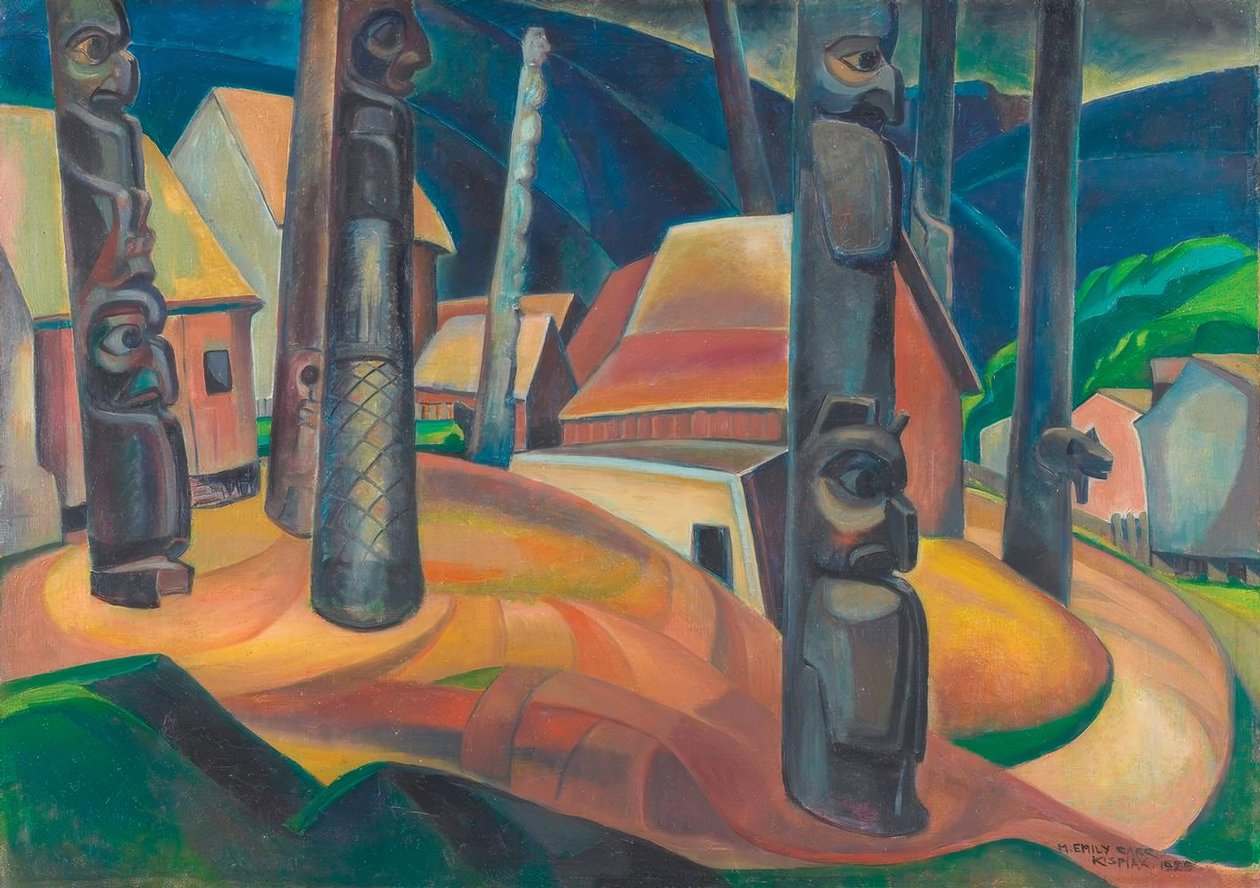
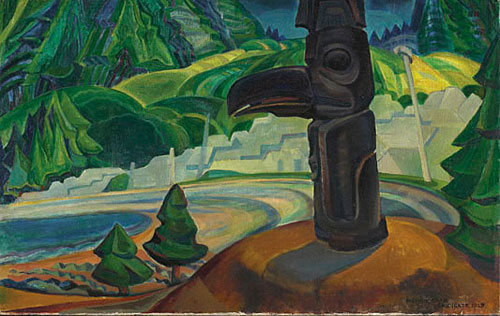
Many villages were deserted, their poles shattered and buried beneath a sea of undergrowth or dragged off to museums, Dr Newcombe lead but his second son, William, always called “Willie” by his family and old friends, came to her assistance.
Willie had inherited his father’s intense love of nature and his affection for the Indians, and from his carly teens had accompanied him on hazardous voyages up and down the coast. He had been educated at private schools and had a brilliant mind and great ability. but declined a scholarship, preferring the free. outdoor life and direct contact with nature.
He said:
My father was a recognized authority on natural history and marine history. He was also an author. I served as father’s roustabout, travelling with him, and while doing so, acquired ground work and background.”
As an expert on marine biology Willie was attached to the Department of Marine & Fisheries for some time before he joined the Provincial Museum in 1927 as assistant biologist. When Emily planned her great journey she used his father’s unique photographs, covering forty years, as a guide to important sites.
Emily was fifty-seven years old when she embarked upon the most prolific and dynamic period of her career. She penetrated to almost inaccessible villages on the Skeena and the Nass, and to the ruined sites on Queen Charlotte Islands. During these journeys she suffered greater physical hardships than she had encountered in the past. but nothing deterred her.The mosquitoes up the Nass River were beyond words or endurance, and Emily said that to try and concentrate on “significant form” or anything else was terrible as life was a torment every moment she was out of doors.
Going into Kitwancool, a village hostile and forbidden to white people, she had to wagon, piled high with lumber, on top of which she was forced to perch with three Indians. There was nothing to which she could hold on, she had to clasp her small ys of 1928-32 he gave her valuable information and loaned her griffon dog in her arms, and the road was so awful that at every moment she expected to be flung violently to the ground.
Wet to the skin, she sheltered in Indian graves from torrential thunderstorms lasting for hours, and spent incredible nights and days on Indian and Japanese fish boats in a wild Pacific storm. Some of her greatest canvases are the results of these journeys but her painting was again undergoing a change, She had outgrown the Indian subjects and turned to the wholly creative task of interpreting the majestic landscapes of the West.
About the same time Willie Newcombe resigned from the Museum and concentrated upon collecting and writing for scientific purposes, but he was always ready to help his friends in many ways. Suddenly, in January 1937, while preparing for the Coronation Exhibition at the Canadian National Gallery, Emily was stricken by an extremely severe health physical exertion was forbidden.
No visitors were permitted except her sister Alice, Willie Newcombe and myself, Acute financial worry and despair at the prospect of never being able to resume an active life jeopardized her recovery. Through my sister in the East I contacted the National Gallery, asking what could be done to ease the financial situation, The Gallery instructed Eric Newton, the noted English art critic who was visiting Western Canada, to select fifteen of Emily’s pictures for prospective purchasers in the East.
Willie met Newton on his arrival, showed him Emily’s pictures and took him to see her in hospital. Newton’s visit was the turning point in Emily’s recovery. Her convalescence was slow and her subsequent health precarious, but she was permitted to paint as long as no other physical exertion was involved /
Willie took over the framing, crating and shipping of Emily’s pictures for exhibitions and sale during the rest her attack She was rushed to hospital for long rest and quiet; all of her life: in the following eight years she showed at twenty-nine exhibitions in Europe and America. The telephone would ring: “Can you come to supper tonight? Willie is here, packing my pictures for Paris.” (It was the Exposition Internationale of 1937.)
Emily had a great capacity for friendship though she could be sharp if she considered people thoughtless, pretentious or hypocritical, She was a most exhilarating and amusing companion, witty and original under all circumstances. When she was recovering from a severe set-back on one occasion I took her some Okanagan peaches. When she saw them she said, “I could sit up in my coffin to eat a peach.”
It was never dull in her company, whether her mood was gay or serious. Shortly before she was taken ill Emily had sold her apartment house and rented a small cottage not far from her old home. Two years later she moved to Alice’s little schoolhouse on the Carr property, adding a small wing for herself and using the former schoolroom as her studio.
I was anxious about the effects of the move on Emily but she told me that although exceedingly tired, she had “sat up” well under the strain. Willie had taken complete charge of the pictures. She said he was like “a clucking hen,” and refused to move them until all the workmen had gone, as he had no faith in the possible activities of workmen.
Willie installed racks for her pictures, built an aviary for her “budgies” and a ramp so that she could be wheeled from the house to the street. During the last five years of her life Emily was frequently in hospital or nursing homes. It was war time; domestic help was almost unobtainable, but Willie was literally her right-hand man.
He put up blackout screens, looked after her fuel stocks and showed her pictures to special visitors. He also took under his wing her sister Alice who had become blind. He would never consider remuneration, but Emily no doubt persuaded him to accept some of her Indian work which was of special interest to him, and particularly her earlier work which portrayed Indian life half a century before, and her detailed studies of totem poles which would soon cease to exist.
In 1942, three years before her death, Emily formed the Emily Carr Trust Collection, whereby she bequeathed over 200 examples of her finest work to the Province of British Columbia as a permanent collection, and set aside another 500 pictures to be sold to provide funds for the encouragement of young British Columbian artists,
There was at that time no permanent picture gallery in Victoria, and Emily directed that the pictures should be exhibited in the Vancouver Art Gallery on certain conditions for exhibition and loans. She chose as her trustees Lawren Harris of the Group of Seven, who had inspired and encouraged her more than any other artist, Ira Dilworth, her literary executor, and Willie Newcombe, her long-time friend, tireless helper and invaluable guide in the interpretation of the deep esoteric meaning of Indian art, which was a stepping-stone to her own intense realization of the fundamental unity of all life.
Willie was not artistic in the narrow sense, but he recognized the truth and vitality of Emily’s painting, its great value as a historical record, and her profound sense of the spiritual and symbolic qualities underlying Indian art. His knowledge of the Indian languages, legends and religious beliefs enriched her understanding of their art.
Although entirely different in temperament, Emily and Willie shared many kindred tastes and characteristics, including the love of animals and nature in all its forms. In fact they were both great naturalists in the truest sense. Both were too individualistic to reach their true development through conventional and academic means, but both became masters in their chosen fields.
The Newcombe collections held at BC Archives consists of over 1400 pieces of Indigenous art. Most of the items came with detailed documentation almost as valuable and informative as the objects themselves.
“Emily Carr and the Newcombe Collection”
by Flora Hamilton Burns
The Beaver, Summer 1962 issue
The Newcombe collection held at BC Archives consists of over 1400 pieces of Indigenous art. Most of the items came with detailed documentation almost as valuable and informative as the objects themselves.