
Emily Carr at Home: The Story Behind Carr House
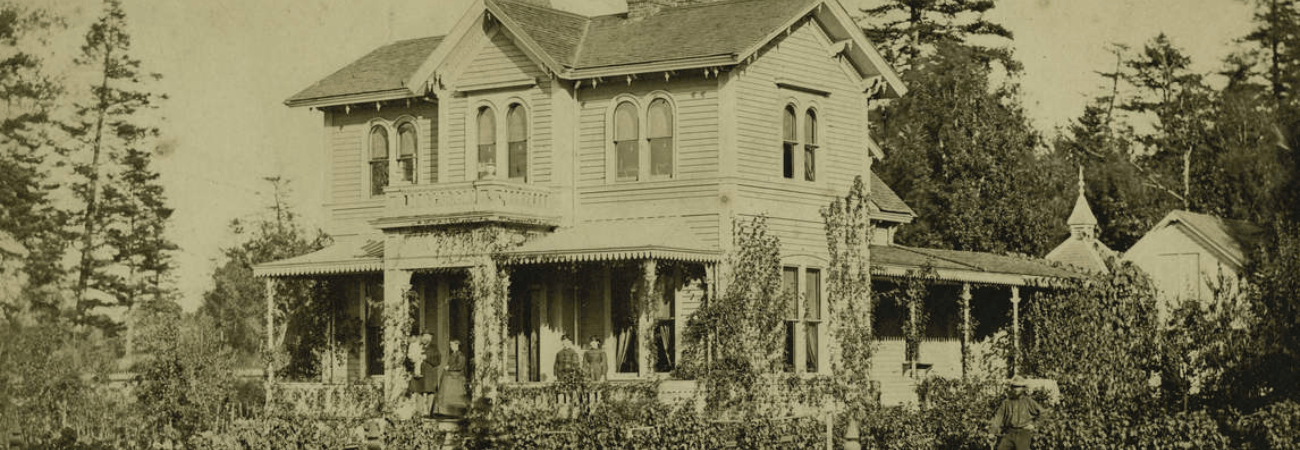
Carr House, at 207 Government Street was built in 1863–64 for Richard and Emily Saunders Carr in James Bay. Designed in an Italianate Picturesque‑villa style by Wright & Sanders, it sat on four 1/2 acres in James Bay, then a fashionable neighbourhood in Victoria. The original address of the house was 44 Carr Street when Richard donated land to widen the road in front of his estate allowing two carriages to pass side-by-side on what had been a narrow dirt lane. By the late 1860s, Carr Street officially became part of Government Street, effectively erasing the original Carr name.
When Emily was born, in 1871 Victoria’s settler population was approximately 3,270, while the Indigenous population—primarily members of what is now the Songhees Nation—was estimated at 300 to 400 permanent residents. Victoria was a bustling colonial capital on the southern tip of Vancouver Island, having become BC’s capital just three years earlier. That same year, British Columbia joined Confederation, marking a pivotal moment in both provincial and national history.
James Bay, Victoria’s oldest neighborhood, once a Songhees village, had developed into an elegant residential area for the city’s British elite, due to its proximity to the Inner Harbour and recently built government buildings. Tree-lined streets, large private estates, and Victorian-era homes gave the area a genteel charm that matched colonial sensibilities. It was in this setting, amid a blend of wilderness and refinement, that the Carr family established their home.
Emily spent her early years here among its English‑style gardens, vegetable plots and early indoor plumbing—elements she vividly recalls in her memoir The Book of Small. It was her primary residence from 1871 until she moved to Vancouver in 1906 to become an art teacher, first for society ladies that didn’t work out so well and then for children that did work out well for her. The years she held art classes for children in Vancouver were the high point of her financial success. It was during these years that she became actively involved in Vancouver’s artists communities. She was a founding member of the BC Society of Fine Arts founded by John Kyle and Thomas Fripp in 1909.
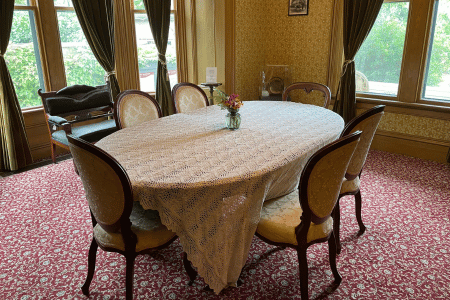
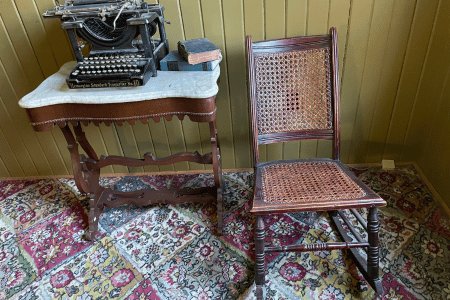
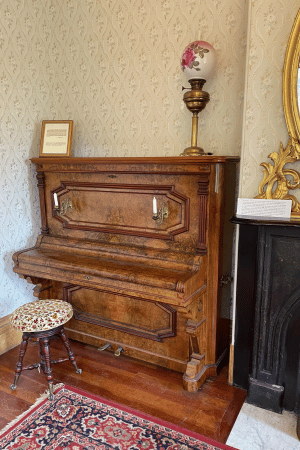
In addition to her parents, Emily had five siblings: four older sisters, Edith, Clara (both born in California), Elizabeth and Alice, and one younger brother, Richard, who died at 24 in a sanitarium in California of tuberculosis., the same illness as their mother
After Richard’s death in 1888, the estate was subdivided by Emily’s sisters, and each of the surviving children inherited a plot of land.
The house remained in family hands until the 1930s. Following a fire in 1938 it passed into private rental, deteriorating significantly. In 1964, Victoria MP David Groos stepped in, mortgaging his home to save Carr House from demolition. He transferred it to the Emily Carr Foundation in 1967; by 1976 the province purchased and restored it to its original condition, reversing later alterations
Today, the house operates as a National Historic Site and interpretive center, featuring heritage‑period furnishings, rotating exhibitions, educational programming, gardens and tours celebrating Carr’s legacy and her influence on Canadian art, feminism, Indigenous awareness and environmentalism
Character-Defining Elements
The key elements relating to the heritage value of this site include: the relationship between the house, Beacon Hill Park and the shoreline; the placement of the house on the property and the historical relationship between house and garden landscape; the Picturesque Italianate treatment of a two-storey, three-bay house form, with its projecting central bay with balconied entrance, ground floor verandah, round-headed paired windows on the upper storey, roof finials and decorative wooden trim, and paired brick chimneys.
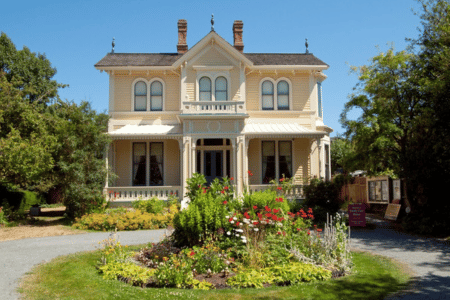
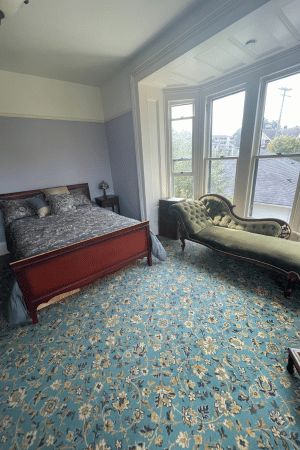
The surviving original interior plan, including the upstairs bedrooms, in particular the one in which Emily Carr was born; any surviving historic woodwork, wall finishes and detailing in the restoration date from the time of the Carr family’s residency from 1864 to 1937.
Here are some of Emily’s own words, drawn from her writings primarily fron The Book of Small (1942) about what Carr House meant to her and how she felt growing up there, and her family relations:
On how she felt about the house and its setting:
As far back as I can remember Father’s place was all made and in order. The house was large and well‑built, of California redwood, the garden prim and carefully tended. Everything about it was extremely English. It was as though Father had buried a tremendous homesickness in this new soil and it had rooted and sprung up English. There were hawthorn hedges, primrose banks and cow pastures with shrubberies….”
On Carr Street and surroundings:
Our street was called Carr Street after my Father. We had a very nice house and a lovely garden… Carr Street was a very fine street. The dirt road waved up and down and in and out. the horses made it that way, zigzagging the carts and carriages through it. The rest of the street was green grass and wild roses. …In front of our place Father had made a gravel walk but after our trees stopped there were just two planks to walk on…
On her mother:
Our childhood was ruled by Father’s unbendable iron will, the obeying of which would have been intolerable but for Mother’s patient polishing of its dull metal so that it shone and reflected the beauty of orderliness that was in all Father’s ways, a beauty you had to admire, for, in spite of Father’s severity and his overbearing omnipotence, you had to admit the justice even in his dictatorial bluster.
On her father:
From “Head of the Family”: “I am sure our childhood could not have been comprehended any human, a more Almighty being on earth, than was my Father. His word was absolute. He was stern but we reverenced him more for that.”
On her siblings, especially in the context of loss:
While many of her siblings died in infancy, she had four older sisters and a younger brother Richard (Dick). Only Dick lived past childhood but died young at the age of 24 at a tuberculosis sanitarium in San Francisco. Emily had just arrived in London to attend art school when she heard the news of his death Emily’s relations with her sisters carried both affection and strains—Emily felt sometimes out of step with them in terms of her ambitions, personality and artistic leanings.
Recollections of her childhood spent at Carr House:
From her descriptions, several themes appear in how she felt about Carr House and her upbringing:
Deep love & beauty
She remembers the house, garden, surroundings with affection, particularly their ordered beauty (gardens, shrubs, flowers, lawns), and how the house embodied English traditions transplanted to BC. The natural world—orchards, farmyard, proximity to pastureland, Beacon Hill Park—is vivid in her memories and seems foundational to her sensibilities. (Her painter’s eye was attuned from early childhood to natural textures, colors, plants.)
Strictness & discipline
Her father was an authoritarian, with strong expectation of obedience; mother acted as an intermediary, softening things, but still within a strict framework. Emily’s childhood was structured, with daily routines, religious practices, formal expectations. Emily often felt constrained by that, especially as her artistic impulses emerged.
Loss and responsibility
The deaths of her mother (when Emily was twelve) and later her father (when she was about 17) shifted responsibilities. Her oldest sister, Edith (“the Elder”) took on much control of the household after their deaths. Emily sometimes felt stifled Edith (who she sometimes refers to as “The Kaiser”), though also clearly recognized Edith’s strength.
Duality: comfort vs longing / constraint vs freedom
The home was a place of comfort, safety, rootedness, and beauty—but also of restriction. Emily’s memories show longing: for greater freedom, for the wild, for expression. One sees in her recollections how her childhood environment both grounded her and, in its rigidity, spurred her to push beyond its bounds.
Brother Richard (Dick) & sibling relationships
Of Emily’s four brothers, only Richard (“Dick”) survived infancy. The Carrs lost two sons at infanncy in San Francisco and another when they first arrived in Victoria. This loss had emotional weight on Emily.
The elder sisters (especially Edith) were responsible in the household, especially after parents’ deaths. They enforced aspects of the family’s moral and domestic regime. Emily sometimes felt that her sisters were less supportive of her artistic ambitions. For example, her sisters “disliked my new work intensely” she wrote in her autobiography decades later.
No doubt Alice was her favourite sister. They travelled to Alaska together in 1907 and to France in 1910. Emily spent the last four years of her life living with Alice in her small cottage behind the Carr House. In the last year of her life in 1953, Alice commissioned the Emily Carr Memorial Footbridge in Beacon Hill Park, Emily’s favourite place to paint.


0 comments