
Before the Totems: Emily & Alice in Alaska 1907
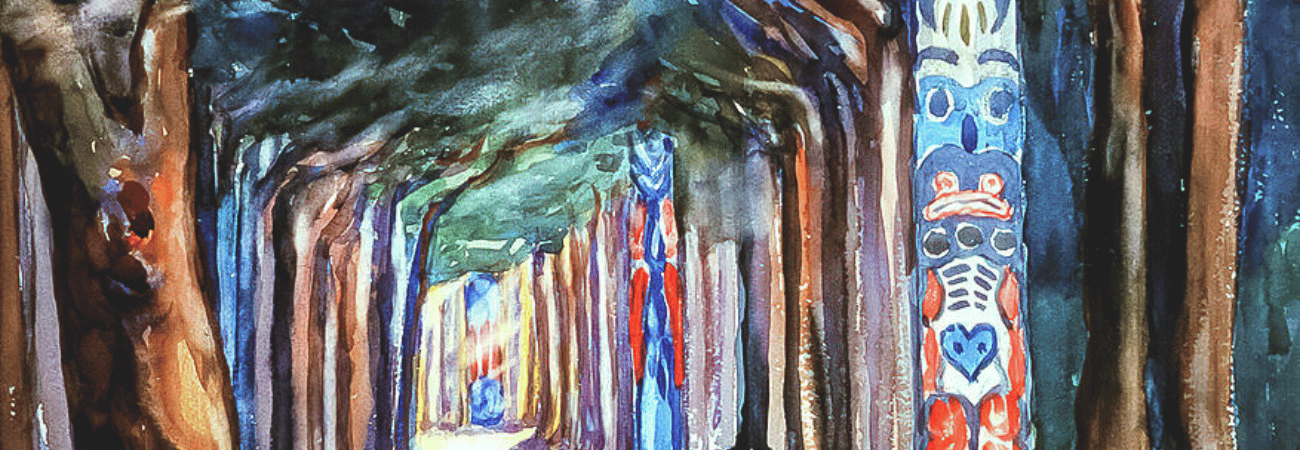
In the summer of 1907, Emily Carr and her sister Alice set out on an adventurous three week holiday to Alaska—a journey that would have a major impact on Emily’s life and art. The pair left from Seattle on August 18th, 1907, on the cruise ship ‘S.S. Princess Royal’ This would be Carr’s first direct encounter with the Indigenous villages of the Northwest Coast, and it played a formative role in the development of her artistic identity.
At the time, Emily was 35 and had recently returned to Victoria after art training in England (1899–1904). She was eager to find subject matter that was authentically Canadian and deeply expressive. The Alaska trip was motivated in part by curiosity and in part by a growing interest in Indigenous art and culture. Alaska was then a popular tourist destination, and the steamship cruises up the Inside Passage were popular among middle- and upper-class travelers from the U.S. and Canada.
Upon docking at Sitka on Baranof Island, Emily and Alice spent a week exploring Alert Bay, Skagway, Juneau, It was in the historic coastal town of Sitka where she first encountered a collection of totem poles that had been relocated from surrounding villages. In Sitka National Historical Park (then called Indian River Park), the U.S. government had gathered totem poles from nearby villages like Tongass, Klukwan, and Klawock as part of a federal preservation effort in the early 1900s. These poles were restored and re-erected in parkland for display. One watercolor, titled Totem Walk at Sitka (1907), reflects her reverence and marks the moment she committed to documenting totem poles across coastal B.C.
Emily was deeply moved by what she saw—especially by the art and its spiritual power—and distressed by what she perceived as the vanishing of Indigenous cultures under colonial influence. This trip planted the seeds of a long-standing commitment in her work to record and respond to the monumental art forms of the Indigenous peoples of the Pacific Northwest.
Although these poles were already removed from their original cultural contexts, seeing them standing outdoors in a natural setting was far more impactful to Carr than viewing Indigenous art in museums or books. The poles in Sitka were carved by Tlingit and Haida artists—massive cedar monuments that commemorated family lineage, clan crests, oral histories, and ancestral events. Some poles featured Raven, Bear, Eagle, and Frog figures; others were mortuary poles, house front poles, or memorial poles.
For Carr, these were monumental, spiritual, and alive—vastly different from the Western art traditions she had been trained in. She was struck by the emotional weight and spiritual energy of the carvings, their interconnectedness with land and story, and their bold abstraction and expressive form.
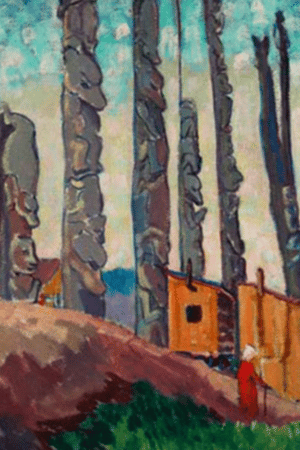
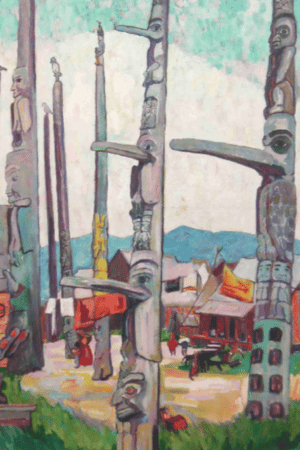
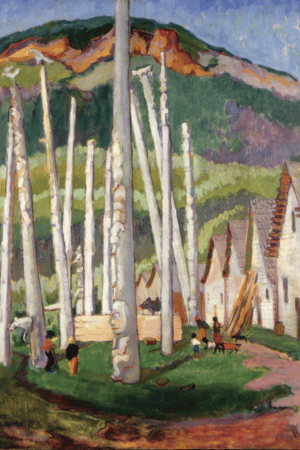
Soon after the Alaska trip, Carr traveled to Skidegate and Cumshewa on Haida Gwaii, and then to Alert Bay, Cape Mudge, and other Kwakwaka’wakw and Coast Salish communities in subsequent years. She began painting Indigenous villages and totem poles, not as ethnographic records but as artistic interpretations. The Alaska cruise was her gateway into this phase of her practice, which would define much of her early work before her exposure to modernist movements in France in 1910–1911.
Emily later reflected on the Alaska trip as a pivotal event—her first real encounter with the subjects that would shape her most meaningful work. While some of her early paintings of totem poles are now critiqued for their colonial gaze, they were also part of a sincere artistic and spiritual search. She regarded the Indigenous art she saw as profound and powerful—and sought ways to express that depth in her own voice.
Decades later, she would write in her autobiography Growing Pains:
Whenever I could afford it I went up North, among the Indians and the woods, and forgot all about everything in the joy of those lonely, wonderful places. I decided to try and make as good a representative collection of those old villages and wonderful totem poles as I could, for the love of the people, and the love of the places, and the love of the art.
For Carr, these were monumental, spiritual, and alive—vastly different from the Western art traditions she had been trained in. She was struck by the emotional weight and spiritual energy of the carvings, their interconnectedness with land and story, and their bold abstraction and expressive form.
Indian Art broadened my seeing, loosened the formal tightness I had learned in England’s schools. Its bigness and stark reality baffled my white man’s understanding… I had been schooled to see outsides only, not struggle to pierce.
Her early watercolours and sketches from 1907 and 1908 show detailed but interpretive views of poles she saw in both Alaska and later in Haida Gwaii. Works like Totem Walk at Sitka (c. 1907) and Skidegate (1908) are direct outcomes of this first trip.
From that point on, Carr was obsessed with totem poles—not as ethnographic artifacts, but as living art forms. While she didn’t fully grasp the ceremonial or cultural meanings behind them at that time, she approached them as an artist—interpreting their forms, expressing their presence, and eventually transforming them into a modernist visual language after her return from France in 1911. Motivated by a deepening interest in Indigenous art forms, Carr undertook a study of the symbolic meanings embedded in individual totem poles, culminating in the delivery of her first public lecture, Lecture on Totems, at Dominion Hall in Vancouver in 1913.
Emily Carr viewed totem poles with deep reverence and fascination, recognizing them as profound expressions of Indigenous spirituality, culture, and artistic achievement. She believed the poles were not merely decorative or historical artifacts but living symbols of a rich, complex worldview that had been long misunderstood and dismissed by settler society.
In her writings, Carr lamented the destruction and neglect of these monumental carvings and sought to preserve their essence through her art and lectures. She was especially moved by their connection to the land and the spiritual beliefs of the communities who created them, seeing in them a raw, authentic power that deeply influenced her own artistic development.


0 comments