Sister and I in Alaska: An Illustrated Journal of Their Trip in 1907
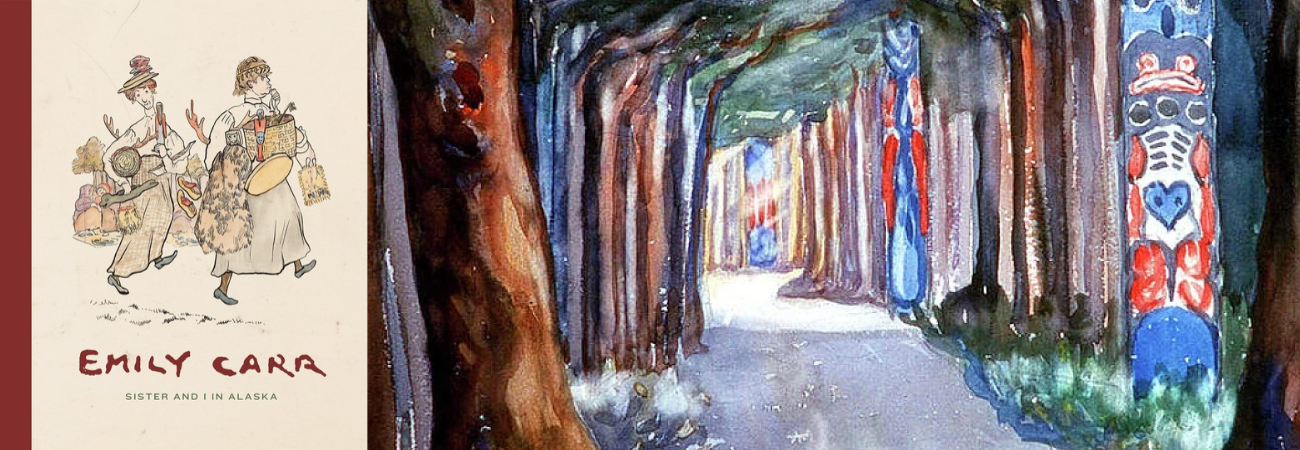
Emily Carr was a lifelong journal keeper, turning to her notebooks to record her observations, experiences, thoughts and feelings about the world around her. Writing was as important to her as painting, providing an outlet for her sharp observations, restless imagination, irreverent humour and deeply personal reflections. Her journals offer an intimate record of her life, revealing not only the development of an artist but also the personality of a woman who was curious, outspoken, unconventional and often very funny. They allow us to hear Carr’s own voice, unfiltered by the interpretations of others.
Among the most delightful examples of her journal writing are three illustrated volumes she affectionately called her Funny Books. Created for the amusement of family and friends, these little books combine watercolour illustrations with witty, often mischievous commentary about the people, places and adventures she encountered. They reveal a side of Carr that is sometimes overshadowed by her reputation as a serious and determined artist: her playful spirit, keen eye for human eccentricities and talent for storytelling.
The three journals are also wonderful examples of how naturally she moved between words and pictures, using both to capture the world with humour and affection. The first, Sister and I in Alaska, recounts an adventure with her sister Alice in 1907 and offers a particularly charming introduction to Emily Carr, the journal keeper, illustrator and raconteur.
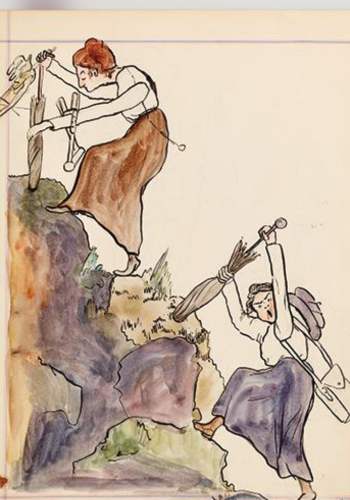
“Sister and I in Alaska” is an illustrated, humorous, one-hundred-page, and charming account of Carr’s trip to Alaska in 1907 with her sister, Alice, for whom the diary was made and to whom she dedicated and gave it. The illustrations themselves are particularly delightful because Carr signed some of them “SPUDZ,” one of her pseudonyms.
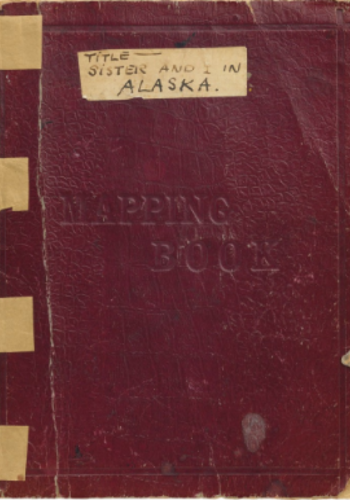
The forty-seven full-page watercolours, still fresh and bright, are accompanied by Carr’s saucy comments about people, animals, ships, and hotels. The original manuscript contained approximately 100 pages, with diary entries :on the left-hand pages and colourful watercolours on the right. Carr gave it the title Sister and I in Alaska: An Illustrated Diary of a Trip to Alert Bay, Skagway, Juneau, and Sitka in 1907 and she gave Alice as a gift.
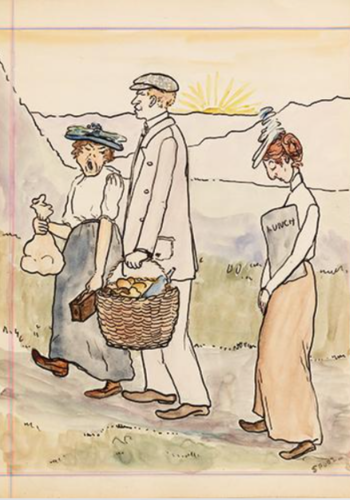
What began as a holiday took Emily and Alice aboard the steamship in August 18, 1907, tourist voyage that included a stop at Alert Bay, Skagway, Juneau and several other destinations in Alaska during the three week trip. Carr’s diary was far removed from a conventional travel journal. She made herself and Alice characters in an entertaining narrative, filled with comic observations, playful language and amusing descriptions of their fellow travellers.
When Emily Carr and her sister Alice travelled to Alaska in the summer of 1907, the territory was still experiencing the after-effects of one of the great gold rushes in North American history. The Klondike Gold Rush of 1897–98 had brought thousands of prospectors north through the coastal ports of Skagway and Dyea, transforming small settlements into bustling, sometimes rough-and-ready communities.
Although the initial rush for gold had subsided, mining continued, and Alaska was developing new industries in fishing, salmon canning and trade. It was also becoming an increasingly popular destination for tourists. Steamship companies promoted excursions along the spectacular Inside Passage, offering passengers opportunities to see glaciers, mountain scenery, coastal forests, historic mining towns and Indigenous villages. Alaska was still a U.S. territory, not yet a state, and for travellers from British Columbia, a cruise north was an exciting opportunity to explore a relatively unfamiliar part of the Pacific Northwest.
Part of the charm and humour of Sister and I in Alaska lies in Carr’s wonderfully distinctive approach to writing. Her handwriting is carefully printed rather than written in conventional cursive, giving the pages the appearance of a child’s illustrated storybook. Her spelling is often delightfully unconventional, with words misspelled, invented or playfully adapted to suit her purposes.
Emily seems unconcerned with grammatical rules or conventional spelling, preferring instead to capture the sound of a word, the rhythm of a conversation or the absurdity of a situation. Her made-up words, phonetic spellings and exuberant descriptions give the narrative an almost childlike spontaneity. Rather than detracting from the story, these quirks add enormously to its personality and comic effect. We can almost hear Carr’s voice as she recounts the sisters’ adventures, poking fun at themselves and the people they encounter along the way.
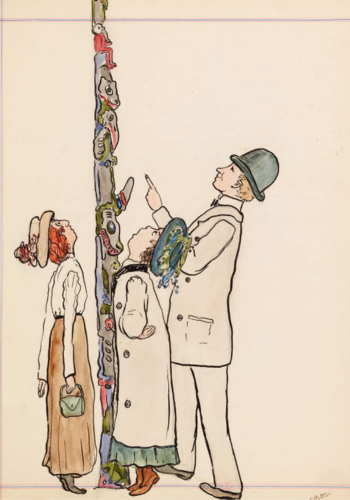
For Emily and Alice, the journey was intended primarily as a holiday and an adventure together. Emily was then living and teaching in Vancouver, having returned to British Columbia after several years of art study in England. Neither sister could have anticipated how profoundly the experience would influence Emily’s artistic direction. Their visit to Sitka, in particular, introduced her to the monumental Tlingit totem poles in their village and park settings.
What began as a sightseeing holiday became a turning point in her life, inspiring her determination to travel throughout coastal British Columbia to paint and document Indigenous villages and their monumental carvings.
Sister and I in Alaska Publishing History
The story of how Sister and I in Alaska finally reached readers is almost as remarkable as the diary itself. Although Emily Carr created it in 1907 as a personal gift for her sister Alice, the little volume remained unpublished during her lifetime and was eventually thought to have been lost. It resurfaced more than half a century later when a few pages were photographed for the Victoria Times-Colonist in 1958, but then disappeared from public view.
In an extraordinary discovery, the original burgundy-covered diary turned up in an attic in 2012. Its rediscovery attracted considerable interest among Carr scholars and art historians, particularly because the original illustrations had remained remarkably fresh and had never been exhibited.
Art collector and publisher David P. Silcox was responsible for bringing the diary to publication. He first encountered it in 2011 while visiting the family of Ruth and Tom Daly in Montreal, who had inherited the volume. Recognizing its historical and artistic importance, he arranged for its publication with the family’s permission. Working with the original, he prepared an edition that would allow readers to appreciate Carr’s handwritten narrative and reproduce her colourful watercolours as faithfully as possible.
Silcox also wrote the introduction, providing historical context for the journey and explaining the diary’s significance in Carr’s artistic development. A limited, slip-cased facsimile edition appeared in 2013 and sold out in less than 48 hours. A more widely available hardcover trade edition followed in 2014, published by Vancouver’s Figure 1 Publishing under the title Sister and I in Alaska: An Illustrated Diary of a Trip to Alert Bay, Skagway, Juneau, and Sitka in 1907. The book was an immediate success, attracting considerable attention in Canada and abroad and requiring additional printings. Happily, more than a decade after its publication, it remains in Figure 1 Publishing’s catalogue, allowing new generations of readers to discover this delightful and previously unknown side of Emily Carr.