Beyond the Forest: Emily Carr, Japanese Woodblock Prints and the Art of Seeing
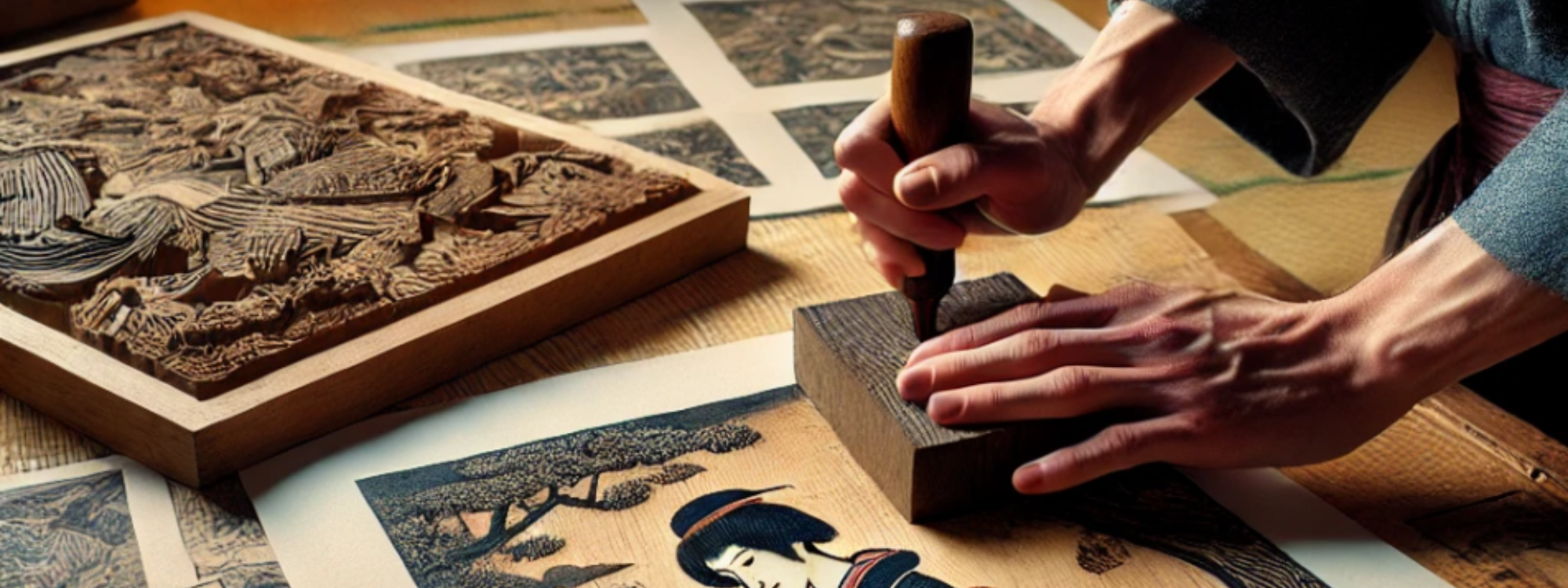
Emily Carr’s art was deeply rooted in the landscapes, forests, and Indigenous cultures of British Columbia, yet her artistic language was shaped by ideas that reached far beyond Canada. Among these influences was the art of Japanese woodblock printing. Japanese woodblock prints offered Carr a new way of thinking about nature, composition, colour, and the relationship between humans and the landscape. Although Carr did not simply imitate Japanese prints, she absorbed aspects of their visual approach and transformed them into something distinctly her own.
Japanese woodblock printing, particularly the ukiyo-e tradition, had already had a major impact on European and North American artists by the time Carr was developing her mature style. Artists such as Hokusai and Hiroshige demonstrated that a landscape did not have to be represented as a realistic, carefully measured scene. Instead, it could be simplified, flattened, cropped, and organized through powerful shapes and areas of colour. This approach offered Carr possibilities for expressing the spiritual and emotional qualities of the British Columbia landscape.
Simplification
One of the most important lessons Carr could draw from Japanese art was the idea of simplification. Japanese woodblock artists often reduced complicated scenes into a limited number of strong forms. A mountain might become a large triangular shape; a tree could be represented through sweeping branches and a dark mass of foliage; water might be expressed through a few rhythmic lines. Rather than recording every detail, the artist selected the elements that were most important to the overall feeling of the scene.
This idea became particularly important in Carr’s paintings of the West Coast. When she painted forests, she did not simply reproduce individual trees as a botanical study. Instead, trees became expressive forms. Their trunks could bend and rise dramatically, while branches and foliage could create sweeping movements across the picture. The forest became something alive and almost spiritual. This way of organizing nature into powerful shapes has similarities to the visual economy found in Japanese prints.
Composition
Another important influence was composition. Traditional Western painting often emphasized a balanced, central viewpoint, but Japanese woodblock prints frequently used unusual viewpoints and asymmetrical arrangements. An object might be cut off by the edge of the image, while a large empty area could be deliberately left in the composition. The viewer might see a landscape from an unexpected angle rather than from a conventional central viewpoint.
These techniques can be connected to Carr’s own experiments with composition. She frequently allowed trees to dominate her paintings, sometimes bringing them close to the viewer so that they almost seem to extend beyond the boundaries of the canvas. Instead of presenting a landscape as a distant postcard-like view, Carr made the viewer feel surrounded by it. The forest becomes immediate, powerful, and immersive.
Flat Areas of Colour
The Japanese woodblock tradition also demonstrated the artistic power of flat areas of colour. In many prints, colour does not gradually model objects in the same way as traditional European oil painting. Instead, broad areas of blue, green, red, brown, or grey can create a visual structure. Lines and shapes work together to communicate form without requiring realistic shading.
Carr increasingly developed a similar interest in colour as an expressive force. Her later paintings contain strong greens, blues, greys, and earthy colours that are not simply attempts to reproduce what the eye sees. Colour becomes a way of communicating atmosphere and movement. Her forests can appear to breathe, bend, and rise through the landscape.
Lines Depict Movement
Japanese prints also influenced Western modernism more generally through their use of line. In woodblock printing, the carved wooden block could produce strong outlines and controlled marks. Lines could describe the movement of branches, waves, mountains, buildings, or human figures. The resulting images often possessed a clarity and rhythm that differed from European academic painting.
Carr’s own paintings increasingly relied on energetic lines and rhythmic shapes. In her forest paintings, trunks and branches often create vertical, diagonal, and curving movements. These lines guide the viewer’s eye through the painting. Rather than being merely descriptive, they become expressive. The trees appear to have movement and personality.
The connection becomes especially interesting when considering Carr’s relationship with the Pacific Northwest. Japanese artists had developed a sophisticated visual tradition for representing forests, mountains, water, mist, and changing weather. Carr was working with a completely different environment, but she was similarly interested in the idea that landscape could express something beyond physical appearance.
For Carr, the forests of British Columbia were not simply collections of trees. They represented a deeper relationship between nature, spirituality, and place. She often experienced the landscape as something powerful and living. Japanese artistic principles gave her another visual vocabulary through which she could explore that relationship.
Japonisme Influence on Western Conventions
The influence can also be seen in Carr’s willingness to move away from strict European realism. Her early training had exposed her to European traditions of painting, but she gradually searched for a more personal artistic language. Japanese art was part of the larger international movement that encouraged artists to reconsider established Western conventions.
This was particularly important during the late nineteenth and early twentieth centuries, when European and North American artists encountered Japanese prints in increasing numbers. The phenomenon known as Japonisme influenced artists through unusual perspectives, flattened forms, asymmetrical compositions, decorative patterns, and bold colour. Carr developed her own style within this broader modernist environment.
However, it would be misleading to say that Japanese woodblock prints simply determined Carr’s style. Her art developed from many different experiences and influences. Her encounters with Indigenous art and cultures of British Columbia were enormously important, as were European modernism, Post-Impressionism, her travels, and her direct experience of the West Coast landscape.
What makes the Japanese influence significant is that it helped provide Carr with a different way of seeing. The techniques of Japanese woodblock art encouraged artists to consider what could be removed from an image as well as what could be included. Carr similarly learned to move beyond literal representation. She could simplify a forest, exaggerate its movement, intensify its colours, and transform it into an emotional experience.
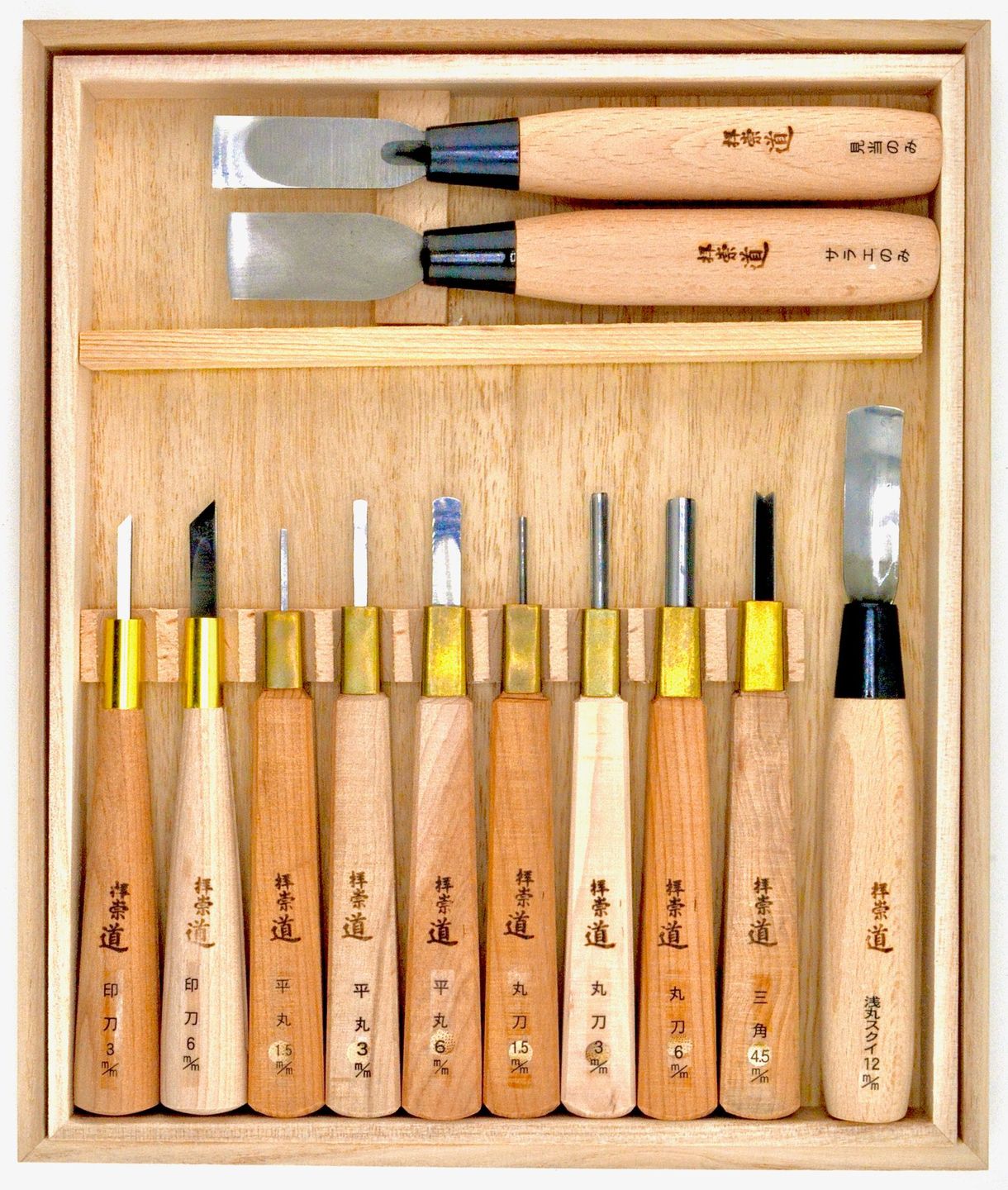
The physical process of woodblock printing also offers an interesting comparison with Carr’s methods. A woodblock print is created through a process of reduction. The artist carves away parts of the block, leaving raised areas that receive ink. Multiple blocks or carefully registered colour layers can then build the final image. This process encourages clarity, planning, and an understanding of the relationship between positive and negative space.
Carr did not work as a Japanese woodblock printmaker, but the visual principles of the medium could still inform her painting. Her compositions often demonstrate a similar awareness of large shapes, empty spaces, strong contours, and carefully organized colour. The result is a painting that can feel almost constructed from interlocking visual forms.
One of the clearest similarities is Carr’s treatment of negative space. In Japanese prints, empty areas are not necessarily unfinished portions of the image. They can create silence, distance, atmosphere, or emphasis. Carr also used open areas and simplified backgrounds to make the major forms of her paintings more powerful.
Her trees, for example, can stand against simplified backgrounds rather than being surrounded by endless realistic detail. This allows the viewer to concentrate on the movement and character of the trees themselves. The forest becomes both a physical environment and an emotional presence.
Carr’s interest in Indigenous subjects also makes this question more complex. She collected and studied Indigenous objects and incorporated Indigenous imagery and experiences into her artistic development, though modern scholarship also emphasizes the colonial context of her encounters and the need to distinguish her artistic interpretations from Indigenous perspectives themselves. Her paintings therefore exist within a complicated meeting of cultures: European artistic traditions, Japanese-inspired modernist ideas, and the Indigenous and natural worlds of British Columbia.
Ultimately, the influence of Japanese woodblock art on Emily Carr can be understood less as direct copying and more as an influence on artistic vision. Japanese prints demonstrated that landscape could be simplified without losing meaning, that unusual composition could create emotional power, and that colour and line could communicate more than literal appearance.
Carr took these possibilities and adapted them to her own environment. Instead of Japanese mountains, rivers, and trees, she painted the immense forests of British Columbia. Instead of reproducing the techniques of ukiyo-e, she transformed ideas about composition, line, colour, and simplification through modern painting. Her trees became sweeping, expressive forms; her forests became spaces of movement and spiritual energy; and her landscapes moved increasingly away from straightforward representation.
In this sense, Japanese woodblock art helped contribute to Carr’s transformation from a painter who recorded landscapes into an artist who interpreted them. The influence was not about making British Columbia look Japanese. It was about discovering that a landscape could be reorganized through shape, colour, rhythm, and space to reveal an inner character.
Emily Carr ultimately created a distinctly Canadian and West Coast artistic language. Yet within that language can be seen the broader international currents of modern art, including the powerful lessons offered by Japanese woodblock printing. The encounter between these traditions helped demonstrate that art could cross cultural boundaries, absorb new ways of seeing, and transform them into something personal and original. For Carr, the forest was never merely scenery. Through her evolving visual language, it became a living subject—and Japanese art helped her find new ways to make that life visible.
How Japanese Woodblock Prints Shaped Emily Carr’s Vision of the Landscape
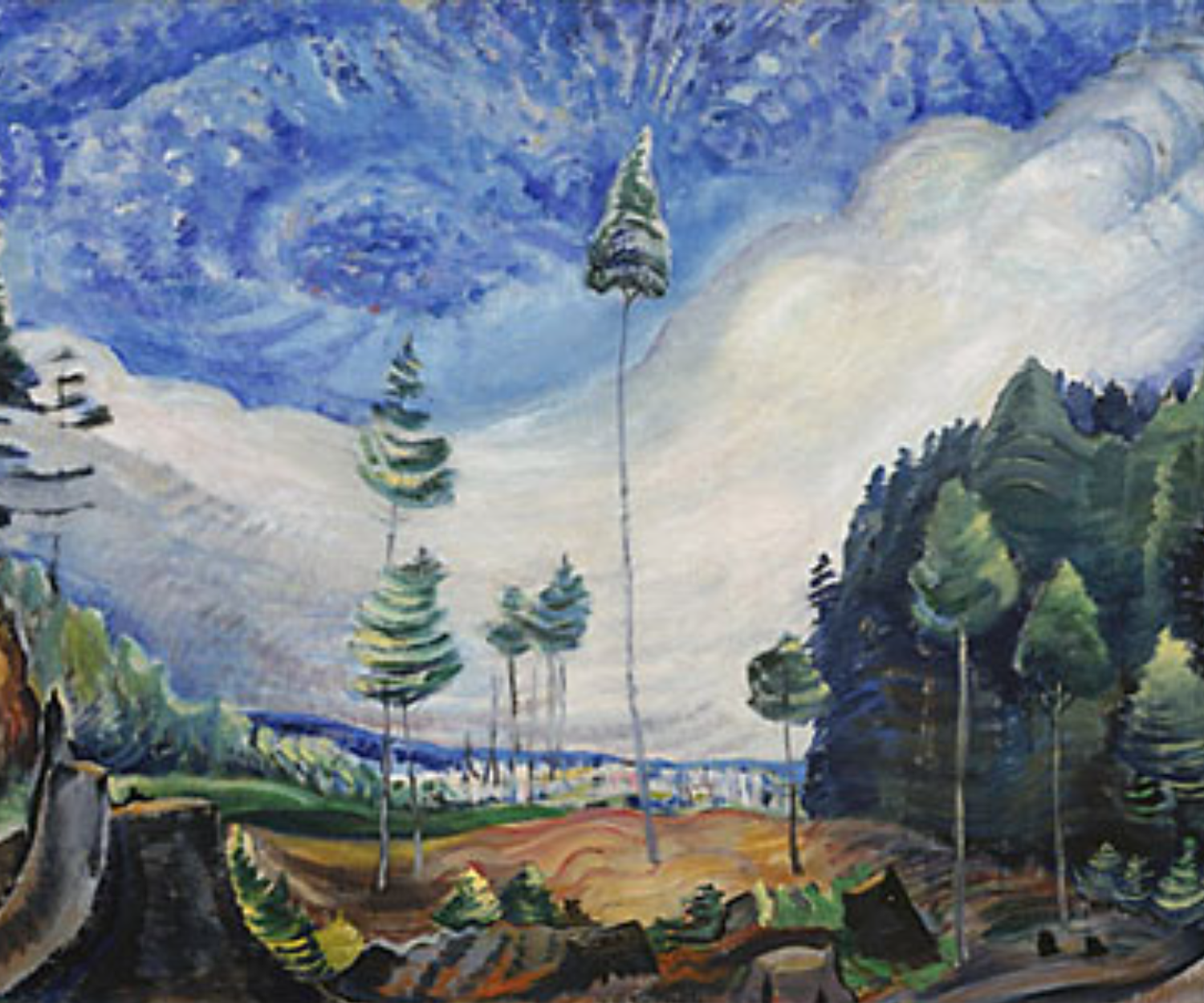
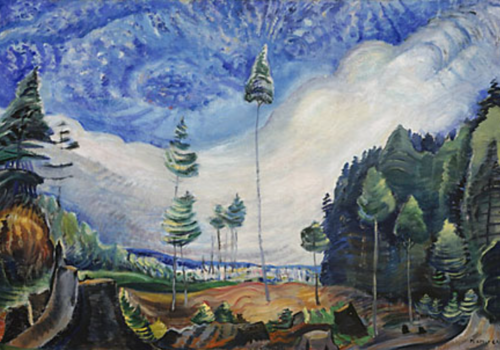
The title refers to trees left behind after logging—the “culls” that were considered unsuitable for cutting. The painting belongs to the group of works Carr made in the mid-1930s in which the forest itself, rather than a picturesque landscape, became her subject. Loggers’ Culls is also a good example of Carr’s increasingly modern approach to landscape in the Japanese woodblock style: she reduces the scene to strong masses, rhythms and spaces rather than attempting a conventional, realistic description.
Where the Japanese woodblock influence can be seen
1. An asymmetrical composition
Rather than placing the principal subject neatly in the centre, Carr distributes the trees unevenly across the horizontal picture. This is characteristic of Japanese ukiyo-e composition, where asymmetry and an off-centre focal point were frequently used to create movement and visual tension. Japanese prints helped Western artists move away from the balanced, centred compositions of academic European painting.
2. Strong, simplified shapes
Carr reduces the forest to trunks, branches, sky and ground as relatively simple shapes. She isn’t interested in describing every individual branch or leaf. This relates closely to the Japanese woodblock tradition, in which the artist designed the image in terms of areas of shape, line and colour rather than modelling every object illusionistically.
This simplification is also characteristic of Carr’s mature style. The Art Canada Institute notes that during this period she was increasingly reducing and unifying natural forms and treating the forest as an arrangement of interconnected planes.
3. The importance of negative space
One of the most useful things to point out to your audience is the space between and around the trees. Carr allows areas of sky to become active elements in the composition rather than simply background.
This is very close to the Japanese approach to ma—the purposeful use of empty or unoccupied space. Contemporary discussion of Carr’s technique specifically identifies her interest in Japanese woodblock prints and Chinese ink painting, particularly their precision of line, brushwork and use of negative space.
4. Strong linear rhythms
Look at the repeated verticals and diagonals created by the trunks and branches. Carr turns the trees into a kind of visual rhythm. Instead of simply looking through the forest toward a distant horizon, our eyes move across and through the pattern of the trees.
That emphasis on line and rhythm has an obvious affinity with Japanese print design, where a few decisive lines could describe an entire tree, mountain or landscape.
5. Flattening of pictorial space
Carr does not construct the landscape using conventional European perspective. The foreground, middle ground and background are increasingly compressed into a unified surface. The trees, ground and sky become interlocking areas of colour and brushwork.
This is important because Japanese prints helped Western artists discover that a landscape did not have to create the illusion of deep three-dimensional space. It could instead function as a designed two-dimensional surface. The Metropolitan Museum identifies unusual viewpoints, flattened forms and unconventional compositions as among the major influences of Japanese prints on Western modernism.
6. Cropping and the feeling that the landscape continues beyond the frame
The trees appear to extend beyond the boundaries of the painting. This is another useful comparison with ukiyo-e. Japanese printmakers frequently used cropped forms, allowing a tree, figure or architectural element to enter or leave the picture rather than enclosing the entire subject within the frame.
Carr and Hiroshige: Side by- Side Comparison
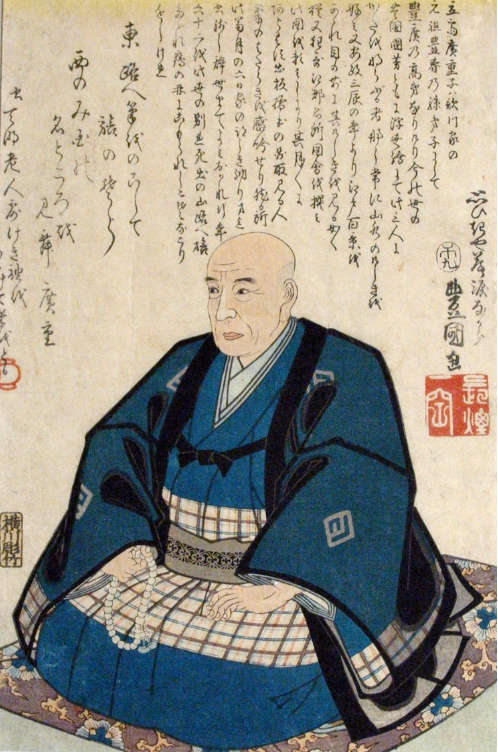
Utagawa Hiroshige (1797–1858) was one of Japan’s most celebrated ukiyo-e artists, renowned for his woodblock prints depicting landscapes, travel routes, and scenes of everyday life. His series The Fifty-three Stations of the Tōkaidō and One Hundred Famous Views of Edo demonstrated his mastery of composition, atmospheric effects, bold colour, and changing seasons.
Hiroshige’s innovative perspectives and simplified forms influenced European artists, particularly the Impressionists and Post-Impressionists such as Monet, Gauguin and Van Gogh, and helped shape Western approaches to landscape painting.
1. The Landscape Becomes a Design
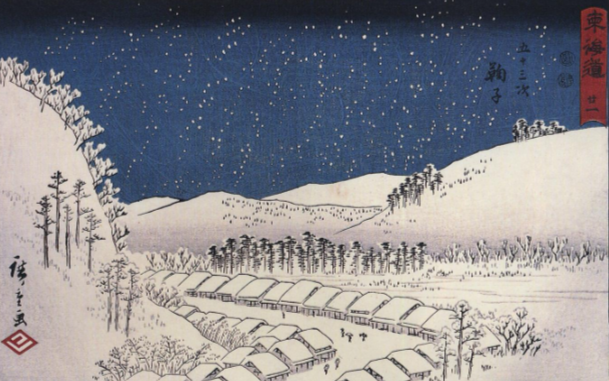
In Hiroshige’s Winter Landscape, the landscape is not constructed like a traditional European landscape, with a carefully graduated foreground, middle ground and distant background. Instead, the image is organized around large areas of land, sky, trees and snow.
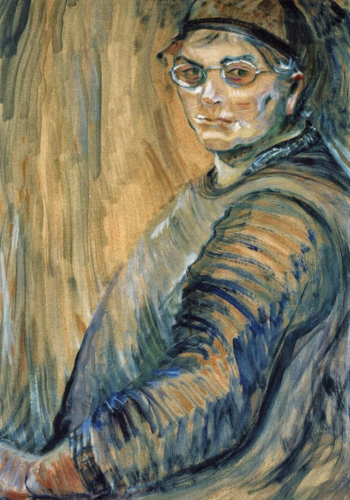
Emily Carr (1871–1945) was a bold, independent spirit who transformed the forests, coastlines, and Indigenous villages of British Columbia into some of Canada’s most memorable works of art. Inspired by European modernism and Japanese woodblock prints, she experimented with dramatic compositions, flowing lines, and simplified forms to capture the energy of the natural world.
Carr does something comparable in Loggers’ Culls. The forest is not presented as a literal transcription of what she saw. The trees, stumps, ground and sky become interlocking shapes and movements across the canvas. Carr was increasingly thinking about the forest as a composition rather than simply painting a view of a forest.
2. Trees Become Graphic Elements
This is particularly noticeable in both works.
Hiroshige uses trees as strong graphic shapes that establish the structure of the image. Carr similarly turns the trees and remaining trunks into vertical and diagonal strokes that organize the entire composition.The result is almost musical. Your eye moves from trunk to trunk rather than simply looking toward a distant horizon.
This is consistent with Carr’s mature concern after 1933 with what she called “unity in movement”—the idea that the individual forms in nature are connected through a larger rhythmic movement. The Art Canada Institute discusses this development in Carr’s style.
3. Cropping makes the landscape feel larger than the picture
Rather than giving us a complete, enclosed landscape, Carr allows her trees to dominate the picture and suggests that the forest continues beyond the edges of the canvas.
Japanese printmakers frequently used this kind of cropping. The Metropolitan Museum, for example, specifically describes Hiroshige’s cropping as producing an “abstract composition” with powerful graphic force.
That is an important connection to Carr because Loggers’ Culls does not feel like a little window onto a forest. It feels as though we have been placed inside it.
4. Negative space becomes an important part of the composition
Look at the spaces between the trees in Carr.
The sky isn’t simply empty background. The openings between the trunks and branches become shapes in their own right. They help establish the rhythm of the painting.
This is one of the places where Japanese art offers a particularly useful way of understanding Carr. Japanese print and painting traditions often treat unoccupied space as an active compositional element rather than something that needs to be filled.
In Loggers’ Culls, the spaces around the surviving trees are almost as important as the trees themselves.
5. Carr replaces conventional perspective with overlapping planes
This is perhaps the most sophisticated connection.
Hiroshige can suggest considerable depth without constructing the landscape according to Renaissance linear perspective. Objects overlap; shapes become progressively less defined; and colour and atmosphere establish distance. Carr similarly compresses the space of the forest. The trunks, stumps and ground seem to push toward the surface of the canvas, while other forms recede.
The result is simultaneously: a real British Columbia forest + an abstract arrangement of shapes. This combination is fundamental to Carr’s mature work.
For Emily Carr, Japanese woodblock prints were part of a broader artistic movement that transformed European painting in the late nineteenth and early twentieth centuries. Through exhibitions, art publications, and her travels in Europe, Carr encountered artist works such as Paul Gauguin (1848-1903), Henri de Toulouse-Lautrec (1864–1901) and Vincent van Gogh (1853–1890) whose visions reflected the influence of Japanese prints, particularly their bold compositions, flattened areas of colour, unusual viewpoints, and simplified forms.