Beyond the Canvas: Ira Dilworth and the Making of Emily Carr the Writer
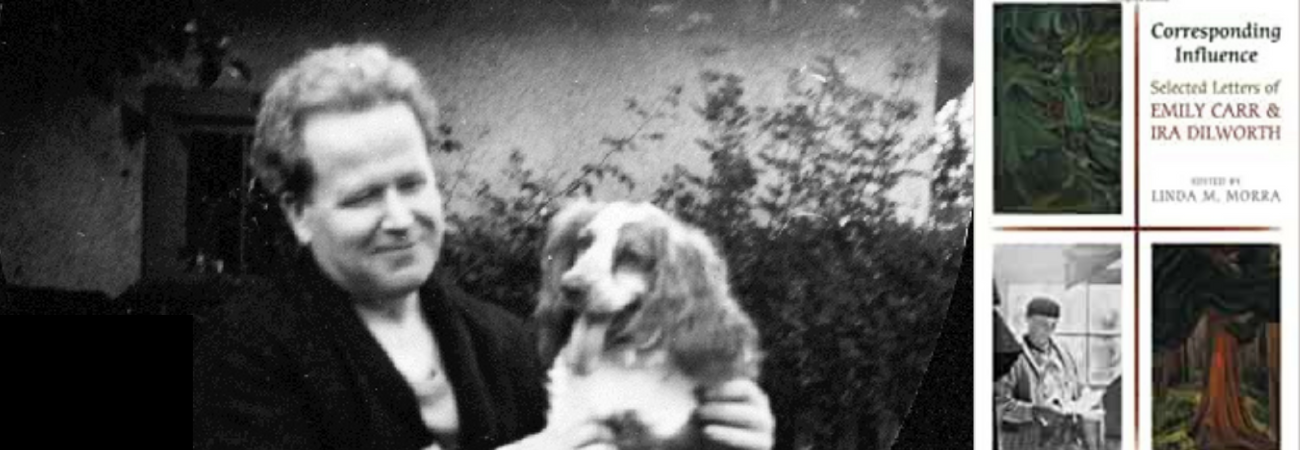
Emily Carr is often portrayed as the lone wanderer of the West Coast—sketchboard in hand, caravan behind her, dogs and her monkey Woo her side. But her later life, and especially her legacy as a writer, was shaped profoundly by one person: Ira Dilworth, the steady, insightful mentor who became her most important literary conduit.
Dilworth was born in High Bluff, Manitoba in 1894 but grew up on a 5,000 acre ranch in the Okanagan valley, BC. After graduating from Kelowna High School in 1909, he studied at Victoria High School (VHS), and graduated with a BA English from McGill University in 1915, with an MA (Harvard) 1920.
From 1915 to 1934, Dilworth taught English at Victoria High School, where his gifts as a teacher were soon matched by the administrative skill that made him principal in 1926. Twice elected president of the B.C. Teachers’ Federation, he earned a reputation for combining inspiration with precision—lifting students to high expectations while tending carefully to detail.
His direction of the annual Shakespeare productions and his role in morning assemblies infused the school with dramatic flair and musical life. Many students and former students were invited into the Dilworth home, where poetry, song, and lively discussion widened horizons and opened doors to cultural experiences entirely new to them. His energy naturally spilled beyond the school’s walls, and Victoria’s cultural landscape benefited enormously from his enthusiasm and generosity.
When Dilworth moved to Vancouver to become Associate Professor of English at the University of British Columbia from 1934 to 1938, he again attracted students in remarkable numbers to his lectures on the Romantic poets. His enthusiasm for the era’s verse—infectious, incisive, and deeply felt—left a lasting impression on students who themselves would become teachers. During these years he also directed the Bach Choir (1938–40), blending his passion for music with his love of language.
This combination of aesthetic sensitivity and administrative skill soon carried him into an even larger sphere. In 1938 he became regional director of the CBC in British Columbia, a role that expanded his influence considerably. He used his position not only to shape regional broadcasting but also to promote local artists and writers, including Emily Carr. It was during this period that he began reading Carr’s stories on air, after recognizing the raw originality of her early manuscripts—introductions made through Ruth Humphries and George Sedgewick at UBC. By championing Carr’s writing before she believed in it herself, Dilworth played a decisive role in launching her second career as a literary artist.
He also helped organize the Vancouver Community Arts Council, the first such arts organization in Canada. and became its first president in 1945, further cementing his influence on cultural life on the coast.
Dilworth’s reach widened again when he moved to Montreal. There he became general manager of the International Service of the CBC (1947), director of program production in Toronto (1951), director for Ontario (1953), and finally director of all CBC English networks in 1956. Through these decades—and even after his retirement—he devoted his insight, energy, and warmth to fostering cultural life across Canada, especially by nurturing the talents of young people he delighted in encouraging.
A résumé can capture the breadth of Dilworth’s career, but it cannot fully convey the gracious, spirited, and empathetic personality behind it. He was a meticulous editor, refining high-school texts, compiling an anthology of twentieth-century verse, and compassionately preparing Emily Carr’s prose for publication. Yet he was never the scholar intent on publishing for prestige; his humanistic passion found expression instead in communication, mentorship, and the quiet work of bringing out the best in others.
His tireless efforts to ensure Emily Carr’s recognition as a writer—editing Klee Wyck, shaping The Book of Small and The House of All Sorts, and later preparing her journals and diaries for publication—live on in her affectionate letters and in the books that would not exist without him.
Dilworth was a man with a deep love for music and literature along with a remarkable sensitivity for the written word. He was also one of the rare people who could see Emily Carr clearly—not just the public figure, not the eccentric local character— but the extraordinary artist and thinker she was.


When Emily Carr passed away, Lawren Harris, her executor of her artwork, helped divide up the Emily Carr trust. Most of Carr’s large 44 x 27 inch canvases from the 1940s were contributed to the permanent collection of Vancouver Art Gallery. When asked to choose a painting by Carr for himself, Dilworth selected Quiet painted in 1842. “It is rare that a Carr painting of this scale and quality comes available for sale,”; says president David Heffel. “The painting has not been seen since it was displayed at an exhibit in the Vancouver Art Gallery in 1942, when it had a sale price of $250. Fast-forward to 2004 – and Quiet had a conservative pre-sale estimate of $300,000 to $400,000 placed on it. It was sold was for $1,121,250
Their friendship began not in the art world, but through Emily’s writing. In the mid-1930s, as Emily’s health began to fail and painting became more physically demanding, she found herself turning more and more to words. She had always kept journals, had taken two creative writing courses, one by correspondence in 1927, and another at Victoria College in 1934, and she had always written little stories, but she wasn’t confident about publishing them. She wrote in a voice that was direct, funny, humble, and deeply observant. But she wasn’t sure anyone would take it seriously.
Dilworth was one of the first people who did.
He had come to know Emily as a teenager while living across the street from her House of All Sorts on Simcoe Street with his mother. In 1930, he was introduced to her artwork at her Crystal Gardens exhibition in 1930 by Max Maynard and Jack Shadbolt, two former students who attended the poetry and music evenings he held on Thursdays. He was not impressed and left the exhibition early. Decades later, he was introduced to Emily’s writing in 1939 by Ruth Humphries, an English professor, one of her three listening ladies who critiqued her short stories beginning in the mid-1930s.
Dilworth read some of her early pages—rough, handwritten, unpolished—and immediately recognized something true and original. He reached out to her, gently but persistently, encouraging her to continue. And in Emily Carr’s world, encouragement was not something she took lightly. She had been dismissed by critics, ignored by many patrons, and misunderstood by some members of Victoria’s polite society. So when someone as thoughtful as Dilworth said, “Emily, this is good,” she listened.
Dilworth was so impressed by her stories that he gave the manuscripts to George Sedgewick, the head of the English department at UBC, and encouraged him to read them on air during the CBC poetry program Dilworth hosted. He then began to continue to read them on his poetry program himself.
Through Dilworth’s guidance, Emily Carr published Klee Wyck in 1941. The book won the Governor General’s Award for Literature—an astonishing achievement for someone who had never considered herself a professional writer. Dilworth was thrilled, but Emily took it in her usual unsentimental way: grateful, but always thinking about the next piece of work.
And thanks largely to Dilworth’s encouragement, there was more work. Together they shaped The Book of Small (her loving portrait of her childhood in Victoria. Then The House of All Sorts, drawn from the chaos and comedy of her life as a landlady in James Bay. All three books reflected the two things that Emily valued most: honesty and insight. And Dilworth valued these too. They aligned not only in artistic vision but in temperament.
Their friendship grew warmer as the years went on. Dilworth visited Carr frequently, especially in her final decade when she was often confined by illness. Their conversations were animated and wide-ranging—art, spirituality, the writing life, and the changing Canadian cultural landscape. In Dilworth, Emily found someone who took her intellectual life seriously. He admired her mind as much as her writing.
Though their relationship was not romantic, it was undeniably intimate. There was tenderness on both sides. From reading her letters to Dilworth, it is obvious that Carr trusted him with her insecurities—her fear that her work wouldn’t matter, her frustration at being physically limited, her doubts about fame. He responded with unfailing patience and care. He reassured her, pushed her gently when she needed it, and shielded her when she was overwhelmed.
When Emily Carr died in 1945, Ira Dilworth became her literary executor. He took this role to heart. He compiled her diaries, her letters, her sketches of thought—hundreds of pages she probably never intended for anyone to see—and he shaped them into the volumes many of us now treasure: Growing Pains, The Heart of a Peacock, Pause, and finally Hundreds and Thousands, her extraordinary journal of her painting years. Through his careful editing, we hear Carr’s unmistakable voice: clear, unpretentious, and deeply human.
It’s fair to say that without Ira Dilworth, who passed away in Vancouver in 1962, we might not know Emily Carr as the writer she was. He preserved her voice not just on canvas, but on the page. And in doing so, he made her legacy richer, fuller, and more complete.
So when we talk about Emily Carr the artist, the writer, the icon of the West Coast, it’s worth remembering this quiet but essential partnership. Carr brought fire, originality, and vision. Dilworth brought steadiness, patience, and belief. Together, they created a body of work that has shaped Canadian culture for generations.
Their relationship stands as one of the great creative friendships in Canadian history—a reminder that even the most independent spirit sometimes needs a trusted companion who understands the work, the struggle, and the heart behind it. In the case of her written work, Ira Dilworth was her one trusted companion, confident and loving friend.