Joe Fafard, Emily Carr and Her Friends
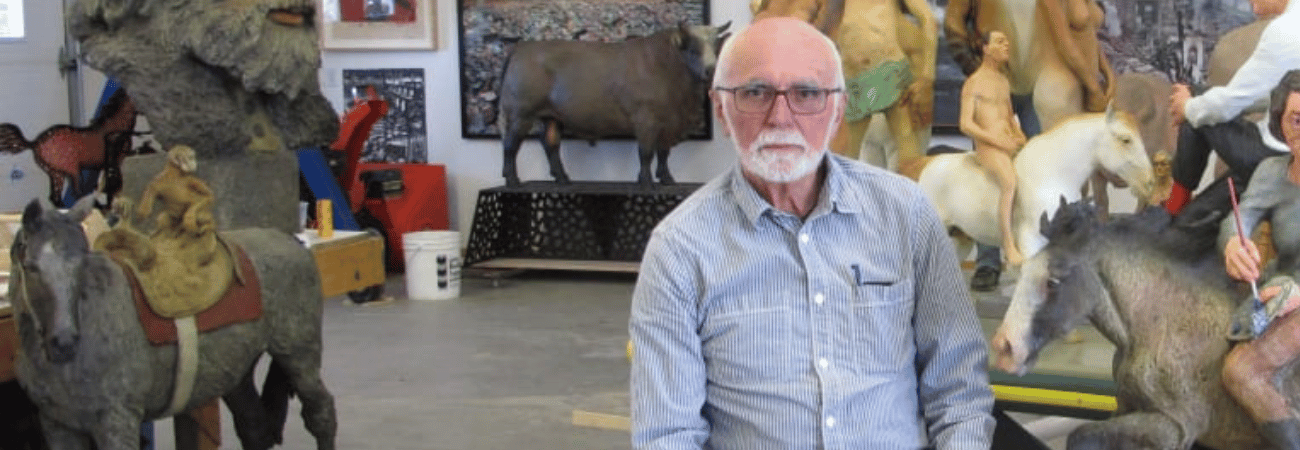
The bronze Emily Carr sculpture created by Edmonton sculptor Barbara Patterson installed outside the Empress Hotel in Victoria in 2010 is not the first statue created in her honour. That distinction belongs to Joe Fafard—a celebrated Saskatchewan artist and longtime admirer of Carr’s work. By then, he had created two different versions of Emily Carr sculptures, one of Emily on her horse in 2003 and another in 2005 with her off her horse with her dog Billie beside her with her monkey, Woo on the horse that Fafard called Emily and Her Friends.
Known for his earthy, often whimsical portrayals of farm animals, rural life, and iconic Canadian figures, Fafard worked in clay, bronze, and steel. His art was rooted in the land and people of the Prairies, but his reach was national, his gaze often turning toward figures who shaped Canada’s cultural identity. Among these was Emily Carr.
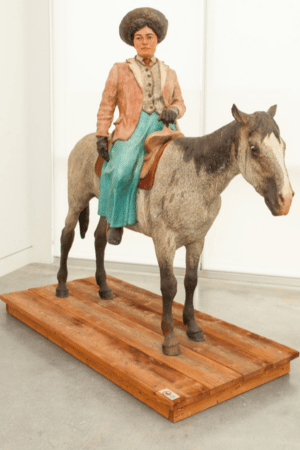
Joe Fafard created his first Emily Carr sculptures in 2003. Today, two of them are housed at the Emily Carr University of Art + Design in Vancouver, where Fafard once studied. One sculpture stands near the escalator, while the other is displayed on the second floor.
In 2005, Heffel Fine Arts Auction commissioned Fafard to create seven copies of another version of an Emily Carr sculpture. Three of this version are installed in front of the Heffel Fine Arts Auctions in Vancouver, Toronto and Montreal.
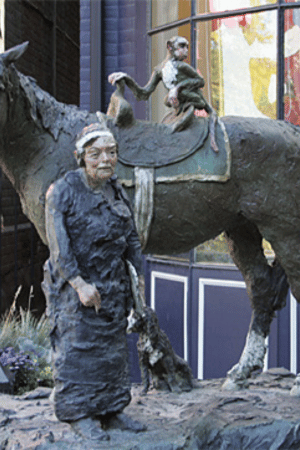
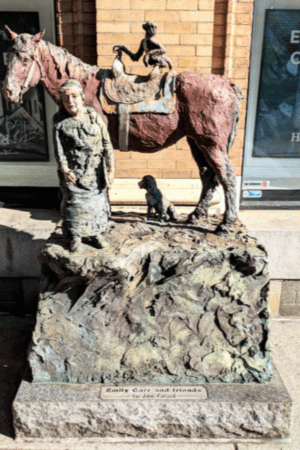
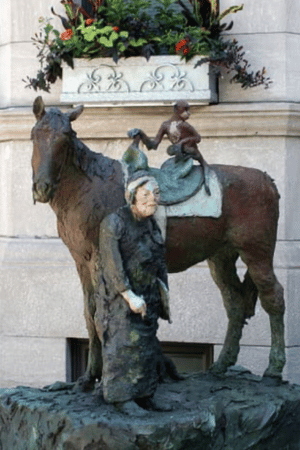
The Emily Carr and Her Friends sculpture depicts Carr in full stride. It’s a kinetic, affectionate, almost cartoon-like rendering that captures both Carr’s eccentricities and her creative drive. Fafard’s Emily is not a solemn cultural icon; she’s in motion—alive, curious, determined, and a little chaotic.
His portrayals of Carr is part homage, part reinvention. He brings a sculptor’s physicality to a woman who worked in paint and prose, rendering her in three-dimensional form for the public to encounter in daily life. His sculpture invites viewers to imagine her not in a gallery or on the pages of her books, but out in the streets of Victoria, walking with her animals, seeing the world through an artist’s eyes.
Although separated by time—Carr died in 1945, just three years after Fafard was born—Fafard developed a deep artistic connection to her. He never met Carr, of course, but his creative admiration resulted in several sculptural tributes that brought her into his visual world. In doing so, he offered Canadians a new way of seeing Emily Carr—not just as a painter and writer, but as a symbol of artistic persistence, originality, and rootedness in place.
Emily Carr as Muse and Subject
Emily Carr was already part of the Canadian artistic canon when Fafard began referencing her in his work. He was drawn not just to her art, but to her spirit—her deep connection to nature, her outsider status, and her perseverance in the face of isolation and rejection. Carr, like Fafard, created art that celebrated the land and its stories, often at odds with prevailing aesthetic trends.
In this way, Fafard opened a dialogue across time and mediums. His Emily Carr sculptures reanimates her legacy, blending biography, mythology, and playfulness. The piece reflects his own values: a respect for the land, a love of character, and a commitment to making art that is accessible, grounded, and alive with personality.
In 2013, Farard created and assembled the works for the exhibition Emily and Her Menagerie, a tribute to the artist and the animals she loved. The show and sale of more than 40 pieces was held at the Carr House, Emily’s family home, now a national historic site on 207 Government Street.
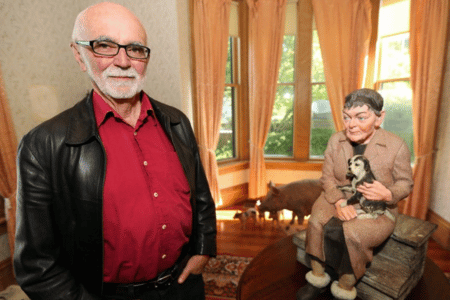
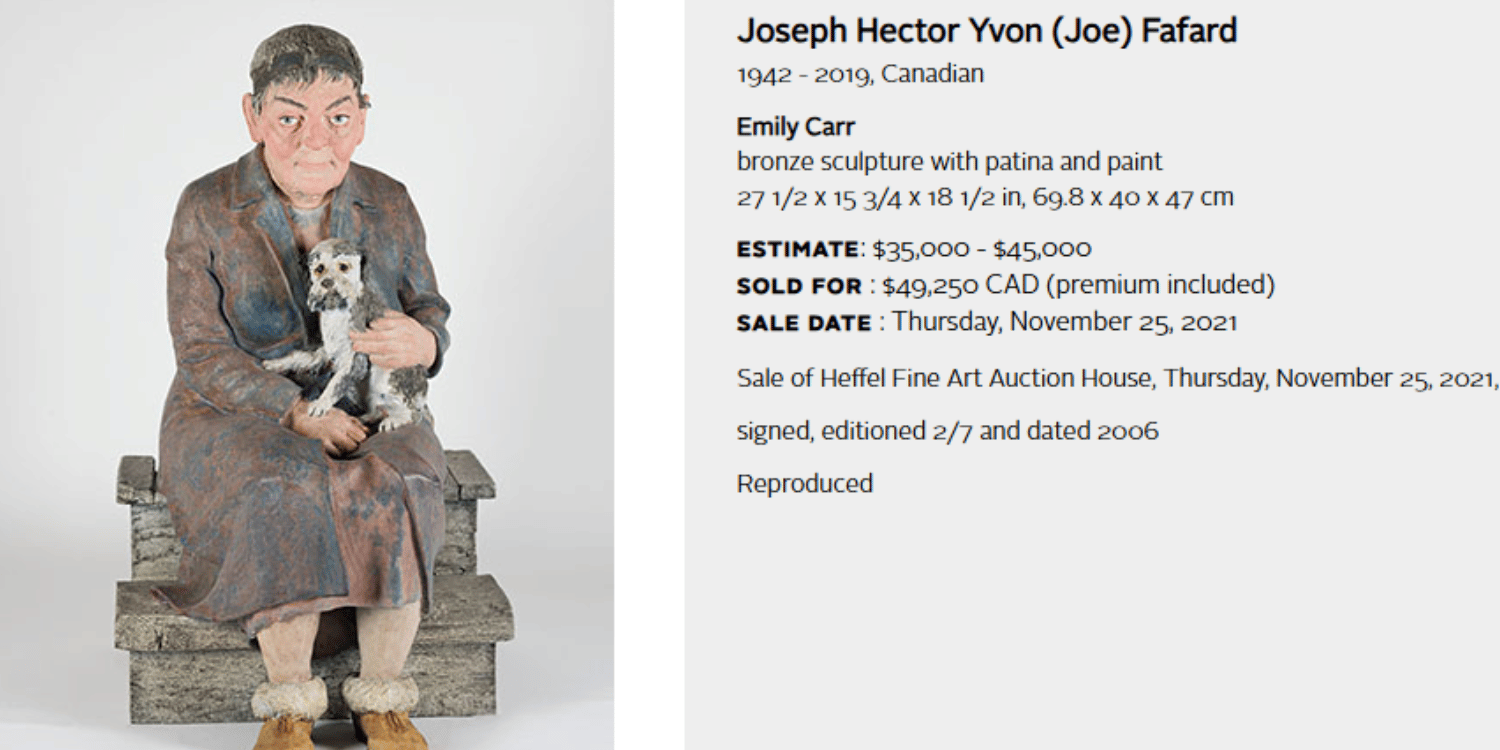
It is basically an homage by the amazing Joe Fafard to Emily Carr, her love of animals — which matches his — and really his interpretation of how she inspired him to create these amazing sculptures,” said Carr House curator Jan Ross.
Two Canadian Originals, Rooted in Place
Both Joe Fafard and Emily Carr were deeply shaped by their respective geographies—Fafard by the wide skies and open plains of Saskatchewan; Carr by the rainforests and coastline of British Columbia. Yet both transcended regionalism, creating work that speaks to the broader Canadian imagination. Their artistic kinship lies in their attention to ordinary life, their embrace of individuality, and their shared belief that the land itself carries stories worth telling.
Fafard’s tributes to Carr are more than sculptures; they are a gesture of creative respect from one artist to another. Though they never met, in his hands, Emily Carr walks again—striding forward with her animals, defiant and full of purpose, still chasing the light.
Like Emily Carr, Fafard is wildly recognized as having been at the forefront of his art, and his outstanding contributions to the arts have significantly raised the profile of both Saskatchewan and Canada on the national stage.
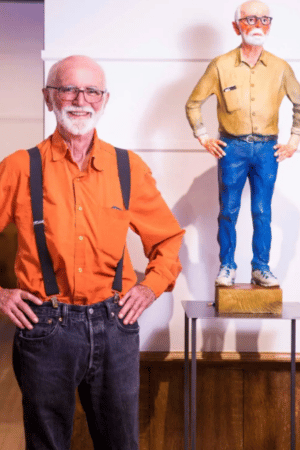
He was named an Officer of the Order of Canada in 1981; awarded the Architectural Institute of Canada Allied Arts Award in 1987; received an honorary degree from the University of Regina in 1989, and from the University of Manitoba in 2007; received the Saskatchewan Order of Merit in 2002; received the National Prix Montfort in 2003; received the Lieutenant Governor’s Saskatchewan Centennial Medal for the Arts in 2005.
In 2006, he was named CTV Citizen of the Year and the Saskatchewan Arts Board Lifetime Achievement Award in 2007. He received his third honorary doctorate degree from the University of Saskatchewan in June of 2012.
I try things, rather than just repeating the thing that has already proven successful. I take the attitude that I’m like a scientist who wants to experiment and discover things and dig out the truth.” – Joe Fafard
Fafard’s tributes to Carr are more than sculptures; they are a gesture of creative respect from one artist to another. Though they never met, in his hands, Emily Carr walks again—striding forward with her animals, defiant and full of purpose, still chasing the light.
Sadly, Fafard passed away peacefully at home on his farm near Lumsden on March 16th, 2019.