
The Unsung Childhood Art Teachers Who Shaped Young Emily Carr
In her autobiographical writing, Emily Carr was careful to portray herself in the tradition of the romantic individual by highlighting historical facts about herself that conformed to the modernist image of the artist as a professional and a genius, and downplaying those that did not. Born during a snowstorm, “contrary from the start,” she emphasized her difference from the rest of her family and insinuated that her “fondness for drawing” was not only viewed with disinterest by her sisters, but was something she had initiated on her own at a very young age.
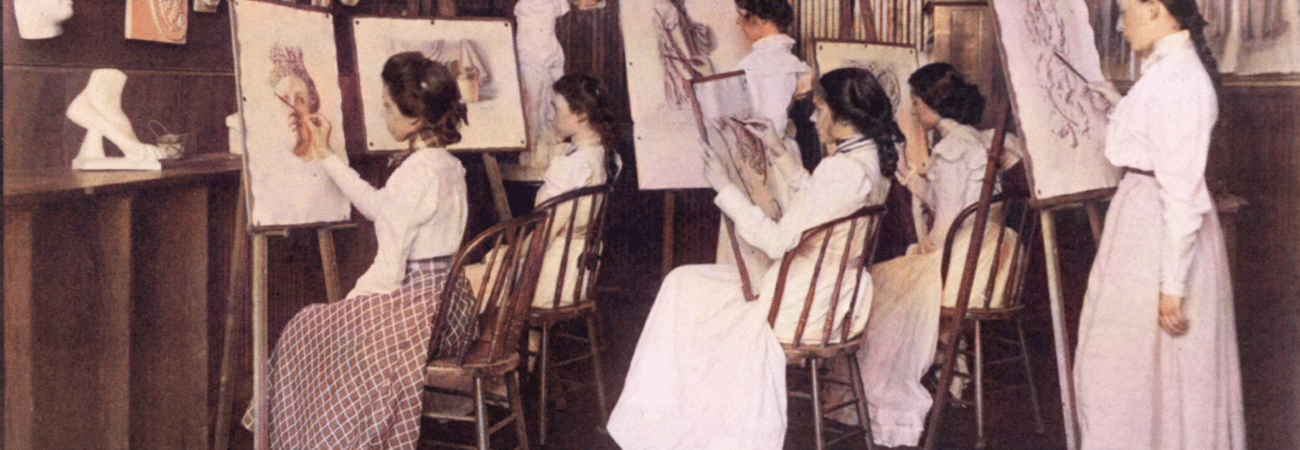
In Victoria during the 1880s, when Emily was in her teens, it was not out of the ordinary for upper-middle-class young ladies to receive training in drawing and painting as a standard part of their formal education. Such artistic training in “the accomplishments” was considered a necessary marker of class status and refinement of character.
Emily’s early art is equally as conservative as the work of other “gentlewomen” of the time, and would not look particularly uncomfortable alongside the watercolour still lives or the landscape sketches of the “society ladies” Emily mockingly referred to as “a very select band of elderly persons, very prehistoric in their ideas on Art.”
Although Emily Carr received a good deal of such art education in her early life in Victoria, overall, scholars have not paid the same careful attention to it as they have to the formal methods of art training she experienced in San Francisco and Europe. The artistic training that was part of a young girl’s education in accomplishments during the Victorian era was designed to inculcate femininity, and was invested with connotations of morality.
The products created out of women’s efforts to employ the artistic skills they were taught within this system do not reflect the results of art training, but are the complex by-products of women’s efforts to function within and around the social pressures and limitations that were placed on them.
Emily Carr’s early art education belongs within this training in “the accomplishments” that nevertheless played a critical importance to how she used her creative skills, determination and resourcefulness to overcome the challenges that would lay the foundation for the success she found late in life and beyond.

Emily Woods was born in Ireland,. Her family had immigrated to Victoria, along with her uncle Reverend C.T. Woods, in 1860. She had attended Angela College, an Anglican private girls’ school, with Emily Carr’s older sisters where, like most upper-middle-class young ladies, they had all received lessons in pencil and watercolour drawing. Woods excelled in botanical and landscape drawing, and over two hundred of her own pencil and watercolour drawings are held in the BC Archives collections.
Wood’s principal painting interest was botany; throughout her life she dedicated her time to painting plants, using both scientific and common names, and sometimes included notes on the First Nations uses of plants alongside her illustrations. She produced over 200 watercolours of flowers, trees as well as fifty landscapes. Four albums of these works are housed in the BC Archives. They were published in 2005 alongside a collection of Emily Carr’s writings in “Wild Flowers.”
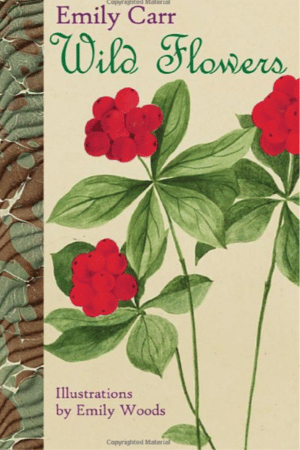
From 1940 to 1941, during a period when Emily Carr was bedridden after a heart attack and strokes and unable to paint, she focused her creativity on writing about wild flowers. When her manuscript for Klee Wyck was accepted by a publisher she put wild flowers aside to to work on Klee Wyck and never got back to it
The resulting 21 vignettes are accompanied by delicate watercolours of wild plants by Emily Woods edited by Kathryn Bridge and published in 2006 by the Royal BC Museum. See her watercolours
Emily spent the first few years of her education at a private school run by Mrs. Frazer at Marifield Cottage near her home in James Bay. There she received drawing lessons from Miss Emily Woods, who “came every Monday with a portfolio of copies under her arm.”
Wood’s principal painting interest was botany; throughout her life she dedicated her time to painting plants, using both scientific and common names, and sometimes included notes on the First Nations uses of plants alongside her illustrations. She produced over 200 watercolours of flowers, trees as well as fifty landscapes. Four albums of these works are housed in the BC Archives.
Emily Carr later recalled the pride she had felt at winning a prize from Woods for copying a picture of a boy with a rabbit. Emily Woods’s method of instructing her students to copy other drawings probably reflects the way she herself had been trained. Although at the time copying was still the foundation of academic art training, it had also been promoted as an especially suitable pastime for ladies because it was not thought to require original thinking, talent, or a gift for genius. Thus it remained safely in the realm of the amateur.
Emily Takes Private Art Lessons at Public Schools
A commonly repeated philosophy of the times stated that “anyone who can learn to write can learn to draw,” suggesting that drawing skills could be acquired through careful practice, and that they had more to do with accuracy than with creativity. By the time Emily Carr was ten years old she was attending Central Public School with her sisters Lizzie and Alice. Although Emily’s two eldest sisters, Clara and Edith, had attended the prestigious Angela College, and most of Emily’s and Alice’s friends continued to do so, their father was no longer convinced that an expensive private ladies’ school could provide a proper academic grounding.
According to Emily, her father was of the opinion that even though such schools taught young ladies manners, or what she satirically described as “how to hold their heads up, their stomachs in and how to look down their noses at the right moment,” by the late 1880s they had fallen behind the academic standard set by the Canadian public education system. Because drawing was apparently not part of the curriculum at Central Public School, Emily, Alice, and Lizzie took private art lessons with Miss Ada Leslie Withrow, who had opened an art studio in Victoria in 1883.
Miss Withrow gave lessons to young ladies in oil and watercolour painting, as well as crayon and pencil drawing. Along with Alice and Lizzie, Emily joined the class of Miss Withrow who had received her early drawing lessons at St. Ann’s Academy. Eva Withrow’s name may not be well known today, but her impact continues through the achievements of those she taught. As one of Emily Carr’s earliest art instructors, Withrow offered more than drawing lessons—she embodied what it meant to live and work as a self-supporting artist in a time when few women could.
Ada Withrow had numerous works of art on exhibit in various Victoria storefronts from the time she opened her studio in 1883 until1888 when she was married. She appears to have been a highly regarded artist in Victoria at that time, and was commissioned by prominent families to do portraits in oil, four of which are held in the BC Archives collections.
It seems likely that Ada Withrow introduced Emily Carr to oil painting. In addition, Maria Tippett credits Withrow with encouraging and assisting Emily in submitting work to the California School of Design, which she attended in 1891. Like Emily Woods, Ada Withrow taught Emily Carr to draw by copying.
Just as Miss Woods had given her a prize for her earlier copy work, Emily Carr’s father gave her five dollars for two copies of portraits she had drawn using a grid method Miss Withrow had taught her. The rewards and attention Emily received from her teachers and father encouraged her to continue to work at her drawing skills. It is notable that one of the rewards she received was money, which must have reinforced the idea that art could be a way to financial independence.
Miss Woods and Miss Withrow, both gainfully employed upper-middle class ladies, provided Emily Carr with positive role models. She eventually followed their example and taught art lessons to children when she returned from studying in San Francisco and later in Vancouver.
After being dismissed from her position as art teacher from the Vancouver Art Club in 1906, Carr claims she would rather starve than spend one more second teaching art to women she described as “vulgar, lazy old beasts.” Yet, what separates Emily Carr from the lady painters she so disdained, or from her sisters who were content to paint china and sketch flowers, is not so much that she was an artist, but that, by the time she turned her attention to the past, she saw herself as a particular kind of artist.
Even though, while attending art classes in San Francisco, she had been exposed to a diverse range of drawing styles and techniques, Emily refused to attend life drawing classes on moral grounds and instead focused on landscape and still life. She later referred to the kind of art she produced during this time as “humdrum and unemotional—objects honestly portrayed, nothing more.” Even after returning from five years of study in England she called her work “narrow, conservative, dull seeing, perhaps rather mechanical, but nevertheless honest.”
These criticisms were launched from the perspective of hindsight during a time when Emily Carr identified strongly with the modernist ethos of Lawren Harris and the Group of Seven, and represent her attempts to reframe her own artistic career. Emily Carr could not reconcile the disparity between the two images of herself as a gentlewoman art teacher and an eccentric artist, and so created a dichotomy between her conservative early work and her later “true” work, which brought her notoriety and acceptance from other artists.
Her Childhood Art Teachers Serve as Lifelong Role Models
Later biographers and writers have tended to follow Emily Carr’s lead, and have overlooked her early local art training. This lack of interest in the “unexceptional” has resulted in a historical picture that tends to favour a traditional stereotype of the artist as a heroic genius. Yet the art and artistic products women created during the late nineteenth-century functioned in more complex ways than simply by attempting to fit into the fine art system perpetuated by popular art schools like the Royal Academy in England.
Her two childhood art teachers served as important role models for Emily beyond how well they painted. Both were professional women painters supporting themselves by their artistic talents at a time where women painters were considered “society ladies” and limited to portraying domestic scenes and portraitures.
Focusing solely on Emily Carr’s place within the formal art world overlooks the wide range of creative work she produced—hooked rugs, pottery, political cartoons, and satirical illustrations—that often fell outside conventional definitions of professional art. To fully understand these diverse and inventive expressions, we must consider the formative influences that shaped her early on—especially the example set by her childhood art teachers, Miss Emily Woods and Miss Ada Withrow.
Both were not simply genteel amateurs but professional painters who supported themselves through their artistic skills. As independent, working women in a time when few female artists earned a living from their craft, they modeled a version of artistic life that combined technical training with self-sufficiency—an example that clearly left a lasting impression on the young Emily Carr.


0 comments