
Love and Loss: How the Death of Emily Carr’s Mother Shaped Her Life and Art
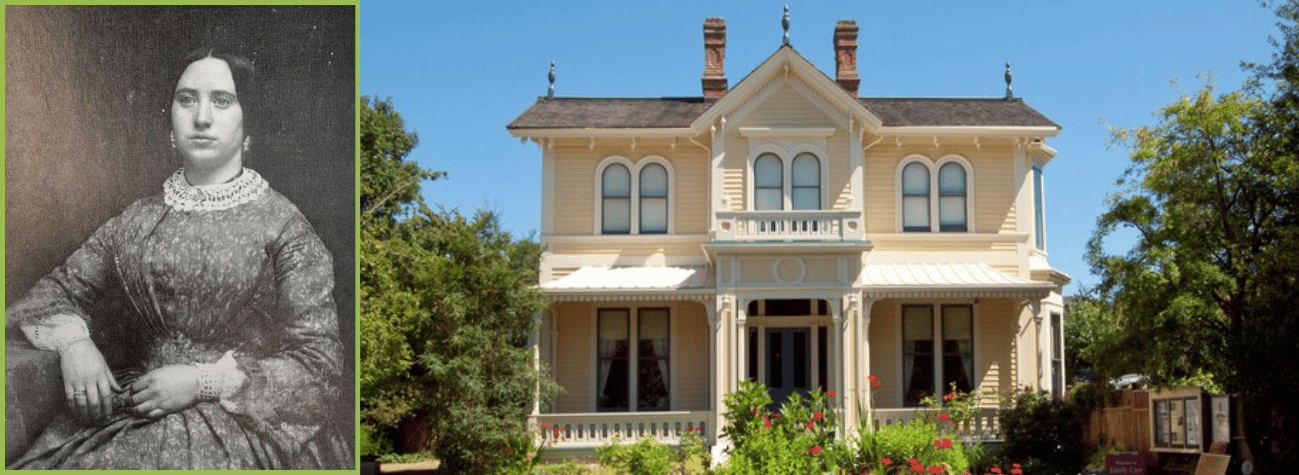
Emily Saunders, Emily Carr’s mother, was born in Freeland, a small town in Oxfordshire, on July 3, 1836, to a single mother, Mary Saunders. Her birthplace was less than ten miles from Beckley, where Richard Carr was born — though they didn’t meet in England, as Emily was eighteen years younger and Richard had emigrated to America at age eighteen.
Roots in a Large, Devout Family
Emily Saunders Carr was one of eleven children born to Samuel and Mary Saunders of Helston, Cornwall. The family, part of the Evangelical Anglican tradition, was respectable and tightly knit. One of her sisters, Lizzie, accompanied her to San Francisco in the early 1850s, where Emily met and later married Richard Carr. Like many Victorian families, others may have also emigrated in search of opportunity.
Meeting Richard Carr in San Francisco
It’s unclear why Emily was living under the care of a Mrs. Quantack in San Francisco, but it was there she met Richard. They soon returned to England to marry on January 18, 1855, in her hometown parish. Back in California, Emily gave birth to her first two daughters: Edith in 1856 and Clara in 1857.
Grief and Hardship in England
The Carrs returned to England in 1861, but the next three years were marked by loss. Emily’s health continued to fail. Her son William died just four days after birth in 1861, and John lived only two days in 1862. Concluding that the return was a mistake, the Carrs set sail for Vancouver Island.
A Colonial Matriarch in Victoria
In Victoria, Richard built a large house for the family. Emily gave birth to nine children in total, though only five survived to adulthood. Another son, Thomas, died in infancy. Her surviving children included Elizabeth (b. 1867), Alice (b. 1869), Emily (b. 1871), and Richard (b. 1875). With help from eldest daughter Edith, Bong the house boy, and Mary the wash lady, Emily ran the household despite her poor health.
Structure and Severity at Home
Emily Saunders Carr ruled the home with religious discipline and moral clarity. Each child had a defined role: Edith was the responsible eldest, Richard the fragile and distant only son, and Clara and Lizzie were conventional and obedient. Emily, the youngest, often clashed with her mother’s austere temperament.
Austere Affection and High Expectations
Their mother was affectionate in principle but emotionally reserved. Her calm but unbending temperament shaped a household where duty came before affection. Deeply religious, she infused daily life with Anglican ritual and moral instruction, earning a reputation for propriety in Victoria society.
Loss and Emotional Fallout
Emily Saunders Carr died of tuberculosis on September 22, 1886. Her only surviving son, Richard, died the same year at age 24. She was the first family member buried in the Carr family plot in Ross Bay Cemetery. Emily Carr was just 14 at the time. Her father died two years later, leaving her emotionally unmoored.
A Daughter’s Reflection, Fifty Years Later
After her first heart attack in 1937, Emily Carr began writing about her mother. She had taken writing courses nearly a decade earlier, perhaps sensing a creative shift. Losing her mother young shaped Emily’s identity — as an outsider, artist, and spiritual seeker in a secularizing world.
Nature as Mother
In her writing and art, Emily fused visual and verbal metaphors, often portraying trees — especially cedars — as maternal figures. Through these towering forms, she expressed the strength, sanctuary, and emotional connection she longed for after losing her mother. These themes became a lasting element of her work and legacy.
Here are three paintings and three writings by Emily Carr where the emotional and symbolic influence of her mother’s loss—and the maternal connection she sought in nature—are especially visible:
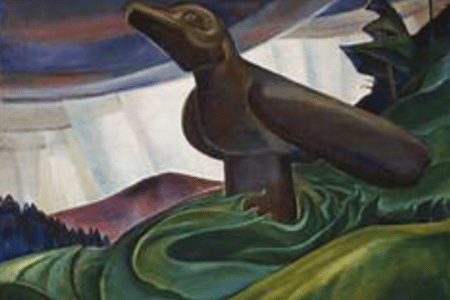
Big Raven (1931)
- Description: A large, solitary raven carved in wood stands alone against swirling, atmospheric skies.
- Connection to Mother: The raven, a figure from Indigenous mythology, becomes a kind of guardian or ancestral presence. Its isolation and dignity evoke Carr’s feelings of reverence, loss, and spiritual search—paralleling how she idealized her mother after her death.
- Mood: Solitude, strength, spiritual depth.
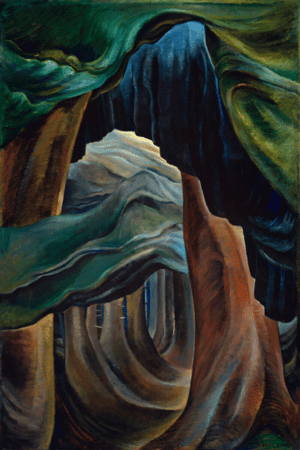
Forest BC (1931-32)
- Description: A dense, dark forest filled with twisting trees and an almost mythic atmosphere.
- Connection to Mother: The enclosing forest feels protective yet mysterious, like a memory. It represents the inner landscape Carr explored after the loss of her mother—complex, maternal, and deeply spiritual.
- Mood: Enchantment, inner sanctuary, Carr’s memory.

Above the Gravel Pit (1937)
- Description: Towering, semi-abstract trees rise above a ravaged, human-disturbed landscape.
- Connection to Mother: Carr often described trees as mother-like figures, watching over the land. These monumental trees appear to resist destruction—perhaps a metaphor for the nurturing presence Carr yearned for and projected onto the natural world.
- Mood: Resilience, shelter, endurance.
Three writings reflecting her mother’s influence:
1. “Mother” (1953, published posthumously)
- Source: Included in The Heart of a Peacock
- Content: A poignant account of Carr’s mother’s life and death, written decades after the fact.
- Impact: Carr reflects on her mother’s sacrifice, quiet suffering, and strength. It’s one of the most direct and emotionally candid pieces she wrote about her.
“She wore out… All the while Mother was slowly, slowly slipping away.”
2. “The Book of Small” (1942)
- Type: Autobiographical memoir of childhood
- Connection: Many stories recall her mother’s orderliness, quiet strength, and gentle presence, often with a childlike lens.
Mother moved through the house like a Sunday breeze—light, still, and full of goodness.
3. “Growing Pains: The Autobiography of Emily Carr” (1946)
- Type: Full autobiography
- Relevance: Carr reflects explicitly on her emotional upheaval after her mother’s death, and the way it left her unmoored.
When Mother died, the warm heart of home died too.


0 comments