
A Day in the Life of Emily Carr, the Elephant & Friends
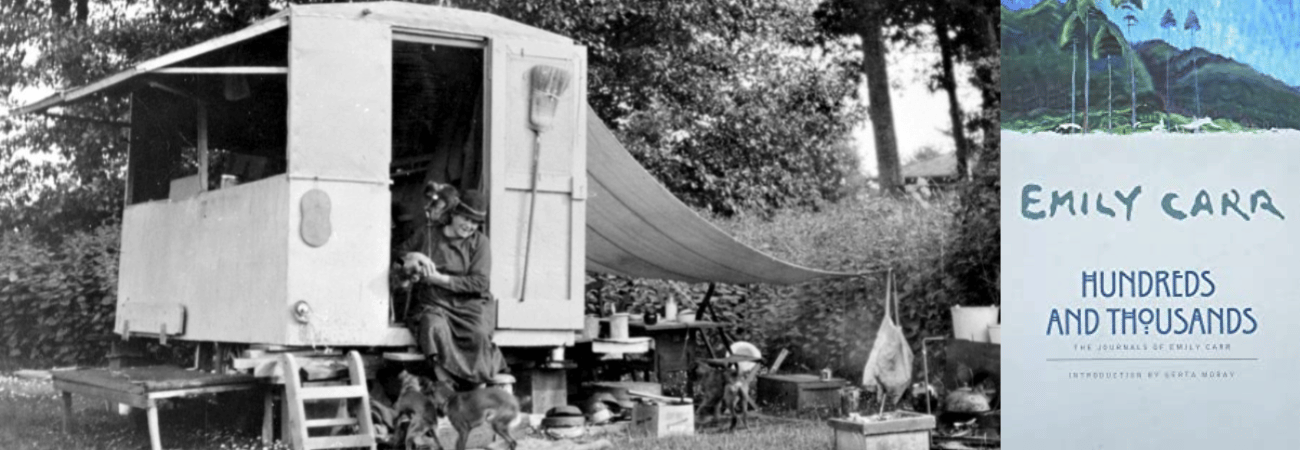
In 1933, after years of dreaming of owning one, Emily Carr purchased a small travel trailer that would change the rhythm of her creative life. To Carr, it was more than just a vehicle—it was liberation. She spotted the travel trailer with a for sale sign posted to it. A small canvas topped , metal trailer that was a bit worse for wear. It became more of a personage than a thing that she called The Elephant.
My van elephant is now a reality. While she sat there in the lot she was only a dream shaping itself.”
Willie Newcombe, the son of Dr. Charles Newcombe, one of her early benefactors, helped her fit it out with a row of dog boxes down the side, a monkey-proof corner, a built in table and a shelf for books. Furniture was sparse, a bed for Emily, three chairs and a hammock. On August 17 she had it hauled to Goldstream Park.
Carr had long imagined a way to escape the noise and demands of urban Victoria, where her boarding house duties had drained her time and spirit. When she finally brought The Elephant home, it represented her intent to reconnect with nature, to live close to the forests, and to paint from life again.
She wrote:
She was bought so suddenly after long years of waiting. It is two months from the morning that I got out of bed at 5 a.m. to peep out of the studio window and see if she was really there in the lot beneath.
The Elephant was parked outside her boarding house, and soon, it would carry her deep into the woods.
Living and Working in the Wild
The Elephant served as both studio and shelter. Carr continued to equip it with a wood stove and and a typewriter. She used it for several summers throughout the 1930s, venturing into Vancouver Island’s forests and up the coast to camp, sketch, and write. In a journal entry from June 1936, she describes her life on the road with warmth and awe:
Life seemed so responsive, and awefully good. I did up camp cooking over an open camp fire & shouldered my big sketch sack & went off to the woods. In the evenings there were good skies over the sea and pits and when the light was gone & the campfire out the Old Van with the lamp & the hot brick for my feet and my typewriter clicking out the tune of my stories.”
These quiet evenings, alone in the wilderness, gave Carr space to reflect. Her daily life in The Elephant—cooking over fire, hiking with her sketch kit, typing by lamplight—became a routine of creative solitude.
“Quietly Waiting for God and My Soul”
The Elephant offered more than physical freedom; it gave Carr spiritual clarity. Removed from the distractions of the city, she often described a heightened state of perception and receptivity:
The woods were in a quiet mood, dreamy and sweet. No great contrasts of light and dark but full of quiet flowing light and fresh from recent rain … I’ve a notion, imagination perhaps, that if you are slightly off focus, you vision the spiritual a little clearer … I leave myself open to leads, doing just what I see to do at the moment, neither planning nor knowing but quietly waiting for God and my soul.
These passages reflect Carr’s embrace of intuitive creativity, a kind of artistic faith that trusted both nature and the divine to guide her hand.
The Limits of Solitude
Although The Elephant was meant to provide privacy, Carr was not always able to escape the prying eyes of curious onlookers. When camped near roads or public sites, she often found herself the subject of unwanted attention:
The Elephant is beside the public road. For every two feet that pass, kicking up the dust, one nose, two eyes and one gaping mouth are thrust into the caravan.
Her refuge could quickly become a spectacle, and Carr, ever sensitive to intrusion, resented this loss of peace. Despite these occasional interruptions, and visits from friends, her time in The Elephant remained a deeply productive and spiritual chapter of her life.
The Legacy of The Elephant
Carr used The Elephant regularly from 1933 to around 1939, when heart trouble forced her to stop camping alone. Though the vehicle itself has not survived, its legacy lives on in her sketches, paintings, and journals. More than a mobile studio, The Elephant became a symbol of Carr’s fierce independence, her bond with the natural world, and her late-life artistic rebirth.
Through her own words, we glimpse how this unlikely home on wheels allowed her to journey not only across British Columbia’s landscapes—but deeper into her own creative soul.
One particularly meaningful connection was with the Jones family, who owned what is now Glengarry Farm, off Taylor Road. Carr was friends with Mrs. Jones, the wife a surgeon in Victoria, and the family helped support her financially during difficult times.
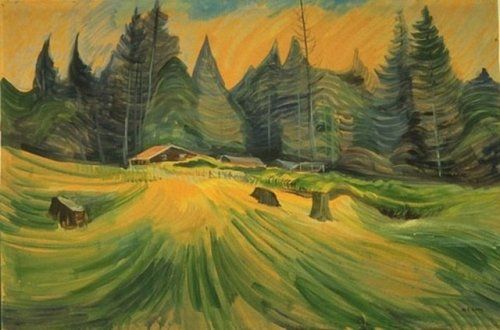
Carr would park The Elephant on their land, and during one of these stays, she painted the landscape that became “Mrs. Jones’ Farm (1938),” now held in the Vancouver Art Gallery.
Carr’s time in Metchosin wasn’t limited to one site. She also painted seascapes and rural scenes from nearby areas including Albert Head Lagoon, Esquimalt Lagoon, and the forests around Goldstream, where she is even said to have gone skinny-dipping in the river. She traveled through communities now known as View Royal, Langford, Colwood, and Metchosin—though, in Carr’s time, Metchosin’s boundaries were broader and included what would later become these municipalities.
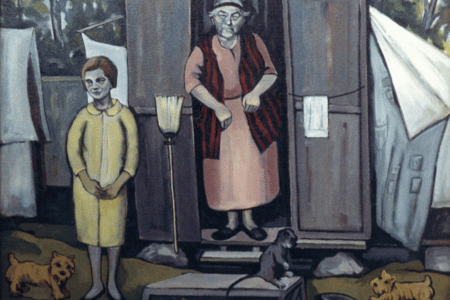
Her rugged camping trips sometimes accompanied by friends such as Edythe Hembroff-Scheicher and young art student Carol Pearson. Both would go on to write books about their friendship with Emily,
Emily Carr spent extended periods each year painting in Metchosin, where she parked her trailer, The Elephant, which served as both her home and mobile studio. In the 1930s, Metchosin stretched from Esquimalt to Goldstream Park and offered Carr the remote, rugged landscapes she craved.
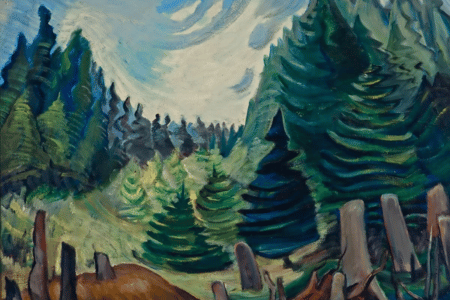
She brought her animals along and sought out quiet places on the outskirts of Victoria, including cabins, lighthouses, and tool sheds, but the purchase of The Elephant in 1933 a turning point in her life.
In 1936, she camped in a wooded area above the Producers Sand and Gravel Pit in Metchosin, where she grappled with painting the vastness of the gravel pits and seascape, writing in Hundreds and Thousands about “the beauty of space” and the “great scoops” of the land and sea that so deeply moved her.
Carr didn’t just go to these places to paint; she went to be alone, to read, to write, to reconnect with nature and God, and to listen inwardly. The Elephant wasn’t just a practical base—it was a spiritual sanctuary on wheels.
I leave myself open to leads, doing just what I see to do at the moment… quietly waiting for God and my soul.
Carr kept journals of these painting sessions in The Elephant. Here is her journal entry, from Hundred and Thousands: The Journals of an Artist (1966) from August 19, 1933:
My van elephant is now a reality. While she sat there in the lot she was only a dream shaping itself. She was bought so suddenly after long years of waiting. It is two months from the morning that I got out of bed at 5 a.m. to peep out of the studio window and see if she was really there in the lot beneath. Then came all the fixings, meat safe, dog boxes and monkey-proof corner. And when she was ready, equipped in full, the hauler came and said that it was impossible to get her out of the lot because she was too low, and he was horrid and I was mad. “
Well,” I said, “if the man brought her 3,370 miles across the Rockies, surely she can be taken twelve miles to Goldstream Flats.” And she was, but not by that old fool. The third who inspected ventured. The family sat on the creature crates and watched the tugging, heaving and wrenching. Sweat and cussings poured! Poor rat Susie was aboard and must have got severely jerked. The lid was off her box when we got there but Susie sweetly asleep within.
Henry and I and the animals drove in the truck. Whew, it was hot at the wood yard! The jacking-up blocks weren’t ready. Then we stopped for the tires to be winded. We lumbered right through Government Street. Mercy, it was hot! And the delays were so numerous I patted my wallet and wondered if she was fat enough but they only charged the original $3.50 agreed upon. I was so thrilled that I “coned” and “ginger-popped” the man liberally when we got to the pop shop on the Flats.
It wasn’t the spot I had picked, but the Elephant found it to her liking. The Elephant is a grand sitter but a heavy traveller.
Henry went all to pieces when we got there, not a steady nerve in his body. He hopped and wiggled and shook and stuttered. I ran hither and thither getting blocks and bricks and stones to aid the man in hoisting the Elephant off her tires. It was almost 5 p.m. when he left. The Elephant had chosen a favourite cow spot and much raking was necessary. This was accomplished with the aid of a row of rake teeth absolutely devoid of a handle.
Everyone on the Flats collected to see us unpack, the monkey, of course, being the centre of attraction. The tent fly tormented me but I got it stuck up at last unaided. I made up the beds and prepared supper. Black fell down among the great cedars before I was nearly out of the mess.
Neither of us slept. I could hear Henry groaning and tossing under the tent. The creatures were all in the van with me and very good. The monkey is housed in a hollow cedar tree, cuddled into its very heart. Surely I have at last found her a habitation she cannot wreck. She’d have made matchwood of the Elephant. I ship-shaped up next morning and we are spick and span, very comfortable and very happy. Henry’s nerves torment and wrack him a little less.
There’s a great peace under these magnificent cedars and the endless water sings its endless sound not a stone’s throw off. I’ve made a range to rival any “Monarch” or “Canada’s Pride” ever invented. The ingredients are a piece of automobile frame, the leg of a stove, a pile of rocks, scraps of iron, tin and wire, and parts of a gridiron. It’s a peach!
Last night we slept like babies. Each creature has dropped into its own niche. The spirit of freemasonry and intimacy among us all is superb. It’s wonderful to watch the joy of the pups playing tag among the cedars. There is a delicious little breeze humming among the leaves without bluster or vulgarity. Today I love life, so do the four dogs, the monkey and the rat. And poor Henry; this must make up to him a little for all that he hasn’t got in life.
Last night when the pop shop was shut and everyone was in bed I slipped into a nondescript garment and tumbled into the river. It was wonderful. I lay down on the stones and let the water ripple over me, clear, soft water that made the skin of you feel like something namelessly exquisite, even my sixty-year-old skin.
When I had rubbed down and was between the sheets in the Elephant’s innards, I felt like a million dollars, only much cleaner and sweeter and nicer. The precious pups were asleep all round, and rat Susie, Woo just outside the window in her hollow cedar, Henry in the tent lean-to. The cedars and pines and river all whispered soothingly, and there was life, life, life in the soft blackness of the night.
Today is wonderful again. Henry has found companionship with the pop lady’s small boys. They are playing ball, all laughing, which is good, for at breakfast he was troublesome and morose. Woo has bathed in the river and is exploring the underneath of a big tree root. I am preparing a stew on the “Monarch” range.
As both shelter, studio and escape hatch from the demands of her tenants in the House of All Sorts, The Elephant allowed her to escape the distractions of city life and pursue her painting and writing with solitude and focus. In its quiet corners, accompanied always by her animals and books, sometimes with painting partners, she painted forests, gravel pits, and seascapes, and reflected on life with spiritual intensity. The Elephant enabled Carr to enter some of her most productive and profound years as an artist, and it remains an enduring emblem of her bold, unconventional path.


0 comments