When one thinks of Emily Carr, images of towering British Columbia forests, brooding skies, and bold totem poles rendered in expressive brushwork come to mind. But nestled between her early frustrations as a painter and her later recognition as a major Canadian modernist lies a lesser-known, yet deeply telling chapter in her creative life: her pottery work from 1925 to 1932. This short-lived career in ceramics, born of financial desperation and simmering artistic tension, not only helped her survive economically but also reveals a complex interplay between cultural borrowing, personal ethics, and the role of craft in art.
From Paint to Pottery: A Creative Detour
By the early 1920s, Carr found herself in an artistic wilderness. Her early ambitions to be a serious painter were stymied by limited opportunities, critical indifference, and above all, the economic strain of living in a small, conservative city—Victoria, British Columbia—that largely ignored her creative efforts. Her personality—eccentric, fiercely independent, and intellectually ahead of her time—set her apart in a social landscape that prized conformity.
In 1924, a chance suggestion from one of her tenants, Kate Mather, marked a turning point. Mather, who operated a gift shop in Banff, proposed that Carr make “Indian pottery” to sell to tourists. The idea likely stung. Carr had always prioritized her art, and to relegate her practice to the status of souvenir production must have felt like a deep compromise. Yet with few alternatives and mounting bills, she saw no viable choice. Her pottery career—lasting just over five years—was reluctantly born.
Ironically, while Victoria showed little interest in her wares, Carr’s pottery sold briskly in Banff and even found buyers in eastern Canadian markets. Despite her ambivalence toward this work, it kept her afloat during a period of near-constant financial struggle.
The Pottery Itself: Methods, Materials, and Meaning
Carr’s ceramic practice was both rudimentary and resourceful. She made do with what was available, which in Victoria often meant scavenging blue clay from the cliffs of Dallas Road or from nearby construction sites. In a striking image of dogged determination, she would haul the heavy, raw clay home in a wicker pram, then process it by hand—sieving, mixing, and kneading it with a rolling pin until it was workable.
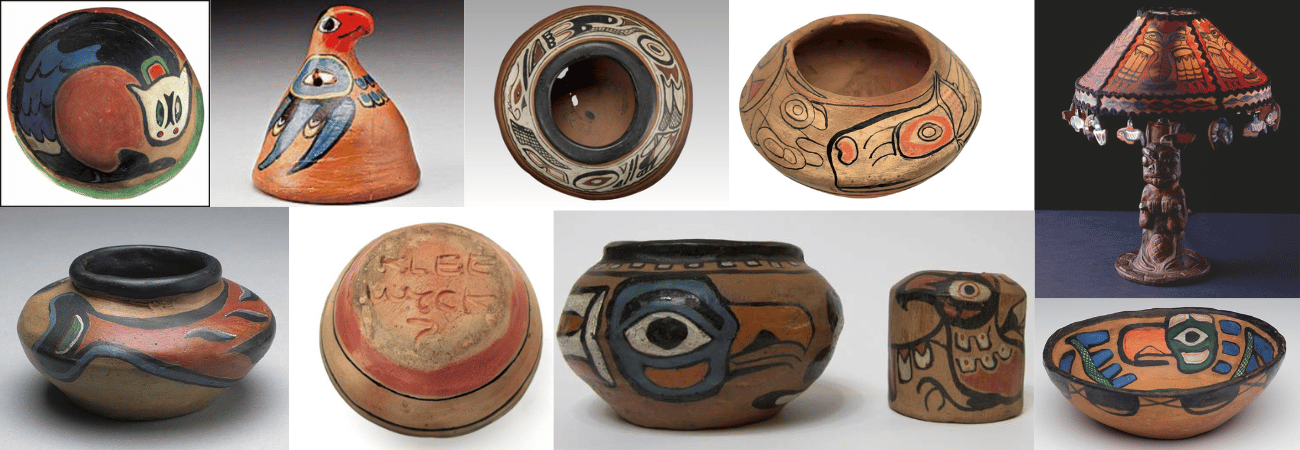
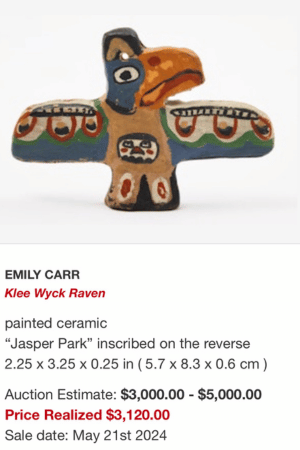
She had some background in clay modelling from her time at the Westminster School of Art in London, but she was not formally trained as a potter. Her production was primarily hand-built—she never mentions using a wheel—and included bowls, candlesticks, plates, plaques, small totem poles, and trinket dishes. The pieces were mostly once-fired earthenware, painted after firing with enamel pigments mixed with sand.
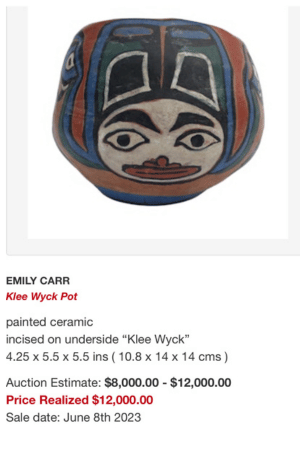
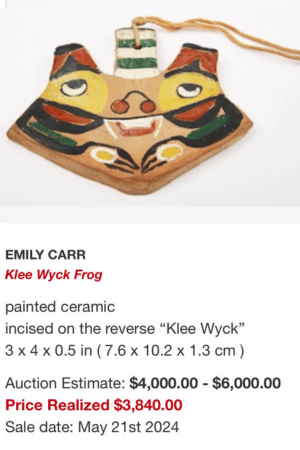
Carr was drawn to Indigenous motifs and often used these as the surface decoration for her works. She applied iconic Northwest Coast imagery—stylized ravens, whales, and rainbow designs—based on the First Nations art she deeply admired and had studied during her travels to Native villages. She painted in colours inspired by those trips: red ochre, black, jade green, and deep blue. Her forms were relatively simple, serving primarily as three-dimensional canvases for her visual storytelling.
But this was not an easy process. Firing, in particular, was an ordeal. In Growing Pains, her autobiography, Carr describes the anxiety and physical toll of managing her makeshift backyard kiln:
“firing my kiln was an ordeal… I stoked overnight, lighting my fire well before daybreak so that nosy neighbours would not rush an alarm to the fire department… The fire had to be built up gradually… every moment of it was an agony, suspense, sweat.”
The risks were real—her roof and floor caught fire during some firings—and the process took up to 14 hours, after which the kiln had to cool for an entire day. Her kiln was basic and lacked essential features like dampers or thermometers. Despite this, Carr became adept at the technical demands of the medium, building and maintaining a working kiln, mixing her own clays, and controlling high-temperature firings. One can only wonder where she gained this practical knowledge. While the Westminster School may have introduced her to clay, the more likely answer lies in the local craft community.
Victoria’s Craft Movement and Cultural Tensions
During the 1920s, Victoria was experiencing a modest pottery revival. Around 1924–25, John Kyle, Director of Technical Education for local public schools, organized summer workshops promoting the use of the local blue clay. An instructor was brought in from Ottawa to encourage interest in pottery, and the classes gained popularity. Much of the local production featured Northwest Coast Indigenous motifs, echoing Carr’s own designs
Carr’s reaction to this development was conflicted and at times furious. She believed that others were imitating her approach but with little understanding of the cultural significance of the motifs they borrowed. Her work, while ethically fraught in its own right, was based on years of personal travel and study, and she felt a certain ownership over the imagery she used. She first exhibited her pottery at the Island Arts & Crafts Exhibition in 1925.
In Growing Pains, she laments:
I ornamented my pottery with Indian designs—that was why the tourists bought it. I hated myself for prostituting Indian art; our Indians did not ‘pot’, their designs were not meant to decorate clay—but I did keep the Indian designs pure…”
This self-awareness is striking. Carr was deeply uncomfortable with the commodification of Indigenous culture, even as she participated in it out of necessity. She distinguished her own efforts—based on observation, respect, and fidelity to design—from those of other potters who, in her view, “falsified” Indigenous motifs for profit.
Between Craft and Art: The Uneasy Middle Ground
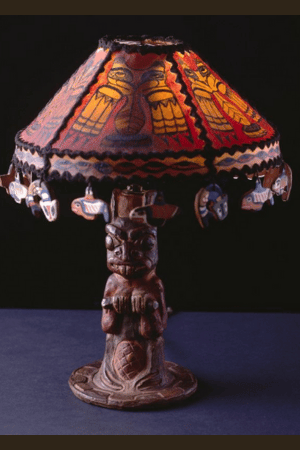
This lamp is my personal favourite piece of her pottery and is part of the Emily Carr Collection at the Royal BC Museum.
Carr’s pottery occupies a unique position in her oeuvre. While she never saw it as true art, it reveals her tactile sensitivity, her design instincts, and her deep, if conflicted, admiration for Indigenous visual traditions. She sold them typically for $5 a piece and the more complicated designs for up to $25.
Importantly, she did not attempt to transpose her painted landscapes onto clay. Instead, she treated her pottery as a separate, if lesser, mode of expression. There are no European-style portraits or landscapes on her ceramics—only Indigenous-inspired decoration, a thematic continuity with her paintings, though in an entirely different medium.
This wasn’t pottery in the purist, ceramic sense. She didn’t explore the potential of glaze chemistry, ceramic sculpture, or wheel-throwing. Rather, the forms were surfaces—vehicles for design. In this way, Carr’s ceramics align more closely with the arts and crafts movement or china painting than with the work of functional studio potters. Yet within those limits, she managed moments of genuine accomplishment. The decoration was often well balanced across the curved forms, and some pieces have a quiet grace that resonates to this day.
Support and Recognition
Despite her own low opinion of this body of work, Carr’s pottery did gain some recognition during her lifetime. She received encouragement from figures like Marius Barbeau, the prominent anthropologist who took an interest in First Nations art, and Eric Brown, the Director of the National Gallery of Canada. Barbeau not only supported her inclusion in the groundbreaking 1927 exhibition “Canadian West Coast Art: Native and Modern”, but also helped facilitate sales in Eastern Canada.
This exhibition marked a major turning point in Carr’s life. It brought her into contact with members of the Group of Seven, artists who shared her passion for nature and national identity. The connections she formed during this time reignited her ambitions as a painter, ultimately leading to the creative explosion of her final two decades.
Her pottery phase ended shortly after. By 1930, major production had ceased. She had never enjoyed the work, had never considered herself a real potter, and once she regained a foothold in the world of fine art, she was only too happy to put the kiln behind her.
Legacy: Survival, Creativity, and Conscience
Today, Emily Carr’s pottery commands high prices at auction, not necessarily because of its intrinsic ceramic merit, but because of the name attached. This reflects both the “brand value” of Carr’s later fame and the rarity of these works. They are the artifacts of a woman at war with circumstance, who found herself compelled to make “stupid objects” in order to keep a roof over her head and some dignity intact.
Yet even in this compromised medium, Carr’s authenticity shows through. Her designs, while ethically complex, were executed with a depth of feeling and a sense of reverence that distinguished them from the mass of tourist kitsch. And while she may have hated the necessity that drove her to pottery, she never treated the craft as a joke.
“I loved handling the smooth, cool clay. I loved the beautiful Indian designs… but I was not happy about using Indian design on materials for which it was not intended…”
These words reveal the crux of her dilemma: an artist in survival mode, struggling to balance economic reality with artistic and moral integrity. The result is a body of work that stands as a testament to her resilience, her conflicted genius, and her ability to create meaning—even from the most unwelcome materials.
hosted, designed & maintained by Marilyn Jones for the walks & talks, bus tours and presentations she offers on Emily Carr in-person and online from Victoria, BC.



0 comments