
Between Fact and Feeling: Emily Carr’s Autobiographical Voice
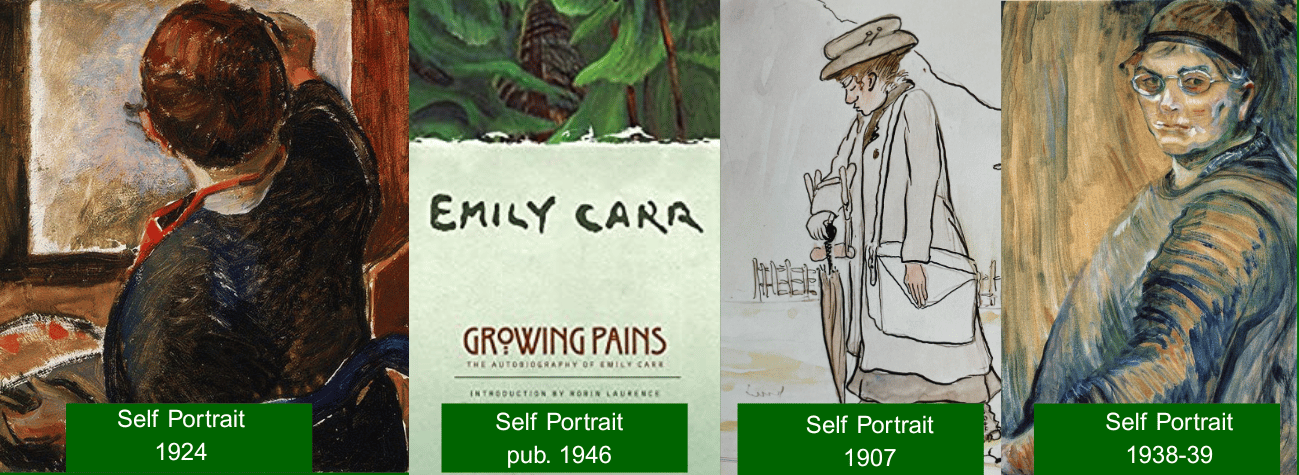
Art historian Stephanie Kirkwood Walker, in her insightful book This Woman in Particular: Concepts for the Biographical Image of Emily Carr (1996, Wilfred University Press), argues that the composite image of Carr that emerges—across biographies, plays, films, poems, and her own words—is a “cultural artefact.” It is necessarily fragmented, constantly evolving, and reflects the wider conversations Canadians have about gender, creativity, spirituality, and nationhood. Walker suggests that the way Emily is portrayed changes over time, depending on shifting societal values and the evolving lens of biography and autobiography itself.
Emily Carr holds a unique place in Canadian cultural history, not only for her striking paintings of the British Columbia landscape and Indigenous villages, but also for her vivid literary voice. Her autobiographical works—Klee Wyck, The Book of Small, The House of All Sorts, Growing Pains, and her journals—continue to enchant readers with their candour, wit, and lyrical expression. Yet her self-portrayal is far from simple. She is a writer who sometimes distorts chronology and facts, but in doing so, creates a deeper emotional and artistic truth. The question arises: How do we reconcile the factual inconsistencies in her autobiographical writing with the enduring sense of authenticity she conveys?
Biographies and autobiographies differ in more than just who holds the pen. Biographers, writing from the outside, aim for a balanced, often evidence-based portrait, placing their subject within wider historical or cultural frames. Autobiographers, on the other hand, offer an intimate, first-person account—shaped by memory, personal bias, and the desire to shape a coherent self. Emily Carr’s autobiographies lean heavily toward the expressive rather than the documentary. Her writing is less about recording precise dates and more about exploring the internal terrain of her artistic journey.
Emily often altered or obscured facts in her autobiographical writings. One example often cited is Emily’s recollection of travelling to Ucluelet. She claims she was 16 at the time of her first visit in 1899 but records confirm she was 27. Rather than a calculated lie, this age-shift appears to be a way of recasting the experience with the wide-eyed vulnerability of youth, underlining the emotional impact it had on her. She was writing her autobiography Growing Pains: An Autobiography decades later, after suffering a heart attack in 1937, when memory, storytelling instinct, and a desire to shape her own legacy all intermingled.
She frequently changed the names of real people: the character “Martyn” in one of her short stories of the same name in Growing Pains is based on Mayo Paddon, a suitor who persistently proposed to her and even followed her to England. Similarly, in Klee Wyck, the characters “Jimmie” and “Louisa” are fictionalized versions of William and Clara Russ of Skidegate, a couple who guided Carr to several Indigenous communities during both of her painting expeditions to Haida Gwaii.
In The Book of Small, Mrs. Drake—a real figure from Emily’s early life—was a friend of her mother who cared for Emily and her sisters while their mother was recovering from illness. Emily fictionalizes her as “Mrs. Crane” in the story of the same name. This episode later inspired Kit Pearson’s novel A Day of Signs and Wonders, which imagines a fictional meeting between young Emily Carr and Kathleen O’Reilly on a Victoria beach in 1881, during the time the Carr sisters were boarding at Mrs. Drake’s home.
She frequently changed the names of real people: the character “Martyn” in one of her short stories of the same name in Growing Pains is based on Mayo Paddon, a suitor who persistently proposed to her and even followed her to England. Similarly, in Klee Wyck, the characters “Jimmie” and “Louisa” are fictionalized versions of William and Clara Russ of Skidegate, a couple who guided Carr to several Indigenous communities during both of her painting expeditions to Haida Gwaii.
In The Book of Small, Mrs. Drake—a real figure from Emily’s early life—was a friend of her mother who cared for Emily and her sisters while their mother was recovering from illness. Emily fictionalizes her as “Mrs. Crane” in the story of the same name. This episode later inspired Kit Pearson’s novel A Day of Signs and Wonders, which imagines a fictional meeting between young Emily Carr and Kathleen O’Reilly on a Victoria beach in 1881, during the time the Carr sisters were boarding at Mrs. Drake’s home.
Emily and Kit are not the only ones who take liberties with the truth to shape a story to their purpose. When Klee Wyck was published by Oxford University Press in 1941, it marked Emily’s literary debut and won the Governor General’s Award. However, the version released to the public was heavily edited. Oxford Press removed approximately 2,300 words from Carr’s original manuscript—passages that were critical of Christian missionaries, the church, and colonial authorities. These edits reflected the conservative sensibilities of the time, particularly during the Second World War, when publishers were wary of controversy.
The deleted sections included Carr’s sharp criticisms of missionary practices that undermined Indigenous cultures, discouraged traditional art, and imposed Western religious values. In one censored passage, Carr described a missionary schoolteacher burning ceremonial masks to “cleanse” children of their beliefs. Another removed section featured Carr’s admiration for the artistry and spirituality of the Indigenous communities she visited, contrasting their richness with the destructive forces of colonialism. She also expressed disdain for church-sponsored attempts to “civilize” Indigenous people through cultural erasure.
In 2004, Douglas & McIntyre published the restored, unabridged edition of Klee Wyck, returning these powerful reflections to the public. This version revealed a more courageous and complex Emily Carr, deeply attuned to the injustices of colonialism and more forthright in her defense of Indigenous dignity and expression.
What remains consistent across portrayals is Carr’s fierce independence, her resistance to conformity, and her devotion to both artistic exploration and the natural world. While her autobiographical writings may occasionally wander from strict factuality, they remain emotionally precise and philosophically honest. They express her frustrations, ambitions, and reverence for Indigenous cultures and the West Coast landscape with a clarity that resonates far beyond literal truth.
Emily Carr’s autobiographical legacy is therefore best appreciated not as a factual record but as a crafted, expressive self-portrait. In blending fact and feeling, Carr gave voice to a creative life that was anything but conventional—and in doing so, she became one of the most compelling narrators of her own myth that will likely continue to change over time.
She tells the life of a women without exemplars who used the materials at hand, both words and images, to forge a self — again and again. Her autobiography in all its forms, can be read as record, in which case there will be questions of accuracy and exaggerating, of invention, issues which enliven the arena of autobiography. It can also be read as an act of self-creation, enhanced by her visionary capacity as an artist.
She tells the life of a women without exemplars who used the materials at hand, both words and images, to forge a self — again and again. Her autobiography in all its forms, can be read as record, in which case there will be questions of accuracy and exaggerating, of invention, issues which enliven the arena of autobiography. It can also be read as an act of self-creation, enhanced by her visionary capacity as an artist.
With this context in mind, check out Emily’s short story Autobiography, from the posthumously published collection Opposite Contraries (2004, Douglas & McIntyre).
The collection was edited by Susan Crean, whose biography The Laughing One (2001, Douglas & McIntyre) is known for its contemporary, feminist, and postcolonial re-examination of Emily’s life, art, and legacy—a perspective she continues to explore in her essays and critical writings on the artist.
link to story to go here


0 comments